Unscripted Small Business Podcast
A Promise You Cannot Keep Is Garbage
Bone Dry Roofing CMO Matt Tyner on why lead volume means nothing if the promise breaks, and the digital over-rotation the whole home services industry is still paying for.
Matt Tyner is the Chief Marketing Officer of Bone Dry Roofing, one of the largest family-owned residential roofing contractors in the United States, with fifteen years in home services marketing behind him. He is a career digital marketer — which is what makes his two most useful observations on Unscripted Small Business so uncomfortable. Both are arguments against the thing he does for a living: that lead generation done brilliantly can still be worthless, and that his industry spent a decade over-investing in the channels he knows best.
We Can Acquire Leads All Day Long
Asked what the most beneficial set of actions is for a home services business right now, Matt did not name a channel. He named a goal — build trust with the consumer — and then immediately explained what makes that goal collapse.
“We can acquire leads and opportunities all day long, but if we’re not able to make a promise and ultimately keep that promise throughout the entire, throughout the entire customer journey… then everything you’re doing is garbage.” — Matt Tyner
Note what he is not saying. He is not saying leads do not matter — Bone Dry acquires them at scale. He is saying the acquisition number is a leading indicator of nothing if the delivery behind it fails, because in home services the delivery is public.
The structural conclusion he draws is about org design rather than campaigns.
“That’s why I’m such a big proponent of making sure operations and marketing is walking hand in hand through the entire process, because we make the promise, but operations ultimately has to deliver that. And if we’re not dialed in on that delivery, then everything we just promised is fake. Right. It’s trash.” — Matt Tyner
Marketing writes the cheque. Operations either cashes it or bounces it. Most small businesses run those two functions as separate kingdoms with separate meetings, then wonder why the reviews do not match the advertising.
The Promise You Make And Whether You Keep It
Bone Dry codifies the promise rather than leaving it to a campaign. Their mission is to ensure peace of mind for customers and for each other by consistently delivering what they call the Bone Dry Experience — and Matt flagged that one word as load-bearing. Not perfection. Consistency. He is also clear about who counts as the customer: “external and internal when they deal with us,” so the crews get the same standard as the homeowners.
The payoff he described is not a brand-equity abstraction, it is a budget line.
“We believe we’re going to have so many raving fans about us that it’s going to allow us to reduce our marketing spend because people want to do business with us.” — Matt Tyner
He offered a real instance: a customer approached the team at lunch, unprompted, and praised the communication, the roof and the insulation work — naming the exact things Bone Dry tries to build into the experience.
It also explains their posture on offers. Nobody enjoys buying a roof, so Bone Dry does not try to make it exciting with inflated-then-discounted pricing. The discounts that exist — medical personnel, first responders, teachers — come out of margin rather than out of a marked-up sticker price. In a market with hundreds of competitors, being the company that is not performing urgency is itself the differentiator. It is the same logic behind our speed-to-lead SOP: the trust is won in how you handle the interaction, not in how loudly you advertise.
We Over-Rotated To Digital
This is the confession. Matt prefaced it himself — his background is digital marketing, so the observation costs him something.
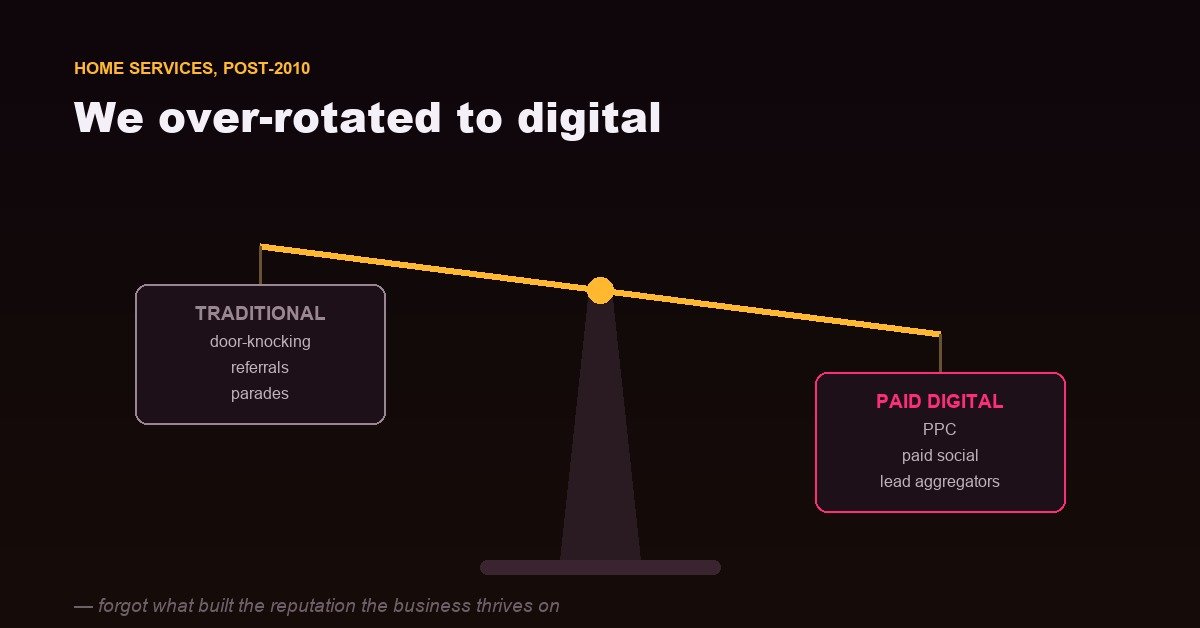
After roughly 2010, he said, home services businesses became “really addicted to paid channels” and all the digital channels around them. And in doing so, he argues, there was a fundamental shift in which the industry forgot both who it serves and the traditional channels that built it.
“It pains me to say that as my background being digital marketing, but we’ve, we’ve over rotated to digital and forgot what built the reputations that the business thrives on.” — Matt Tyner
His argument is not nostalgia, it is arbitrage. TV, billboards, community events, parade floats — “all these different things and activities we could be doing that not everyone else is doing. So you stand out, right? You’re recognizable.” The channels competitors abandoned are, by definition, the uncontested ones. Paid search is where every roofer in the county is bidding against every other roofer in the county.
Jeremy connected it to how agencies fragmented the work: a marketing manager hires an agency, the agency’s ops team briefs a specialist, and by the time the idea reaches the person executing it, the only proposal that survives is “buy some links.” Nobody three layers down was ever going to suggest an LED movie truck.
Matt’s response was to widen the aperture on where ideas come from: “Marketing should be coming from all aspects of the business. We’re just lucky enough to get to execute it.” He named the failure mode directly — the marketer’s reflex that if it is not my idea it is not a good idea.
Rebuilding The Reputation Loop
Bone Dry staffs this rather than hoping for it. There is a full-time community engagement manager, Tony, on the marketing team, whose job is partnerships in the markets they serve.
The anchor is the Humane Society — a natural fit given the company dog, Otis, appears on the uniforms. In Columbus they filled a truck with a PetSmart donation and worked with the shelter to distribute it; elsewhere they run microchipping and adoption days out of their own warehouses. Then veterans: partnered with Owens Corning, who donate the product while Bone Dry donates the labour, they qualify a veteran in each market and install a free roof on 11 November. Two LED trucks handle movie nights for Little Leagues and HOAs.
The reputation loop is the point. Each of those generates conversation Bone Dry does not control and did not buy — which is exactly why it carries weight. As Matt put it, reputation is “absolutely everything, and that’s what you truly earn… that commodity that you have.”
What Tyner Measures Instead Of Leads
A caveat worth stating plainly: Matt did not lay out a replacement KPI dashboard in this conversation, and we are not going to invent one for him. What he did do is repeatedly point at a different scoreboard, and it is consistent enough to describe.
Reviews are the one he treats as non-negotiable, and his framing is unusual.
“You got to respond to reviews, right? You got to respond to those because those are customer conversations, right? It’s not just a review. It’s a conversation you’re having with a customer that is upset. So have that conversation, make it right. If you screwed up, make it right.” — Matt Tyner
He also connected review generation directly back to operations: if you have not built the ask into what the crews actually do on site, you miss the Google reviews that move the needle in local search. Which returns to his opening argument — the marketing outcome is produced by the operational behaviour, not by the marketing team.
Beyond that, the things he treats as evidence are unprompted word of mouth, whether the community would recognise you, and whether the promise held all the way to the end of the job. His own starter list for an owner reading this is refreshingly cheap: respond to every review, find a parade and sign up for it, and put a banner in a Little League outfield for five hundred dollars. Be visible, be a neighbour, and make sure the work behind it is worth talking about.
For the flip side — what happens in the first five minutes after a lead arrives — see Cameron Tope on speed to lead.