🎙️ Unscripted Small Business Podcast
If You Want to Grow, You Have to Budget for It, with Jon Morris
The CEO of Fiscal Advocate on the numbers behind a healthy service business, the sales roles that actually win clients, and when a fractional CFO is worth it.
How much of your revenue do you spend on sales and marketing? If the honest answer is “none, it’s all word of mouth,” Jon Morris has a question for you. He used to ask it of every agency owner who came to him wanting to know how he grew so fast: “How come I’m the only marketer that believes in marketing?”
Jon founded Rise Interactive in 2004 and grew it from just him to “a little bit under 40 million in revenue before selling it.” Part of his secret sauce was how Rise used financial data to make decisions, so in the middle of the pandemic he started Fiscal Advocate to do the same thing for other service-based companies. On this episode of Unscripted Small Business he lays out the scorecard he runs every client against, and it’s a lot shorter than you’d think.
🎧 Listen to this episode
Also on the Unscripted Small Business feed and wherever you get podcasts.
The service-firm scorecard: 20, 20 and 50
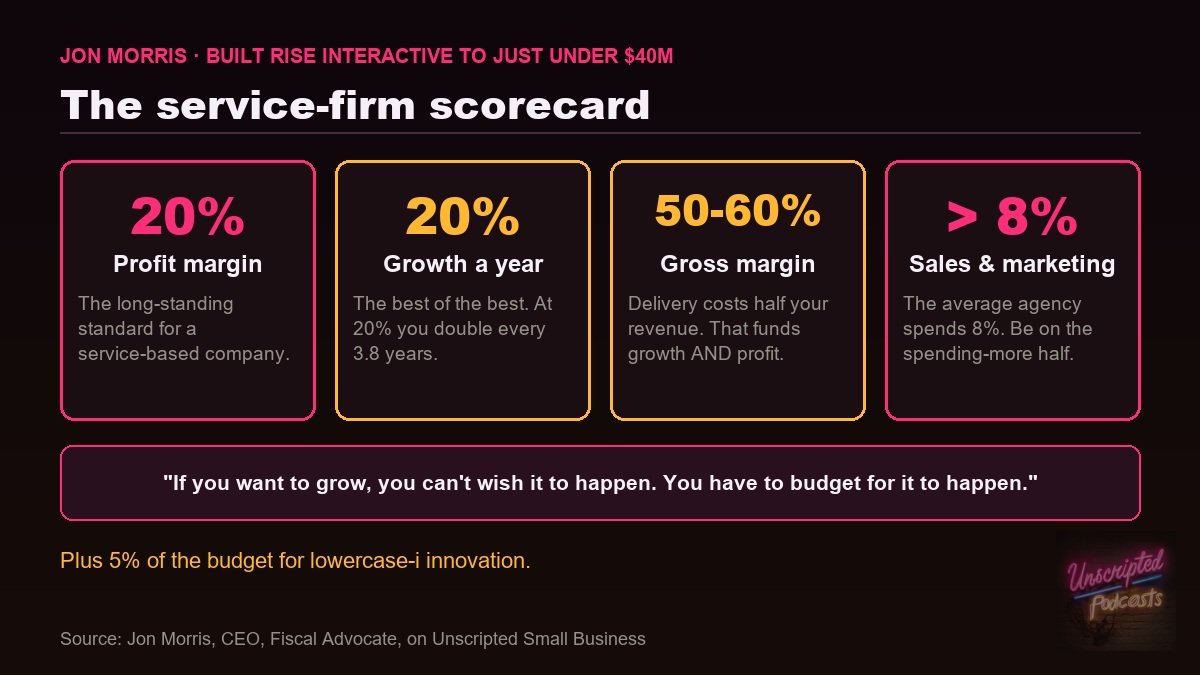
Jon’s point is that finance works a lot like SEO. There’s a pile of messy data, a handful of questions worth answering, and nothing happens until you act on the answers. For a service business, the questions boil down to a few numbers:
- 20% profit margin. “I did not create that as a standard. That standard was long before I existed.”
- 20% growth, year over year. “If you grow at 20% a year, you double every 3.8 years.”
- 50 to 60% gross margin. If delivering for your customers costs you only half your revenue, you can fund growth and keep the 20% profit.
- More than 8% of revenue on sales and marketing. That’s the agency average, and Jon wants his clients on the half that spends more.
Here’s the part most owners skip. Jon’s clients usually don’t know their gross margin overall, “let alone the profitability of each individual service line.” One of them had a healthy-looking 60% blended margin. Underneath it, paid search was running in the 70s and quietly subsidizing a social media line that was losing money. You can’t fix that until you can see it, which is the whole case for clean books before anything clever.
Growth is a budget line, not a wish
Rise averaged 75% growth a year for 16 years, and Jon is blunt about why: “If you want to grow, you can’t wish it to happen. You have to budget for it to happen.” His wife asked whether they could just keep a year’s profits instead of plowing everything back in. The answer was no. He was focused on growth.
That doesn’t mean everybody should chase growth. Jon has one client at $5 million who wants to reach $6 million at 25% EBITDA and stay there forever. Another is also at $5 million and wants to be a $100 million business, so it might run at a 5% EBITDA target and reinvest the rest. “There is nothing wrong with that,” he says about the first one. What matters is that the owner has decided which company they’re running, because there are only four or five buckets your money can go into.
I’ve lived both versions. At Raven Tools, Jon Henshaw ran it as a lifestyle company that reinvested in its people and infrastructure. After it was acquired it got run as a cash cow, and you could watch the value drain out. Neither is wrong on paper. You just need to know which one you are.
Jon also sets aside 5% of the budget for innovation, with a lowercase i. Not the next ChatGPT. Just a deliberate change that makes the business better on December 31 than it was on January 1. If you run an SEO shop right now, he’d be asking whether you need a GEO offering, because “the desire for leads” isn’t going away even if Google’s core search does. It’s a question I keep chewing on with my friend Matt Brooks at SEOteric, too: whether search is going back to being about more than Google.
Sales is three jobs, not one
When you say “sales,” Jon hears three different roles: the hunters at events and on the golf course, the sales operations people who build the CRM, nurture tracks, commissions and territories, and the closers. Before you hire a salesperson, know which of the three you’re actually hiring.
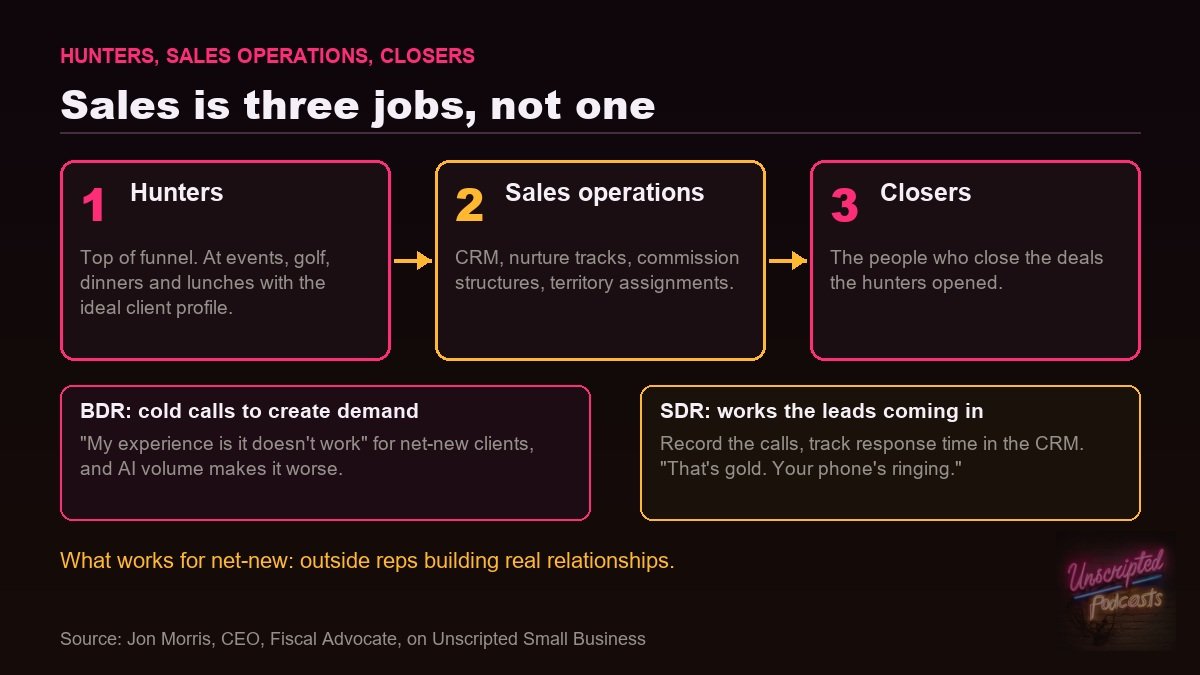
What about the cold-calling business development rep? “My experience is it doesn’t work,” at least for winning net-new clients, and AI-generated volume is making it worse. Jon admits he can’t keep up with his own LinkedIn inbox.
What does work is an outside rep who actually spends time with your ideal client. The rep who won Rise’s insurance business played golf four times a week, and told Jon why: “the most important thing is not that I’m playing golf, it’s who I’m playing golf with.” Four to five hours in a golf cart, and Jon looked at his phone twice.
The leads you already paid for
If you’re a marketer, you’ve probably sent a pile of leads over to a sales team and watched nobody call them back. Jon calls those inbound handlers SDRs, and he treats the inbound phone call as the most valuable thing in the building: “You spent all this money hiring an SEO for him to get your phone to ring.” Put every lead in the CRM, record the calls, and track how long it takes you to respond. (Jake Melendy made the same case on speed-to-lead for home services.)
Then qualify in stages:
- MQL, a marketing qualified lead. It came in, and you have no idea yet if it’s any good.
- SQL, a sales qualified lead. A rep talked to them and wants to pursue it.
- Opportunity. It passes all four parts of BANT: budget, authority, need and timing.
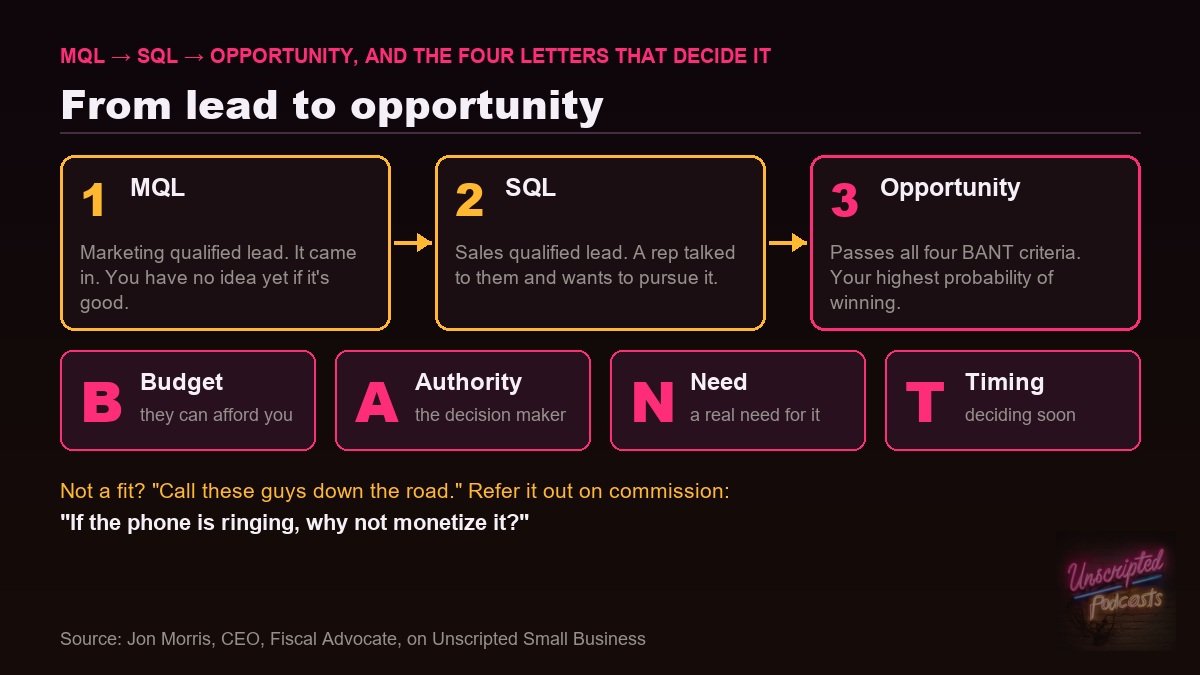
And the leads that don’t fit? Refer them out, ideally on commission. Jon likes it partly because he just likes helping people, and partly because “part of the value of the business is the fact that your phone is ringing.” Karen Aucoin makes a similar argument for treating competitors as friends.
When a fractional CFO makes sense
“CFO” means different things to different owners. For some it’s the bookkeeper who closes the books and pays the bills. For others it’s a controller running a finance team. Jon’s definition is narrower: “A CFO is truly the financial steward of your business,” the person helping you make better decisions and making sure the infrastructure underneath supports them.
A senior CFO is expensive, so below a certain size you’re choosing between a junior hire who trains themselves and a fractional CFO who costs about what the junior person would but brings the experience. Only one of Jon’s clients under $20 million had a full-time CFO, and they let that person go. His rule of thumb is that a true CFO hire starts to make sense between $20 and $50 million in revenue. The tax and compliance side is a separate seat again, and that’s where a CPA firm that works with small businesses earns its keep. If you’re earlier than that, Sal Tirabassi’s episode on fractional CFO services and Meaghan Wall on cash flow are good next listens.
Jon is also disciplined about his own focus. Fiscal Advocate only tracks three things for a client: cash, profit margin and growth. Anything that won’t move those for service companies between $10 and $100 million in revenue doesn’t get built. Shiny object syndrome, he says, is universal. Staying focused is a choice.
The resources Jon mentioned
I promised on the episode that these would be in the show notes, so here they are:
- Jon’s ebook, Decision-Making Science for Agencies, on budgeting, forecasting and gross margin (under Resources on fiscaladvocate.com).
- Fiscal Advocate’s financial planning and analysis service: cash flow analysis, budgeting and forecasting.
- Their webinars on benchmarks and org structure for professional services firms.
- Jon on LinkedIn, where he posts at least three times a week: connect with Jon Morris.
So here’s the question to take back to your own numbers. Do you know your gross margin by service line? And is sales and marketing a line in your budget, or just something you hope happens?
More founder conversations: why a 5% close-rate lift beats 20% more leads, Matthew Pohl on the stages a business moves through, and the small business marketing that actually works hub.
Host: Jeremy Rivera. Guest: Jon Morris, CEO, Fiscal Advocate. Recorded August 19, 2025.