🎧 Listen: Castos | 📺 Watch: YouTube
This week on the Unscripted Small Business Podcast, host Jeremy Rivera sits down for a second time with Bruce Ashford of The Ashford Agency. Bruce spent 19 years in the nonprofit sector, 14 of them in the C-suite, where his team doubled revenue at an educational institution and more than doubled its student population. For the last five years he has run his own agency, advising nonprofits and founder-led small businesses.
His clients are owners who got the business off the ground and then found their systems could not keep up. His job, in his words, is helping the
“small business owner who’s wearing ten or fifteen hats, often a founder, figure out how to put the right frameworks and systems in place that the whole plane can soar.”
If you missed his first appearance, it covered why your customer is the hero and you’re not, and Bruce published his own take as why marketing efforts often fail to persuade. The small business side of that conversation is here: you do not have to be a nonprofit.
Start with an intensive, not a fire drill
Jeremy asked whether Bruce goes after the low-hanging fruit first or the hardest problem. Bruce starts with a two-to-three-day intensive that looks at all six parts of the business at once, because owners rarely do that on their own.
“A business owner is going to focus on the one or two areas that are his expertise or his passion or that are on fire at the moment.”
Once the right people are in the room and the whole picture is on the table, the team prioritizes. The quick wins usually sit in two places: meetings and messaging.
Meetings are a quick win
Jeremy described a former CMO who lived on an all-day Zoom while people dropped in and out of his feed, a round table that wasted hours of everyone’s time. Bruce had never heard of that approach. His version is structured and short.
“When you have a clear meeting structure and defined things that you do, that brings clear communication, unifies the team, that can be a quick win. It’s not hard to install that.”
Two meetings matter most. The all-staff meeting, where each department gives a brief, specific report on what it did and what it will do next, instead of the CEO talking for 45 minutes. And the leadership meeting, held right before or after it, which is about roadblocks and about who owns every project. Departmental check-ins stay at 15 minutes, ideally as a standing meeting.
“I’ve never been waterboarded before, but I have had to sit through some departmental meetings that are an absolute utter waste of time.”
The words are usually what’s missing
Marketing has split into a dozen specialties: SEO, design, web, video, every social channel. Bruce’s specialty is messaging, and he argues it is the piece most often missing.
“First impressions may be visual, first impressions are important. But commitments to act are message based.”
That is the work of his Million Dollar Message intensive.
The six-part airplane
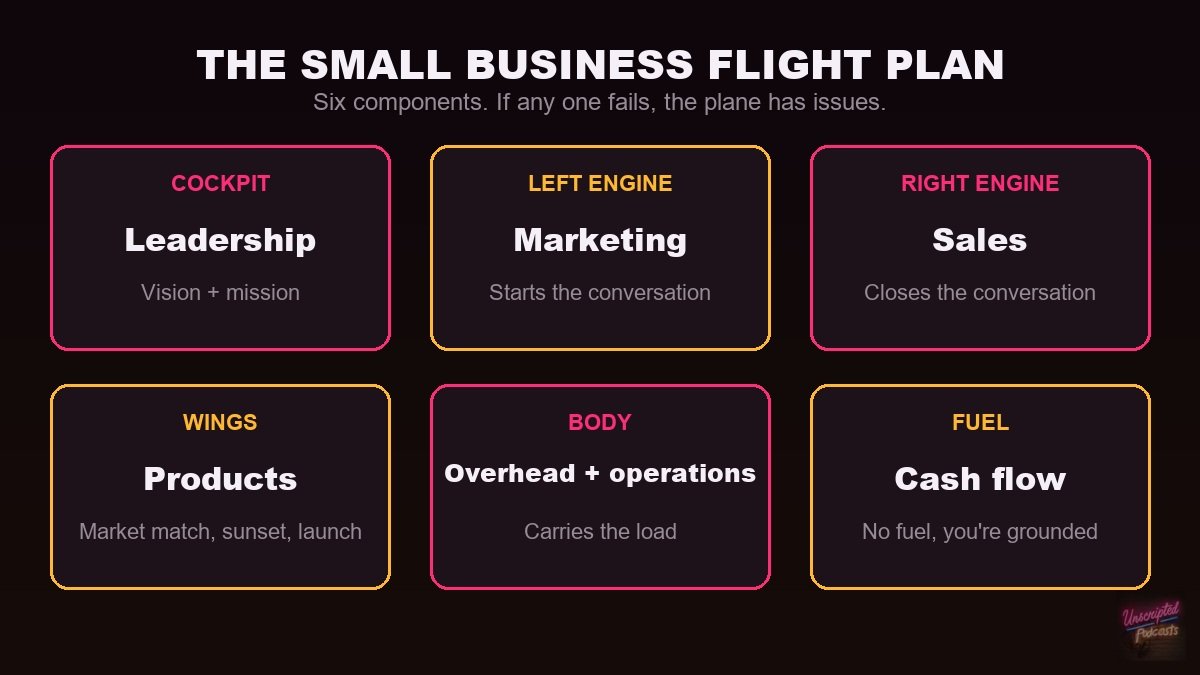
Bruce is certified in Small Business Flight Plan and adapts it into his own nonprofit flight plan. The model treats a business as a plane with six parts:
- Cockpit: leadership. The pilot sets the vision and the mission. “If the pilot’s out of action,” nothing goes well.
- Left engine: marketing. Getting the conversation started with customers.
- Right engine: sales. Closing the conversation with customers.
- Wings: products. Optimized, matched to the market, with the right things sunset and the right things introduced.
- Body: overhead and operations. Where everything gets carried, and where an overloaded plane gets delayed.
- Fuel: cash flow.
“If there’s a problem with the wings, the plane’s going down.”
“If you don’t have cash flow, you’re not headed anywhere. You’re grounded. So those are the six components and if any of are going wrong, you got issues.”
Cash flow: lock down the home front
Jeremy passed along an open question from a past guest, Malith Gamage of Zapdigits, who wanted other ways to think about cash flow. Bruce was upfront that cash flow is the weakest of the six for him, then pointed to Profit First as the simplest system for small business owners and pulled out one principle. (Bruce is also the guest who first asked for alternatives to Profit First; five founders answered him.)
“You’ve got to lock down the home front before you invest.”
Cover your salaries and obligations before you pour money into ad spend or anything else. A smaller budget forces better decisions about where it goes. Ad spend is the usual suspect, since CEOs are perpetually disappointed with their marketing, and Bruce noted that the CMO tends to be the first C-suite member fired.
Vision, mission and three economic objectives
Cash flow is the last part Bruce addresses, but it is shaped by the first one, leadership.
“Casting the vision is the leader’s job is to do two things when he wakes up. One is to point at the mountain that we’re headed toward.”
The mission is the path up that mountain, and Bruce wants it to carry three critical economic objectives, a deadline, and a rationale for why they matter.
“You’re tying all that to your critical economic objectives, and that’s going to improve your cash flow.”
The same objectives drive product decisions. His profit analysis looks at what each product or program actually keeps.
“We look at the difference between revenue and profit. Those two are not the same thing.”
Listen to the customer, ranting or raving
Jeremy pointed out that a product problem people complain about on Reddit now surfaces in AI Overviews, which turns it into a search problem and not only a reputation one. Teams have to work across their buckets. Bruce called that voice of customer data, and said both the negative and the positive matter.
“We find customers saying in natural human language what it is that they want and what they like.”
When he started his agency, his messaging work leaned almost entirely on what the C-suite thought customers wanted. Adding real customer language changed that.
“If we want to make the customer the hero, we need to listen to them, whether they’re ranting or raving, either one.”
He gave himself as the example. After a Million Dollar Message intensive with Learn Local Malaysia, which provides language tutors for Western expats, he asked the owner for feedback. The answer surprised him: the most valuable part was the AI project file he had built for on-brand messaging, an add-on he barely thought about.
“What I did with that is I took that and I foregrounded it in my marketing.”
He sold about twice as many of those packages this year as last, and while he won’t swear that is the only reason, he is pretty sure it is one of them.
Pain is the pathway to progress
“Pain is the pathway to progress, I think is a good life principle. And it’s the same thing in business.”
Bruce grew up working on a neighbor’s farm and has a saltier version of the same idea: what nobody wants to touch is exactly what fertilizes new growth. His business has grown most when he was a little desperate, because “pain has a way of clarifying what’s important.”
Jeremy added that a lot of small businesses run on literal seasons. If you’re installing pools in Nashville, the way Backyard Resort Pools does, winter is not your build season. Builders work around the weather, B2B buyers spend differently in the fourth quarter than the first, and if you’re building concrete walls in Florida, the walls have to be up before hurricane season.
“It’s not always gonna be winter. Summer is coming.”
Bruce’s point is that a plane with all six parts in good condition keeps flying through the headwinds. The hard part is clearing the time to work on it, which is exactly why owners need to.
“It’s really hard to clear out some time, but you have to clear out the time in order to get a lot of the time back.”
The legal basics most owners skip
Jeremy asked about the legal side, which rarely comes up on the show. He has run into the landmines consulting in cannabis and medical marketing, and he had a surprising conversation about intellectual property with attorney Phil Crowley. Legal exposure shows up in more places than owners expect, from IP to the kind of injury claim that sends someone looking for an Atlanta personal injury firm. Bruce kept his advice to the basics.
“Making sure they’ve got the right business insurance and make sure they have already established a relationship with an attorney.”
Usually that means two: one who handles the digital side and one who acts as general counsel, ideally on retainer.
The trust economy
Jeremy closed with an elevator question: what would Bruce give someone before the doors open? His answer is the idea that gets the most traction with owners right now. People do not trust much of anything, and the buying path now runs through AI.
“We have to win over the trust not only of the humans who are gonna buy from us, but the AI models that recommend the humans to us.”
He breaks it into three lanes.
- Humans first: rich, substantive content, and industry recognition or awards.
- AI first: a back end structured semantically with the right schema, NAP consistency (name, address and phone identical everywhere), and fresh content, not FAQs from 2011.
- Both, and most important: public reviews on Google, Yelp and LinkedIn, pricing transparency, case studies, an about page, author pages and a published FAQ.
“If it can’t read it and scrape it easily, it’s moving on to a different business.”
On pricing he did not soften it. Coaches and consultants hide their prices and want a call first, and Bruce thinks they leave money on the table. On about pages, he wants less origin story and more proof that the company understands the customer.
“The about page, as I see it, should still be about the customer.”
He ran the experiment on himself. Using an AI Trust Signals assessment across five AI models, he asked for Google reviews and LinkedIn recommendations, published a free FAQ, and built out an author page.
“My own business ticked up about 20% on average across the five models just by doing a few of these simple things.”
We turned Bruce’s middle lane into a free, eight-step checklist with a printable PDF: the Trust Economy SOP.
Score your business on Bruce’s six parts this week: leadership, marketing, sales, products, overhead and operations, cash flow. Then check the middle trust lane, the one that works on humans and AI at once: do you have recent reviews, visible pricing, at least one case study, an about page written about the customer, and an author page for everyone who publishes?
Connect with Bruce
- The Ashford Agency: theashfordagency.com, where you can subscribe to his biweekly Executive Intelligence Files mailer
- The Million Dollar Message intensive and the Executive Clarity Intensive
- LinkedIn, where he posts three to four times a week: Bruce Ashford
🎧 Listen: Castos | 📺 Watch: YouTube
Keep going → Browse the interviews