🎧 Listen: Castos | 📺 Watch: YouTube
This week on the Unscripted Small Business Podcast, host Jeremy Rivera sits down with Neil Thubron, an executive coach and sales trainer and the founder of XNRG. Neil’s career runs through the military, endurance racing and corporate sales leadership. The last corporate job he held had 450 salespeople and a 1.6 billion target. Now he works with founders who have built a business that cannot run without them.
Neil writes about value selling and leadership on his blog.
Draw the org chart, even if it’s all you
Neil gets brought in for one of two reasons, and they usually blend together. The owner has stopped living a life outside the business, or the owner has a leadership team they never actually let lead. One founder he worked with ran a business of roughly five million turnover and was doing every role in it himself.
“And the first thing we got him to do was draw an organization chart, even if your name’s in every single one of those leadership roles. You’re the CFO, the COO, the chief marketing officer, the chief revenue officer.”
From there they built his skills to lead instead of do, then filled the boxes one at a time with fractional leaders: a fractional CFO to professionalize the books first, then a chief marketing officer for outreach and awareness campaigns, until nearly the whole board was fractional directors.
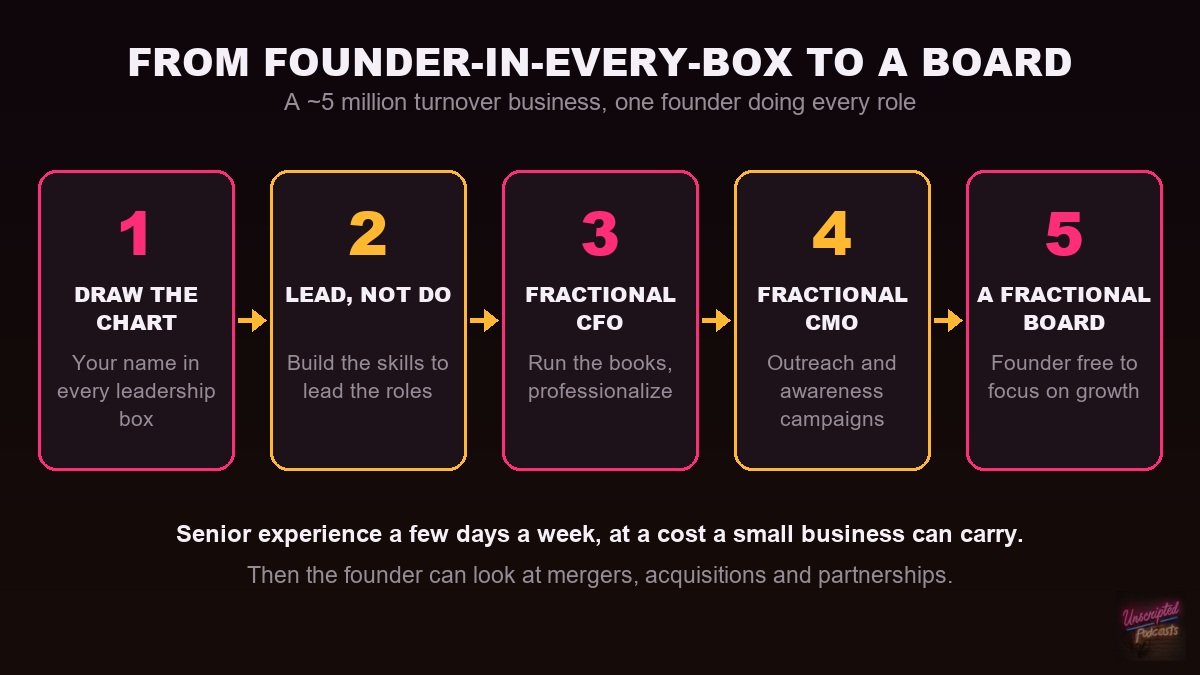
“They would have cost this business a lot of money to hire them for full time. But hiring them fractionally, you were getting all that experience in a few days a week.”
Once the board existed, the founder could finally look at mergers, acquisitions and partnerships instead of the day-to-day. If the CFO seat is the one you’d fill first, Sal Tirabassi walked through what a fractional CFO actually does on an earlier episode.
Values nobody told the team about
Jeremy asked how a founder keeps the business’s values alive once they step back. Neil turned the question around first: if the values only live in the founder, is that a strength or a problem? His answer is a few days offsite with the leadership team, agreeing values and standards they will actually live, “rather than just being nice words on the wall in reception as you walk in.”
Then he told the story of a founder who had run his business for 20 years and was frustrated that his leaders never called out people turning up late. Neil asked if he’d ever told them it bothered him.
“No, actually I haven’t I expect them to know and that’s one of the problems with values and say if we’re not really clear on them people are not mind-readers and we’re always going to be disappointed when our expectations are not met.”
Three kinds of value your customers pay for
Neil’s second question for owners is what customers actually love about you, and whether you know why they bought from you instead of someone else. He borrows the answer from Aristotle.
“And the logos value is the commercial benefit we bring through what we’re selling. And the pathos value is how we make someone feel in the process and how they feel when we bought the product.”
Ethos, the third, is trust: in you, and in your brand. Neil’s point is that B2C buyers lean on pathos and ethos, while a B2B deal needs all three, because somebody still has to build the business case for the CFO.
Sell the outcome, not the product
Several companies have come to Neil frustrated lately, and the cause is the same each time: everything they do is product led. We’ve got a great product, customers must want it, now go and sell it.
“It’s transforming the conversation from a technical sales conversation to a business outcomes conversation.”
In B2B that conversation runs through an internal champion. Jeremy called them “mini ambassadors” inside the buyer’s company. Neil agreed, and said the pathos value there is personal: you’re helping that person look better internally because they brought in a solution. The rapport gets you in the door. The logos case, how this affects their EBITDA, closes it.
Intent is the whole game
Asked for the one thing salespeople should take from his training, Neil didn’t name a technique.
“So the intention you have of when you’re sitting in front of someone is absolutely critical to how successful you’re gonna be in that relationship and that conversation.”
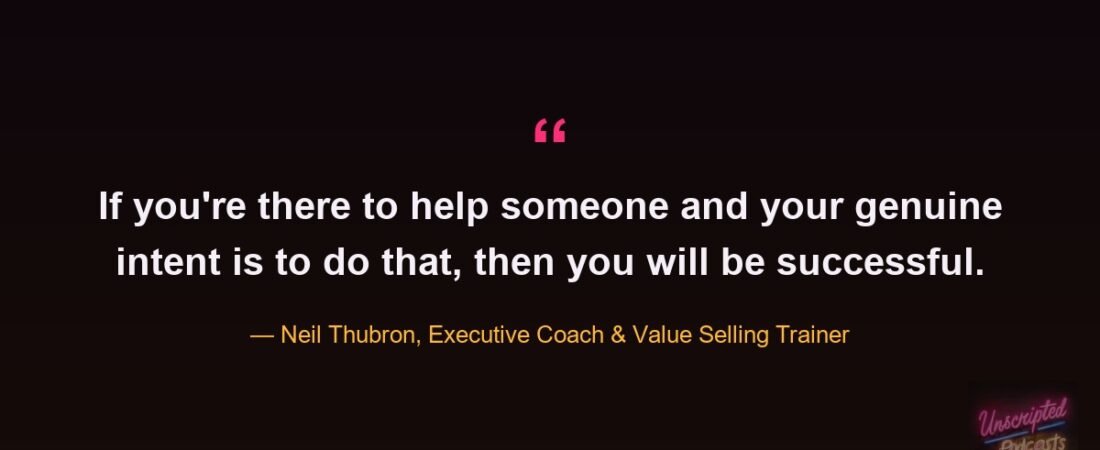
“If you’re there to help someone and your genuine intent is to do that, then you will be successful.”
Jeremy pushed on it. Doesn’t helping people sit in tension with the need to make money? Neil asked why the two would be disconnected. He wants salespeople who are motivated by money, because they get up early and stay late to write the proposal. What he rejects is selling something a customer doesn’t need. You might get away with it once, he said, “but you’re not going to get a repeat customer out of that.”
Let AI take the tasks, and keep the human piece
Jeremy opened the AI question the way he usually does: do you tell owners to just go ham and make some AI slop and use it everywhere, or something more cautious? Neil’s answer was practical. When a business he advises is under financial pressure, he tells them to look at “where can AI replace what some of your team are doing today so that the ones that you want to can focus on the higher value tasks.”
“If you’re not looking at how to integrate AI and grow AI in your business every single day of the week or every single week, you will be going backwards because other people will be.”
Brett Schklar made a similar case on the show: AI is not taking your job, it’s taking your tasks. Neil’s version ends with what’s left over. He uses the 7, 38 and 55 percent split for words, tone and physiology, and says AI handles the 7 percent. Coaches, he said, are trained to look for what’s not being said.
“What AI does is it creates an opportunity for you to spend your time out doing only what only you can do, which is the human contact, the human piece.”
Neil’s first exercise costs nothing. Draw your company’s org chart today and put your name in every box you actually fill: finance, operations, marketing, revenue. Then pick the one box a fractional leader could take a few days a week, and tell your team which standards matter to you. They are not mind-readers.
Connect with Neil
- Website: neilthubron.com
- Free ebook: Whiteboard Value Selling, his sales methodology
- His book on the Arctic race: YuCan: achieve any big goal using the 7P formula for success
- XNRG: xnrg.co.uk
- LinkedIn: Neil Thubron
🎧 Listen: Castos | 📺 Watch: YouTube
Keep going → Browse the interviews