🎧 Listen: Castos | 📺 Watch: full episode on YouTube
This week on the Unscripted Small Business Podcast, host Jeremy Rivera sits down with Pamela Maria De La Luz, founder of AgaveLuz Organic Tequila. Pamela is from Mexico and has worked in spirits sales for over twenty years, most of it face to face with the people buying the bottle. What she saw in that time, big labels and celebrity endorsements and brands cutting corners to speed up a slow process, is what pushed her to make her own.
Read more from Pamela on the AgaveLuz blog.
Two ingredients and seven to eight years
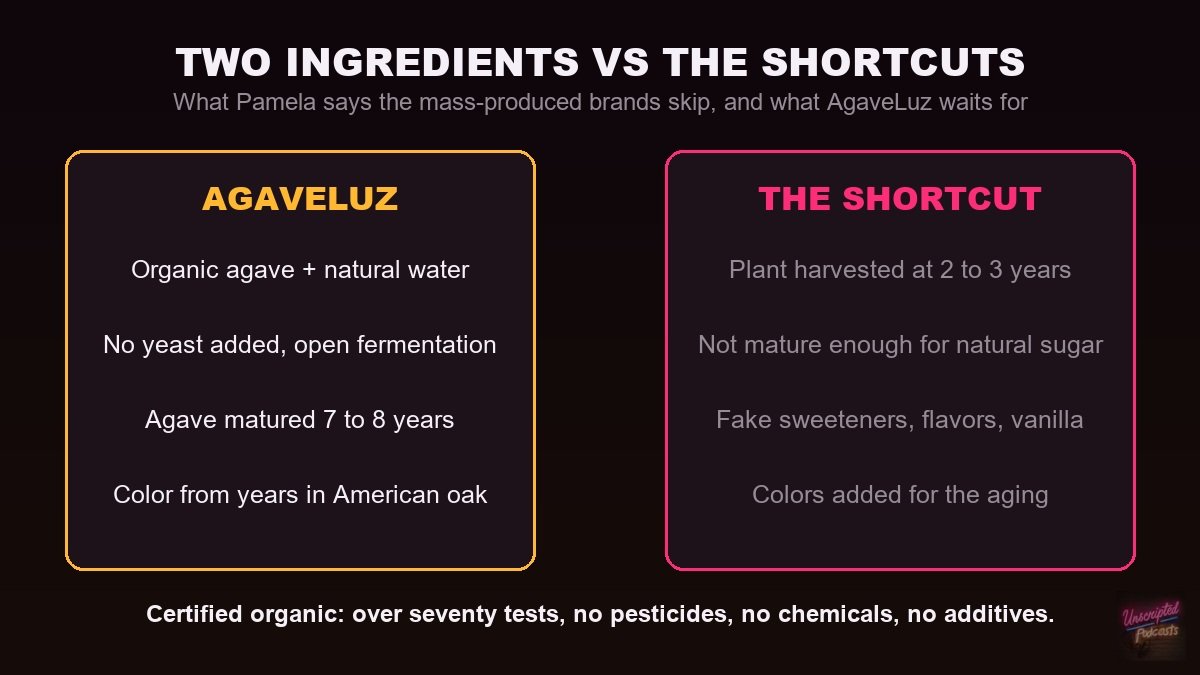
AgaveLuz is certified organic, which Pamela explained means an agency checks that there are no pesticides, no chemicals and no additives in the process. She said they had to pass over seventy tests to get there. The tequila is made from organic agave and natural water, with open fermentation in big tanks in Amatitán, Jalisco.
“We don’t even use yeast.”
The distillery is Las Americas, a family of organic farmers who have done this generation after generation. The agave has to mature seven to eight years before harvest. Pamela’s point about the shortcut brands is that mass demand can’t wait that long, so they harvest at two or three years, before the plant makes enough sugar on its own, and then add sweeteners, flavors and colors to make up the difference. Her Extra Añejo sits in American oak barrels for 12 years. “So to get to this color it takes years,” she said.
Who is she making it for? “The smart consumer, which actually is aware of what they wanna drink, what they wanna eat,” in her words. That’s the whole target market, and it’s a narrow one on purpose.
Three years to launch into 4,000 brands
Jeremy asked what marketing had looked like so far. Pamela started further back. Building the brand took three years: finding the distillery she wanted, choosing the flavor profile, designing the labels and waiting on the CRT, the agency in Mexico that has to approve every word and every design. Then the bottle.
“Nobody wanted to make my bottle. That was a big challenge. So finally somebody did it.”
AgaveLuz launched last year into a crowded shelf. “Here in Southern California is over four thousand brands of tequila,” Pamela said, and most of the attention goes to the celebrity labels and the big companies. She isn’t trying to beat them.
“My plan actually is not competing with the big boys or the big names. I’m just wanna do what I I intended to do.”
The cause came first, then the company
What she intended goes back years before the tequila. Pamela has volunteered with the Humane Society’s Pets for Life program and runs a trap-neuter-return effort for a feral cat colony in Los Angeles. She feeds them, fixes them, vaccinates them and goes back to visit. “I whistle and they come and see me and they remember me,” she said.
When she built AgaveLuz, she built that in.
“So for every bottle that we sell in AgaveLuz, we are partnering and donating to the local rescues in California and in Las Vegas as well. So that’s something that wasn’t planned as a strategy, but I wanted to put together my two passions in life.”
Jeremy compared it to TOMS shoes and to past guest Andy Choi of Do Good Points, who connects nonprofits with for-profit companies to multiply their reach. Pamela pushed back on calling it a strategy at all. People told her it was a smart one. “I’m like, no.” She has seen plenty of brands say they donate, and she asks the same question you probably do: “Do they really? Do they really?” Her version is a donation tied to every bottle. If cause partnerships interest you, Bruce Ashford made the case on this show that you don’t have to be a nonprofit to do good.
Las Vegas, the biggest rescue and the stores that call back
Asked whether she’s focused on retail partners or selling online, Pamela pointed to Las Vegas first.
“So we are with the biggest rescue in Las Vegas. That has been our key to open so many big doors. We are in the menu of big places there.”
Visitors try AgaveLuz in Las Vegas, go home and look for it in their own states, and the stores there reach out to say their customers are asking for it. For anyone who can’t find a bottle locally, the website sells it and ships to any state in the US.
Pamela also does the in-person work herself, at events and as a regular demo person in the chain stores that carry her product. The best part, she said, is when people find out the person pouring is the founder.
The rest of the marketing is in-house: social media and influencers who have pets. Some reached out to make a video for free, and AgaveLuz sent a bottle and a doggy toy. “They just wanna be part of that,” Pamela said. Sherri Langburt covered how small businesses pick the right creators in an earlier episode.
Founders with a conviction, and the end of AI slop
Jeremy’s take was that this kind of marketing is having a moment.
“I think it’s a much better marketing approach than just, I’m going Claude and put out some AI slop, you know, just put up a dozen, you know, a hundred articles on how agave, you know, ferments.”
He told a story from the homeschool class he teaches at a co-op: he put on music for a unit on Germany, and the kids caught that the band was AI and asked for real music. “That’s obviously AI” has become shorthand for junk, he said, and that’s pushing people back toward human connection. Pamela sees the same shift in her buyers. People told her younger generations are drinking less. She disagrees: “I think new generations are making smarter decisions.” And they want to back something. “They love be part of a movement that is something good.”
We don’t wanna do things right now
Jeremy asked what Pamela would tell someone with an idea they want to get to market. Her answer is the line that stuck.
“We don’t wanna do things right now. We wanna do things right. So everything takes time.”
She has watched one brand spend over fifty million dollars to be everywhere. The money ran out. Spending to speed up the process, she said, “it’s gonna be something that is not gonna last.” The brands that are still standing took years. “It’s not gonna happen overnight.” Jeremy put it this way: you can buy publicity, but as soon as your money’s gone, so’s your publicity.
“Something that is meaningful, something that has roots. People don’t forget. People remember.”
Her last word was for founders chasing a quick exit. Starting a business to be a millionaire in a few months and sell it, she said, is “like getting married, thinking about divorce if it doesn’t work.”
“When you do it with love, with passion, something that is not work every day. It’s just something that makes you happy every day. That’s gonna last, that’s gonna be successful.”
Pamela didn’t pick a cause because it tested well. She built the company around the rescue work she already did, partnered with the biggest rescue in one city, and showed up to pour the product herself. If there’s a cause you already give your time to, start there. We turned her play into a step-by-step Cause-Partner Launch SOP you can run this week.
Connect with Pamela
- Website: agaveluz.com
- Where to buy: find AgaveLuz near you, or order online
- The AgaveLuz story: authentic tequila and the AgaveLuz blog
- Instagram: @agaveluztequila
- LinkedIn: Pamela Maria De La Luz
🎧 Listen: Castos | 📺 Watch: full episode on YouTube
Keep going → Browse the interviews