Trust Audit SOP: Fix Your Website’s Trust Signals Before You Buy More Traffic

This is a Small Business SOP: a free, do-this-today standard operating procedure pulled from a real operator on the Unscripted Small Business podcast. This one comes from Irwin Hau, who has run Chromatix, a digital agency in Melbourne, Australia, for 17 years, and who spun its trust work off into a software product, ConversionCow. He says he has personally analyzed more than 60,000 websites (“closer to 70,000”), and that work became what he calls a trust design framework.

Here’s the problem he sees over and over. A business pays for SEO, ads or AI visibility, the visitors show up, and then they leave without calling, because something on the site told them not to trust it. Usually it’s something small, like a typo, a broken image or a claim with nothing behind it. Irwin’s fix is to audit trust first and buy traffic second. Here it is as seven steps you can run on your own site this week.
Irwin Hau quote: We are actually pushing our customers away without even knowing. And we could be spending money doing it.
The Play: One Line
Before you buy more traffic, take a short, focused pass at your website’s trust signals: who you are, proof, visuals, contact details, clean copy, and facts instead of fluff. Then spend most of your time on traffic, and come back to recheck the site as your competitors change.

Why trust comes before traffic

Every dollar you spend on traffic lands on your website. If the site leaks trust, you pay for the visit and lose the call. Irwin put it bluntly on the episode: “We are actually pushing our customers away without even knowing. And we could be spending money doing it.” The culprits are rarely big. He calls them “these little things that push us away.”

AI search doesn’t change that. It’s one more way people find you, and Irwin thinks it makes buyers more careful, not less: “we’re not as trusting as we used to be. If anything, we’re a bit more skeptical, and with AI we’re even more skeptical.” A buyer who got your name from ChatGPT still opens your site and two others before calling anyone.

The good news is in the order. The trust pass is short. Irwin compares it to the anesthetist before heart surgery: quick, potent and first. The long work, traffic, comes after.
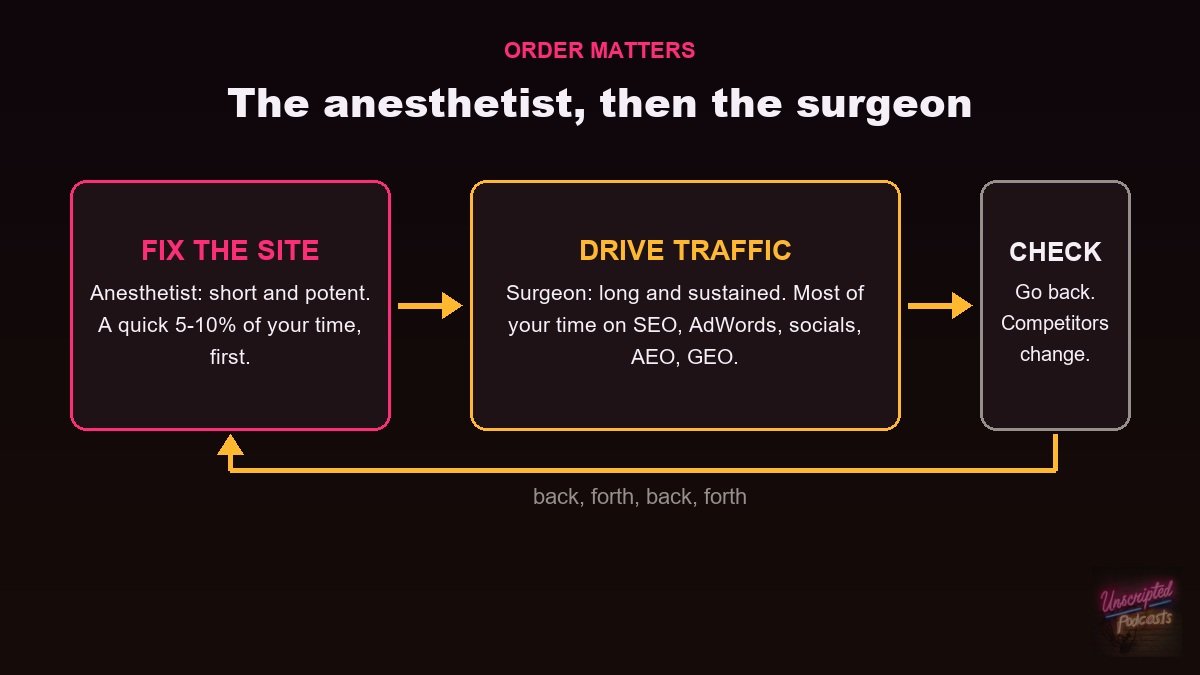
Diagram of Irwin Hau's anesthetist then surgeon order: fix the site first with a quick 5 to 10 percent of your time, drive traffic with most of your time, then check back because competitors change.

The numbers behind the play

All four come from Irwin on the episode. They describe his own work and framework, so treat them as one practitioner’s experience, not benchmarks. Chromatix has a longer write-up on how to establish credibility and increase customer trust online if you want more examples.

60,000+
websites Irwin says he has analyzed personally
17 years
running his agency, Chromatix
15
trust signals in his framework
5-10%
of your time on the site fix, first

The 7-step website trust audit

Every step is built from what Irwin described on the episode. Where we added a detail of our own, like the 1-to-5 score or the quarterly recheck, the step says so.

1
Know
Remember that being found is only half the job
Irwin splits every website into two parts: traffic, meaning how people get there, and conversion, meaning what they do once they land. AI search is one more way to be found, and it stops there. In his words, “once they find you, you still have to close the door and get them to call you.” People still do their homework. They let AI hand them a short list, and then “I’m still going to open those websites and then compare them with each other.” His summary: “getting people to your website is step one. Getting people off that website, onto your telephone, that’s step two.” This SOP is step two.
2
Audit
Run the trust-killer check on your own site
Open your site on your phone and read it like a stranger would. Irwin’s list of what destroys trust, from the episode: you’re “not clear with who you are or what you do”; there’s no proof, “both from what you share or social proof from, for example, customers”; the site “visually looks poor” (“that’s what we call implied trust”); a visitor “can’t even get in touch with you”; “images are missing, pictures are distorted”; and “spelling mistakes, grammar mistakes, extra gaps in lines.” His newest one is “all the AI telltales,” like “the long dash.” Mark each one pass or fix in the worksheet below. None of them takes long to find, and each one is costing you calls.
3
Prove
Swap fluff for facts: names and numbers
Irwin’s rule is “the difference between fluff and facts.” “We make a lot of claims, but we want substance.” “Best in the industry” and “great customer service” are claims. He asks, “Where’s the proof behind everything?” When he introduced himself on the episode, he used names (the agencies he worked at, his own companies) and numbers (17 years, more than 60,000 sites) instead. “It’s not about filling voids with words.” If it were, he says, “then AI would win because it can fill a lot of words.” Go through your homepage and service pages and underline every claim. Next to each one, write the name or number that proves it, or cut it.
4
Match
Pick the kinds of trust your buyers need
Irwin sorts trust into types, and the ones he names on the episode are “borrowed trust, factual trust, implied trust” and demonstrated trust, “which is what we normally call case studies or testimonies.” Different businesses lean on different ones. For a poop-scooping service, he’d skip proof of how many poops you’ve scooped and use borrowed trust instead: “who have you scooped poop for?” For a law firm, “it’s actually the case studies that actually helped.” All of them work, he says, “it’s just which area do we push more into.” Ask what your buyer is really worried about, then decide which type answers it: well-known customers, numbers, a polished look, or a case study.
5
Balance
Find your chicken legs
Irwin’s framework scores “which trust signals are the highest of the 15 that we’ve come up with,” then tweaks the balance. He compares it to working out: “if my legs look like chicken legs and let’s work a little bit more on the legs, because you’ve already got that upper body.” He didn’t list all 15 on the episode, so use the checks in step 2 and the trust types in step 3 as your list. Score each one 1 to 5 and put your time into the lowest scores first. Adding a fourth testimonial slider won’t help if nobody can find your phone number. (The 1-to-5 score is our suggestion.)
6
Order
Anesthetist first, then the surgeon
Irwin’s analogy for how to split your time is heart surgery. “The anesthetist has to go first,” and “the anesthetist is very short but very potent.” The surgeon takes as long as the job takes. “That first part is like fixing your website for trust.” In time spent, he’d put a quick 5 to 10% up front on the site: “fix your website, optimize it as best as you can, but then the majority of your time is spent on SEO, AdWords, socials, AEO, GEO.” So put a date on the trust fixes and finish them before you raise the ad budget or sign up for another traffic channel.
7
Recheck
Go back and check, then improve 1% at a time
The trust pass isn’t one and done. Irwin says “you still want to go back once in a while just to check it, to make sure it’s still optimized because things change. Your competitors change.” He calls it “back, forth, back, forth.” When you can’t tell which channel sent a lead, his rule is “I’m going to control what I can control,” and the site is one thing you fully control. “It’s always 1% on everything.” Put a quarterly recheck on the calendar: rerun step 2 on your site and on your top two competitors’ sites, and fix the lowest score again. (Quarterly is our suggestion.)

Your trust audit worksheet

Copy this table or print the PDF. The middle column is what Irwin flags on the episode. Score your site from 1 to 5 on each row, note the fix, and start with the lowest score.

CheckWhat good looks likeScore (1-5)Your fix
Who you are and what you doClear in the first screen, on a phone  
ProofYour own proof, plus social proof from customers  
Visuals (implied trust)The site doesn’t look poor or dated  
ContactA visitor can get in touch easily  
ImagesNothing missing, skewed or distorted  
Copy mistakesNo spelling or grammar mistakes, no extra gaps  
AI telltalesNo generic AI copy or “the long dash”  
Fluff vs factsEvery claim has a name or number behind it  

If you’d rather have someone else run the first pass, Chromatix offers a CRO audit. ConversionCow came from the same work: Irwin says clients kept telling him “I’m in the hands of my developer,” so the software lets owners update offers and proof on their own site without paying for every change.

Take the whole SOP with you

Two printable pages: the play, the 7 steps, a fill-in trust audit worksheet and a checklist. No email required.

📥 Download the Trust Audit SOP (PDF)

Listen & watch

This SOP is distilled from Irwin Hau’s episode on the Unscripted Small Business podcast:

The episode also covers marketing attribution when buyers say “I found you on Google,” why Irwin built ConversionCow, and what AI means for small business websites next. That’s all in the recap. SEO Arcade wrote up the search side, website trust signals for AI search, and Jeremy wrote about why you fix the website first. You can find Irwin at irwinhau.com and on LinkedIn.

Related SOPs: the Trust Economy SOP covers writing for the AI tools that now recommend you, and the Influencer Pre-Flight SOP applies the same fix-the-site-first idea before a creator sends you a wave of visitors.

Website trust audit: run it before your next ad spend

You don’t need a redesign for this. Block out an afternoon, open your site on your phone, and run step 2 with the worksheet in front of you. Fix the typos, broken images and missing contact details that day. Then put a name or a number behind every claim on your homepage. Only after that, turn the traffic back up. A month later, compare calls and form fills per hundred visitors with the month before. If the number goes up, the site is earning the traffic you pay for.

More operator SOPs, every week.

Real operators, real playbooks: free SOPs you can run this week. Browse the rest at Small Business SOPs and subscribe to Unscripted Small Business so you never miss one.