🎧 Listen: the episode on Castos | 📺 Watch: full episode on YouTube
Ask Irwin Hau why you should trust him and he answers with names and numbers, not adjectives. He started out at two of Melbourne’s top ad agencies, including Clemenger BBDO, then founded his own digital agency, Chromatix, which he has now run for 17 years. In that time, he says, he has personally analyzed 60,000 websites, “I think it’s actually closer to 70,000,” and the agency has picked up what he counts as 80-plus awards and mentions. That work became a trust design framework, and then ConversionCow, the software he spun out of it. On this episode of the Unscripted Small Business Podcast, he and host Jeremy Rivera talked about what pushes visitors off a small business website, how trust signals differ from a law firm to a poop scooper, and where AI search fits.
The small mistakes that push customers off your website
Jeremy asked Irwin to go negative: what destroys trust? Most of his answer is fixable in an afternoon. It starts with “if you are not clear with who you are or what you do.” Then there’s no proof, either from what you share or from customers. A site that looks poor, which his team calls implied trust. No easy way to get in touch. Images that are missing or distorted. “I know it sounds bizarre, but spelling mistakes, grammar mistakes, extra gaps in lines.” And his current favorite, thanks to AI: all the AI telltales, starting with the long dash.
The money is the part that shocks him. An owner pays for ads or SEO to bring people in, and the site quietly sends them back out. “It’s these little things that push us away.”
Trust is what wins the click. Getting named in the first place is its own job, and how to get your business on ChatGPT covers the one move to start with.
Fluff versus facts in your website copy
Jeremy brought up a line from Lum Kamishi of Assertio, a previous guest: a sentence like “cold brew’s increasingly popular” is foam on a drink, with nothing underneath. Jeremy’s frustration is that salespeople keep pushing that kind of copy onto sites, when real sales conversations are about rapport and something real to connect with.
Irwin agreed and pointed at his own introduction. He hadn’t just said he owns an agency, knows what he’s doing and has won awards. “I mean, great, good on you, Irwin, but they’re just claims. Where’s the proof behind everything?” Everything he shared came with a name or a number attached.
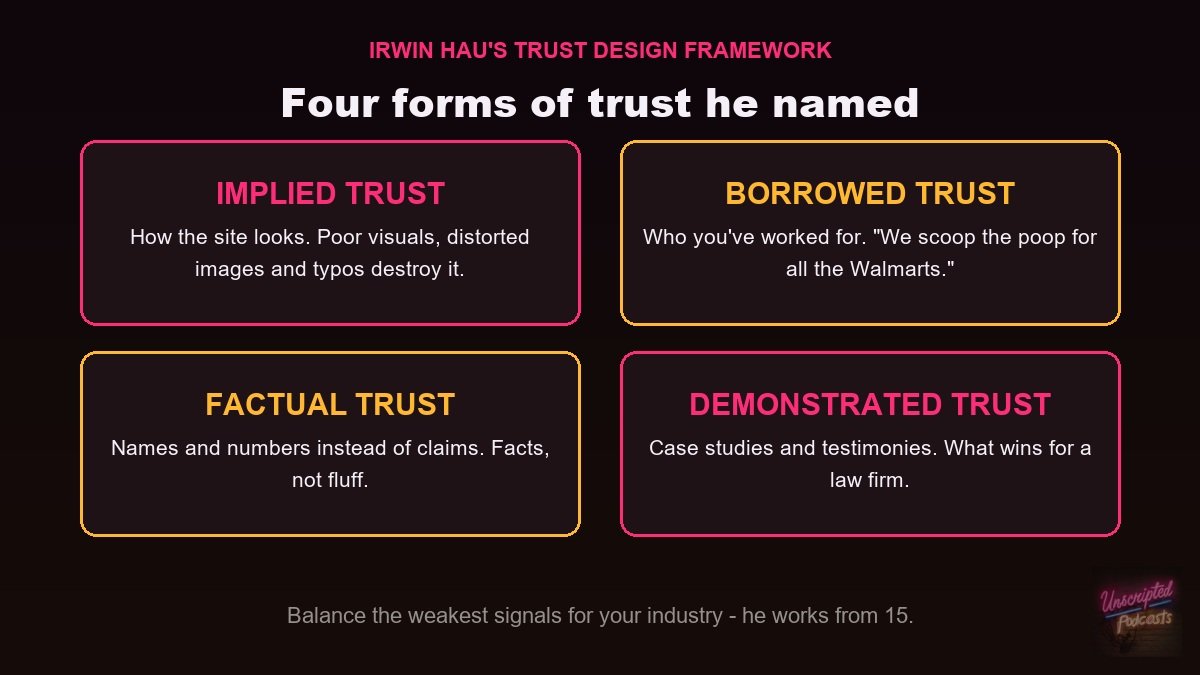
His framework sorts proof into forms of trust. Implied trust is how the site looks. Borrowed trust is who you’ve worked for. Factual trust is names and numbers instead of claims. Demonstrated trust is case studies and testimonies. The Chromatix team has a longer write-up on how to establish credibility and increase customer trust online.
Why a law firm and a poop scooper need different trust signals
Jeremy asked whether a lawyer’s site needs something different from a poop scooper’s. Irwin said yes, and took both examples. Nobody wants to count how many poops you’ve scooped. They want borrowed trust: “So who have you scooped poop for?” Picture the pitch: “We scoop the poop for the biggest. We go to all the Walmarts, all the Targets.” For the law firms his team has worked with, it was case studies that did the heavy lifting.
Irwin says his team works from 15 trust signals they developed. They find which ones matter most for a business, then build up the weak ones. He compares it to the gym: “If my legs look like chicken legs, let’s work a little bit more on the legs, because you’ve already got that upper body.”
Getting found by AI is only half the job
Jeremy asked whether a hard look in the digital mirror is the answer to everybody’s AI Overview worries. Irwin split a website into two parts. Traffic is how people get to it. Conversion is what they do once they arrive. AI search is one more way of being found, and it doesn’t do the second part for you.
He thinks owners forget this. “It’s just more, ‘I’ve been found. Yay, I’m the winner.’” People still do their due diligence. They let AI hand them a short list, then they open each site and decide which business to call.
Five to ten percent on the site, the rest on traffic
Jeremy asked how to split effort between trust signals on the site and visibility work off it, like the locally relevant links his friend Bradley Benner of Semantic Links builds from real sites that send real visitors. Irwin answered with heart surgery. The anesthetist goes first and is done fast. The surgeon takes as long as the job takes. “That first part is like fixing your website for trust.”
In time spent, he’d put a quick 5 to 10% up front on the site, then most of it on traffic: SEO, AdWords, socials, AEO and GEO. Then he’d go back now and then to check the site again, because your competitors change too. If you’d rather have someone else do that first pass, Chromatix runs a CRO audit.
Irwin fixes trust first and buys traffic second: check the site for the small things that push customers away, swap fluff for facts, then spend most of your time on traffic and come back to recheck. We wrote that up as the Trust Audit SOP: seven steps any small business can run on its own website, with a fill-in worksheet and a free printable PDF.
Control what you can in marketing attribution
Jeremy raised the messy state of attribution, and how Alex Zweydoff of ClearLead Digital puts a “how did you hear about us” question on forms and into the script for whoever answers the phone. Irwin’s rule is simple. “I’m going to control what I can control.” If you can trace a visitor from an ad to a page to a conversion, do it, and keep the data clean. Then plan for the share you can’t trace.
He told a story about one lead whose whole path he could see in Google Analytics, down to the page they landed on. When he asked how they’d found him, the answer was “Yeah, Google. I found you on Google.” Half of him wanted to correct them. He takes the customer’s word and his data together, and keeps optimizing.
Why Irwin built ConversionCow
ConversionCow came out of client work. Chromatix was charging people quite a bit to add trust to their websites, and the team wanted a way to do it in half the time that left owners in control. They kept hearing the same complaint: “I’m in the hands of my developer. Every time I need a change, I need to pay whatever it costs per hour, and I just want to move quickly.”
Irwin’s example is The Golf Sanctuary, a golf simulator venue in Melbourne. Family entertainment and leisure businesses live on offers, specials and promotions that change all the time, and paying a developer for every update adds up. ConversionCow built templates so the venue can change them itself.
What AI means for small business websites next
Jeremy’s last question was where all of this is heading. Irwin answered for agency owners first. If you stay away from AI, “you might be behind the eight ball.” He isn’t telling anyone to fire their staff and hire AI agents. He’s telling them to use it to augment what they do, because things change fast.
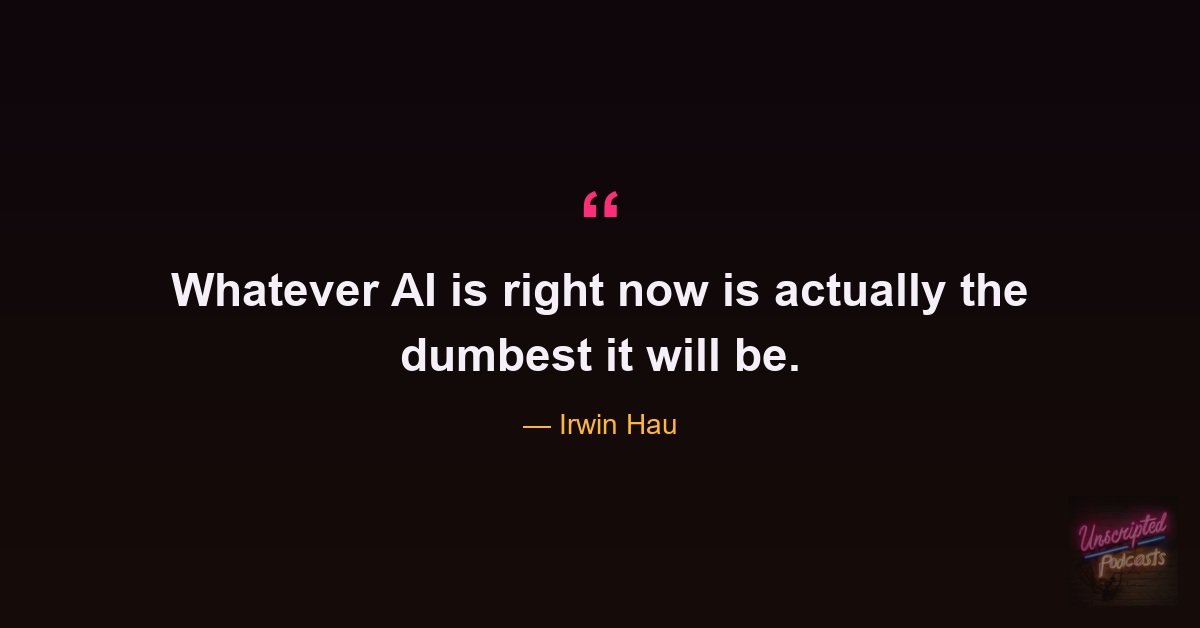
He’s clear about its limits. It still hallucinates, and a lot of what it makes looks and sounds the same, which is the pattern Jeremy’s friend Michael McDougald dug into in his research on how AI slop leaves a fingerprint. “Those who are effective with AI are those who know how to prompt. Those who are able to communicate, who are able to give good inputs, because bad inputs mean bad outputs. And so we just want to make sure we’re not just generating more slop, but we’re doing it effectively.”
For consumers, he expects more caution, not less. With Black Friday sales coming up, he admitted he’s half fallen for a few things himself. He also sees a contradiction. People say they don’t believe a business’s website or its Google reviews, yet they trust AI, which is reading those same websites and reviews and summarizing them. His answer is for businesses to be more personal and more genuine. He even knows people who ask AI to add a few blemishes, pimples and gray lines to an image so it looks real.
Want to run Irwin’s checks on your own site? Ask whether a stranger can tell who you are and what you do. Swap claims for names and numbers. Fix missing or distorted images, spelling mistakes, extra gaps and AI telltales. Make it easy to get in touch. Then pick the form of trust your industry runs on, borrowed trust for a service with big-name clients or case studies for a law firm, and build that up first. After that, spend most of your time on traffic, and come back to the site when your competitors move.
Also on Unscripted Small Business
For another guest who fixes the site before spending on promotion, read what a clinic marketer fixes first, and for the money side of traffic that doesn’t convert, Keith Perhac on auditing your ad spend with AI.
Two more takes on this conversation: on SEO Arcade, website trust signals for AI search for marketers and agencies, and Jeremy’s own reflection on why you should fix the site first.
Where to find Irwin Hau, Chromatix and ConversionCow
- Irwin’s website: irwinhau.com
- LinkedIn: Irwin Hau. He says he loves connecting, so mention you heard him on this podcast.
- Chromatix, his digital agency: chromatix.com.au
- ConversionCow: conversioncow.com
If you’re in Melbourne, he’s up for a coffee in person.
This episode is supported by our sponsors, including WhiteLobby, which does AI visibility for competitive industries. Assertio, Semantic Links and ClearLead Digital, mentioned above, also sponsor the show.
Sponsor disclosure: WhiteLobby, Assertio, Semantic Links and ClearLead Digital are paid sponsors of the Unscripted podcasts. Links to them are marked as sponsored.
🎧 Listen: the episode on Castos | 📺 Watch: full episode on YouTube
Keep going → Browse the interviews