
Unscripted Small Business Podcast
Cash Flow Is Queen
Meaghan Wall of Hot Girl CFO on why cash flow outranks revenue, the commingling habit that makes your LLC legally indefensible, and what actually gets cleaned up in month one.
🎧 Listen: Unscripted Small Business on Castos · Full recap: Meaghan Wall of The Hot Girl CFO
Revenue is the number founders quote at dinner parties. It is rarely the number that decides whether the business is still here in eighteen months. Meaghan Wall has spent more than fifteen years in finance and now runs Hot Girl CFO, a boutique accounting agency serving the creator economy and online service providers. On Unscripted Small Business she made the case for a different scoreboard — and delivered one of the bluntest warnings we have had about the paperwork most owners think protects them.
Cash Flow Is Queen And It Is Also Baby

Host Jeremy Rivera asked her about the lumpy professions — realtors, lawyers, consultants who land a mother lode and then stretch. Her answer reframed the question.
“Yeah, it’s all about cash flow. I always say that cash flow is queen and it’s also baby, right? So like everything you do is like in the name of your cash flow.” — Meaghan Wall
The second half of that line is the part people skip. Queen is a status claim: cash flow outranks the other metrics. Baby is an operating instruction — not a number you check at month end, but a thing that needs attention continuously, on its schedule rather than yours. She was explicit that this is why she uses the word: it needs to be “consistently tweaked and… babysat and monitored.” She includes herself in the lumpy category, too. All her clients pay on the first, and very little arrives across the rest of the month.
The tactic she offered is refreshingly small. Most owners treat expenses as fixed and revenue as the only variable. Meaghan flips it: your expense timing is far more negotiable than you assume.
“Like you can negotiate anything… if you pay a contractor specifically, and normally they would charge you, you know, a retainer rate of two thousand dollars a month at one point in the month — ask them if you can do it weekly, if you can pay them five hundred dollars a week instead.” — Meaghan Wall
Same annual cost to you, same annual income to them, dramatically different pressure on the week the big invoice has not landed. She extends the thinking upstream too: decide where a new offer falls on your monthly cadence before you launch it, not after.
The Commingling Mistake That Voids Your Protection
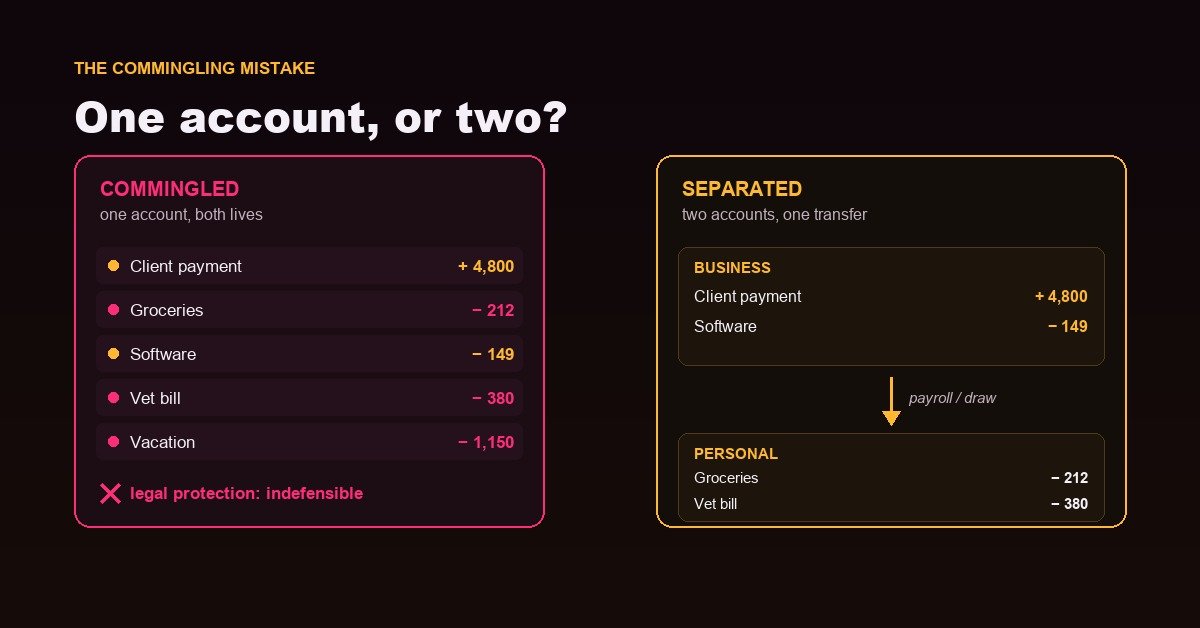
Invited to pick a hill to die on, Meaghan did not hesitate. Her pet peeve is owners at high six and seven figures still running personal spending through the business account.
“Mixing your personal in your business, and I will die on that hill. I have a couple clients who refuse to clean up and I’m like, look, you know better. I’ve told you better.” — Meaghan Wall
Jeremy pushed on the obvious objection: surely a competent bookkeeper can just sort the transactions afterwards? Her correction is the most important thirty seconds of the episode. The problem is not the categorising — she can categorise fine. The problem is legal.
“It’s more like the structure of your business, the legal structure of your business absolutely breaks down if you are commingling your funds. So if you have an LLC, if you have an S Corp, if you have a C Corp, any of these things, you are indefensible if you are commingling your funds.” — Meaghan Wall
You paid for a liability shield. You file for it every year. And then you buy groceries with the business debit card, which is the precise behaviour that lets someone argue the company was never genuinely separate from you. As she put it, it does not make sense to have those legal protections at all if you are going to run personal spending through the business.
The fix is not clever. Two accounts, and money leaves the business through a deliberate, documented route — payroll or an owner’s draw. It is a morning of admin that restores the thing you have been paying a registered agent to maintain.
What A Fractional CFO Actually Watches Weekly
“Fractional” is a slippery word. Meaghan’s definition is about breadth, not hours.
“I’m the CFO for multiple companies, and not just like the CFO for Apple or like the CFO for, you know, Google or whatever. So I’m able to serve multiple companies at once as their CFO.” — Meaghan Wall
Hot Girl CFO layers a team underneath that: a bookkeeper, a CFO and a tax specialist arriving together as what she calls your Hot Girl Finance team — the same bundled logic Sal Tirabassi described on this show. The thing she watches that most bookkeepers do not is profitability per offer.
“A lot of my clients come to me because they don’t have insight into their offer suite profitability. So usually bookkeepers are grouping transactions into one top line revenue account… and there’s really no way to tell, okay, what am I making from this offer? What am I making from that offer?” — Meaghan Wall
That single top-line number is where businesses hide from themselves. Separate revenue by offer on the P&L, build a dashboard per offer, and it is common to discover one product quietly carrying several that lose money — especially when the founder’s own hours are going into them, which she notes are worth more now than when they were solo.
Building A Thirteen-Week Cash Forecast
One point of housekeeping: Meaghan did not prescribe a thirteen-week forecast in this episode. It is not her framing. It is, however, the standard tool that operationalises what she did describe — so treat this section as the mechanism, not the quote.
A rolling thirteen-week view is one quarter of weeks laid side by side: opening cash, money you genuinely expect in, money committed out, closing cash. Weekly, because that is the resolution at which the problem actually occurs — monthly reporting will happily show a profitable month that contained a week you could not make payroll.
Built that way, the forecast turns her advice into something you can act on. The negotiated contractor payment shows up as a smoothed line instead of a cliff. A launch scheduled in the wrong week is visible before you commit to it. And an income spike stops looking like a windfall and starts looking like the funding for the eleven quieter weeks around it.
When To Stop DIY-ing The Books
There is a version of this article that tells you to hire help immediately. That is not what she said. What she described is a threshold: the point where the books stop being a record and start being the thing decisions are made from. Her own onboarding is blunt about where the work goes first. “We definitely clean up the bookkeeping,” she said, and the agency deliberately refuses to bolt a strategist onto a shaky foundation: “I’m not gonna come in as your CFO if you have a bookkeeper. You’ll get my bookkeeper.” Advisory work on unreliable data is theatre.
She was equally candid that the profession has a quality problem.
“People are bad at their job in every industry. But when you hear about a particularly bad bookkeeper, particularly bad accountant, it makes us all look bad.” — Meaghan Wall
So the practical signal to stop doing it yourself is not a revenue number. It is the moment you cannot answer a basic question — which offer makes money, what is landing next Tuesday, whether last quarter was actually good — without half a day of reconstruction. At that point the bookkeeping is a blind spot with a subscription fee.
Start with the free version: separate the accounts this week, split revenue by offer, and put the next thirteen weeks of cash on one page. If that is impossible with the records you have, you have your answer.
More in our guides and the Unscripted Small Business interviews.