This is a Small Business SOP: a free, do-this-today standard operating procedure pulled from a real operator on the Unscripted Small Business podcast. This one comes from David Levine of I am Your Virtual Professional, who owned a brick-and-mortar candy and chocolate store for almost 20 years before he started helping small businesses get found and keep customers coming back.
Your best website content is already being said out loud, in the questions your customers ask you every day. This SOP captures them for a month, puts the answers where customers look, and fixes the first automated email they get from you. You can start it today with a notebook.
Why a paper notebook beats a content brainstorm
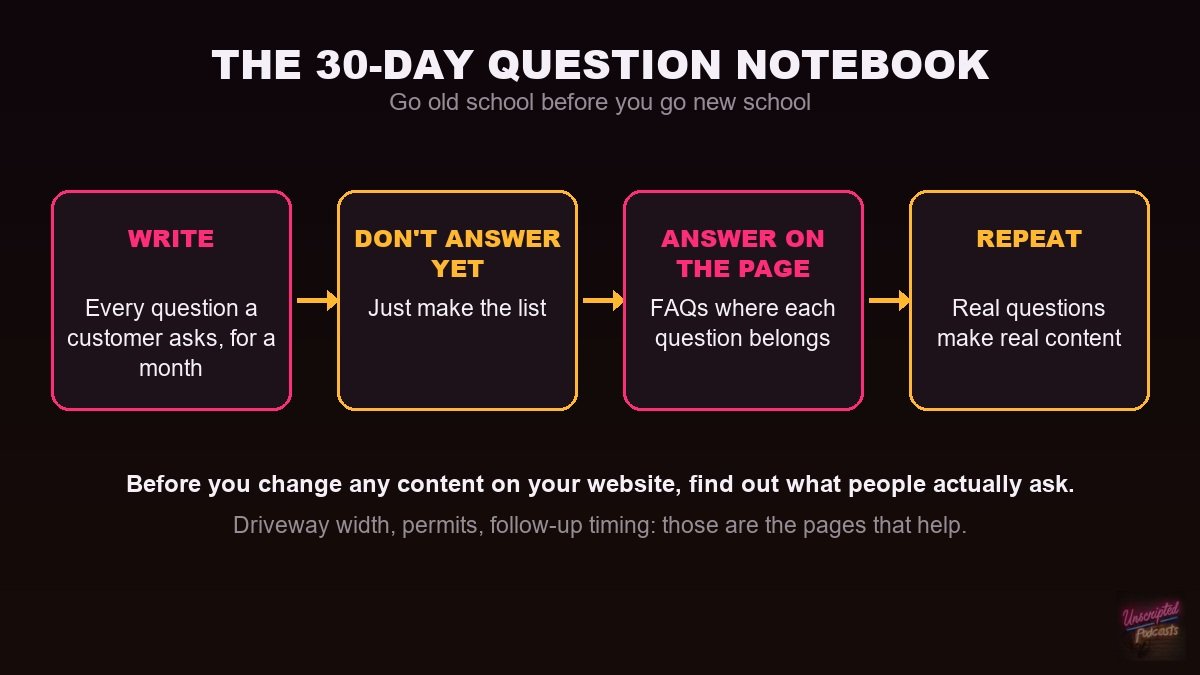
In David’s words: “Before you make any changes to your content on your website, get a notebook. I'm saying old school, a notebook. And for a month, write down every question people ask you.” People now type full questions into Google and into AI tools, and they expect answers. The questions your customers ask you are the same ones they type. They are real, they are in the customer’s language, and nobody had to guess at them.
His other rule is to make it easy: “Make it easy for them. Have the FAQs.” For a fence company, that meant a page for each municipality with that town’s permitting steps. For a firearm instructor, it meant safety FAQs on the pages where people were deciding.
The 7 steps
The numbers behind the play
These are David’s own rules of thumb from the episode, not a study: a month of questions before you change any website content, one automated email with one line changed, and your own phone answered by the second ring. Small on purpose. As he put it, don’t try to implement everything today. Pick one thing.
One printable page: the play, the seven steps, and a fill-in checklist. No email required.
Hear David explain it
This SOP is distilled from David Levine’s episode on the Unscripted Small Business podcast:
- 🔊 Read the full episode recap: David Levine on Old School Service and New School Tools
- 🎧 Listen on Castos
- 🎥 Watch on YouTube
- 📖 Old School Service, New School Tools, David’s book
- ✉️ David’s Follow-Up Helper, for step 7
- 🌐 I am Your Virtual Professional
If the reply itself is what’s slow, pair this with the Speed-to-Lead SOP.
Real operators, real playbooks: free SOPs you can run this week. Browse the rest at Small Business SOPs and subscribe to Unscripted Small Business so you never miss one.