🎧 Listen: Castos | 📺 Watch: YouTube
You can get found online and still lose the customer at the first email. That is the gap David Levine works in. He owned a brick-and-mortar candy and chocolate store for almost 20 years, sold it, and now runs I am Your Virtual Professional, where his job, in his words, is
“helping small businesses get found and keep customers coming back.”
He is also the author of Old School Service, New School Tools, a book about the RAVE System for AI-powered small business customer success. On this episode of the Unscripted Small Business Podcast, host Jeremy Rivera and David cover the free fixes that get you found, the automated email you have never read as a customer, the 500 smudged box tops, why AI makes a broken process worse, and the notebook David hands every client before he touches their website.
🎧 Listen to this episode
📺 Watch on YouTube
Three free fixes that get you found
David’s starting point is that the old SEO formula stopped being enough. A keyword, an H1, a few H2s and H3s, an alt tag that matches, and in his words, “bada bing bada boom,” you were on page one in about three months. Then ChatGPT, Perplexity, Claude and Copilot changed the rules. He still has clients on page one of Google and clients getting recommended by ChatGPT, but you have to adapt. His three free tips work whether you do them yourself or hire someone:
- Make sure your website is indexed. “Think of it like this: you build a house in a new neighborhood, in a big field. How is the post office gonna know where to send your mail?” One of his clients paid two hundred and fifty dollars for a website that sat online for four or five years and was never indexed. Once it was, things started happening.
- Claim your Google Business Profile, then optimize it. It replaced the yellow pages and it is still free. Having a listing with your phone, address and hours is the start. “You need to optimize your listing.”
- Write questions and answers in plain language. People used to type two or three words. Now they type full questions into Google and into whatever AI tool they like, and they expect answers.
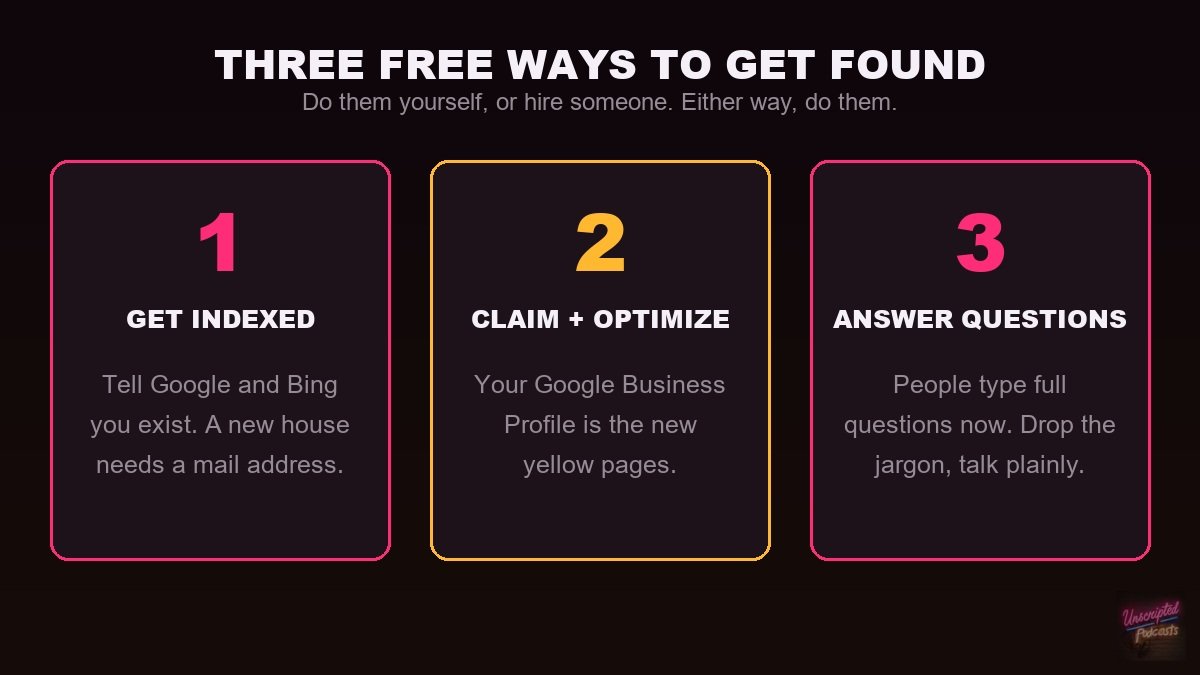
“Start writing questions and answers to what people are asking online. And stop trying to create content that is industry jargon. Talk to the people.”
Whatever your acme widget is, you need to explain it in language people understand. If you’re not answering the questions people actually ask, you’re not going to get found.
Read one automated email as your customer
Getting found is half of David’s tagline. The other half is what happens next, and he wants you to stop calling it customer service.
“We really need to think of customer experience from your first touch point all the way through the process.”
Jeremy’s version of that is to buy from yourself. Use somebody else’s phone or laptop, try to find your own business, call the number, and look for the information that would convince you to buy. Most owners assume what’s in their head exists online. A Facebook page with no website, a buried phone number and an email address nobody checks quickly is a long way for a customer to go. And the speed problem is real: Ignitvio’s lead response study found that 68% of 1,824 local businesses never responded within 24 hours. That is a lot of effort spent fishing for a customer, only for the first contact to go nowhere.
David’s fix is small on purpose. He posted it on LinkedIn and he gave it to you on the show: take one automated email you send out. Just one.
“Read it. Not as yourself, but read it as if you were getting it as a customer. After you do that, okay, change one line in that email to make it more user friendly, to make it more customer centric.”
He knows why those emails are bad. When you build a website, the developer asks a million questions, and one is what the autoresponder should say. Most owners shrug. When David recently built a site and got that shrug, he wrote the autoresponder himself and made it do two jobs. A good autoresponder:
- Tells the customer it is an automated email.
- Sets the expectation: a response tomorrow, or in three hours, or whatever you can actually keep.
- Sends a copy to the owner, so the owner knows somebody is waiting.
“But the important part is you let the customer know what the expectations are.”
Then you follow up, without harassing anybody. If writing that follow-up is the part you freeze on, David built a follow-up helper for exactly that. And if you want the full system for answering fast, the Speed-to-Lead SOP from Cameron Tope covers who picks up and how quickly.
The 500 box tops and the bad review
Jeremy pointed to an analysis of Yelp and Google reviews: the biggest driver of negative reviews was not a failed product. It was a failure to communicate. Late callbacks, no word about what happens next, expectations set badly. If your hose breaks on a job, most customers will live with it. If you go quiet, your reason starts sounding like an excuse.
“People don’t expect a response immediately, they expect a response.”
David’s candy store did a lot of corporate gifting, and one year a new account ordered five hundred boxes of chocolate with custom box tops. The box tops arrived two or three days before the order was due, smudged or misprinted. He called the vendor, got replacements overnighted, and then called the client to tell her exactly what happened.
“And she called me a lot of not nice words and also a liar, and I invited her into the store to see the box tops.”
She came in. The five hundred bad box tops were sitting there, and so were her boxes of chocolate, packed and waiting for their lids. She realized he hadn’t been lying. His lesson is about the apology, and it is in his book:
“I’m sorry, and we’re gonna do the following to fix it is a lot better than saying I’m sorry, but the whatever.”
He also wants you to calm down about bad reviews. “If you have all five-star reviews, it’s not real.” What matters is how you react. Your first instinct as a small business owner is to fight, because it’s your business and you take it personally. One of the AI tools in his book drafts review replies and takes the emotion out, so you don’t answer in anger.
AI on a broken process speeds up the problem
David is not anti-AI. “I am so into AI,” he said. But he holds every AI tool to the same rule.
“AI tools create drafts.”
The time the tool saves you is time you spend making the draft sound like you, checking it is accurate, making sure it isn’t hallucinating, and making sure it isn’t promising something you can’t deliver. Matt Tyner said the same thing about promises from the operations side: a promise you cannot keep is garbage.
A few weeks before the recording, a prospect told David he wanted to implement AI. David asked why. “Because everybody is.” That turned into a conversation about the process, which is where David wants every AI project to start.
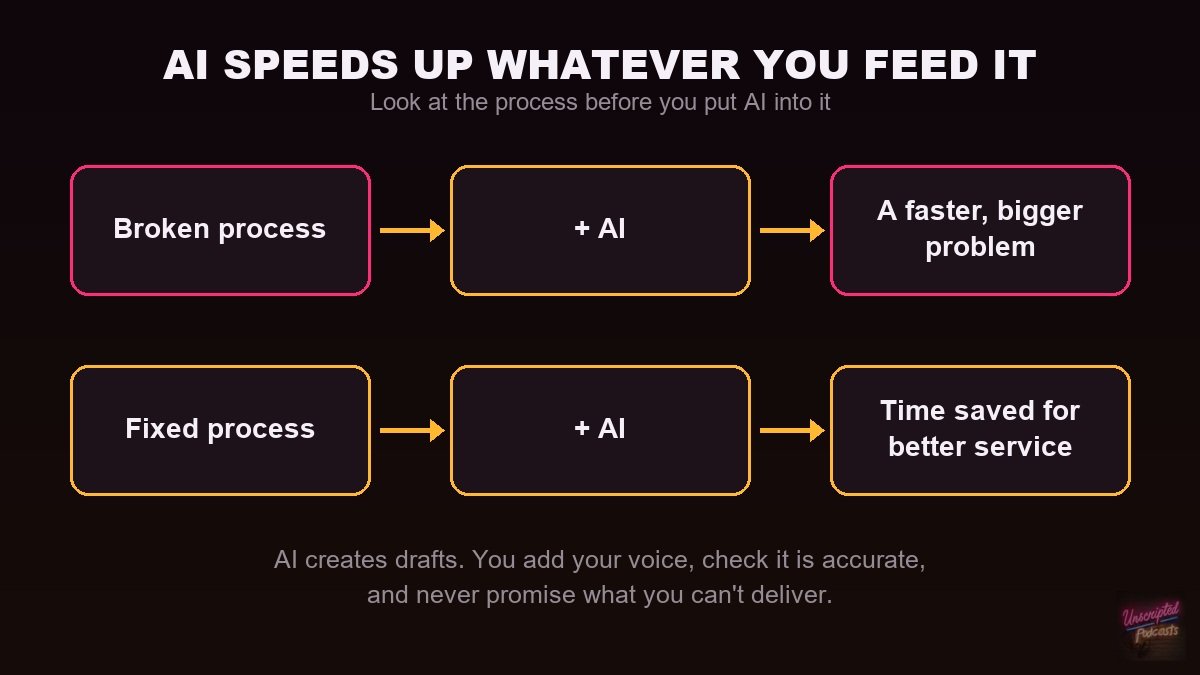
“When you have AI, if you have a broken process and you put AI into it, all you’re doing is speeding up the problem.”
You take a bad process and turn it into an extremely bad one, in the blink of an eye. So before you say you’re putting AI in, look at the process you want to put it into. Brett Schklar makes a similar case for saving customer service for last. David’s other reason for patience: “I promise you in 10 to 15 years, there’ll be something better and more advanced.”
He has watched the tools change for 30 years, from fax machines to email over dial-up, to social media, to Yelp and Google reviews, to AI. The customer did not change.
“Customers wanna feel heard. They want to feel valued. They wanna feel listened to.”
Raving fans cost less than new customers
A big company can afford to lose a few customers. You can’t.
“When you’re a small company, if you don’t listen to your customers, you’re really in trouble.”
David got the idea of raving fans from a former boss: they are the reason a small business grows. His store won Business of the Year from the Village of Skokie without the biggest marketing budget, because raving fans voted for it. He once entered a chocolate dessert burger in a hamburger contest and won that too, the same way.
Jeremy brought in Matt Brooks of SEOteric, who says it is way cheaper to keep a customer than to find the next one. David agreed and pointed to Tony Hsieh of Zappos, who argued customer service should be part of every facet of your business. In practice that means:
- Smile when you pick up the phone, even if nobody can see you.
- Make your phone number easy to find on your website.
- If you put an AI chatbot on your site, train it. “My problem is if you did not train the chatbot.”
- Answer your own phones if you can, by the second ring.
One of David’s vendors swapped its press-one phone tree for an AI phone system. It was so bad that enough complaints came in to send them back to the old menu.
Answer the questions before they have to ask
Jeremy offered a metaphor: your website is not a fishing trip, it’s a zoo. You’re collecting specific customers and you need a habitat they’ll be happy in once they arrive. If you’re a roofer, tell your existing customers what happens at one, six and twelve months: how the tiles age, the insurance questions, whether the expense touches their taxes. Most businesses only publish content to catch the next caller.
David said Jeremy was describing his third free tip. However a customer found you, make it easy for them.
“Make it easy for them. Have the FAQs.”
He puts FAQs on the relevant pages for every client. He repositioned a firearm instructor around safety, with FAQs on the pages that answer what a safe gun owner needs to know. For a fence company, he built a page for each municipality the owner works in, then went to each town’s website and wrote up the steps and permitting it requires. That is what made each page different and useful. And put your phone number in the footer.
“Put it in the footer and don’t bury seven layers under in a sub menu. Make it easy.”
Jeremy told a story he has used before, about a precast concrete wall company in Florida. He interviewed the installer, not just the CEO, and asked what questions he needs answered before a job. Is there room for the truck to pull in? Is the driveway wide enough to bring the slabs through? And did you measure three times? Precast concrete has no flex. Once it is made in the factory, it is exactly that long. Those questions are exactly what belongs on the website.
Start with a notebook, not a website redesign
That story is where David landed on his favorite piece of advice, the one he gives every client before they change a word on their site.
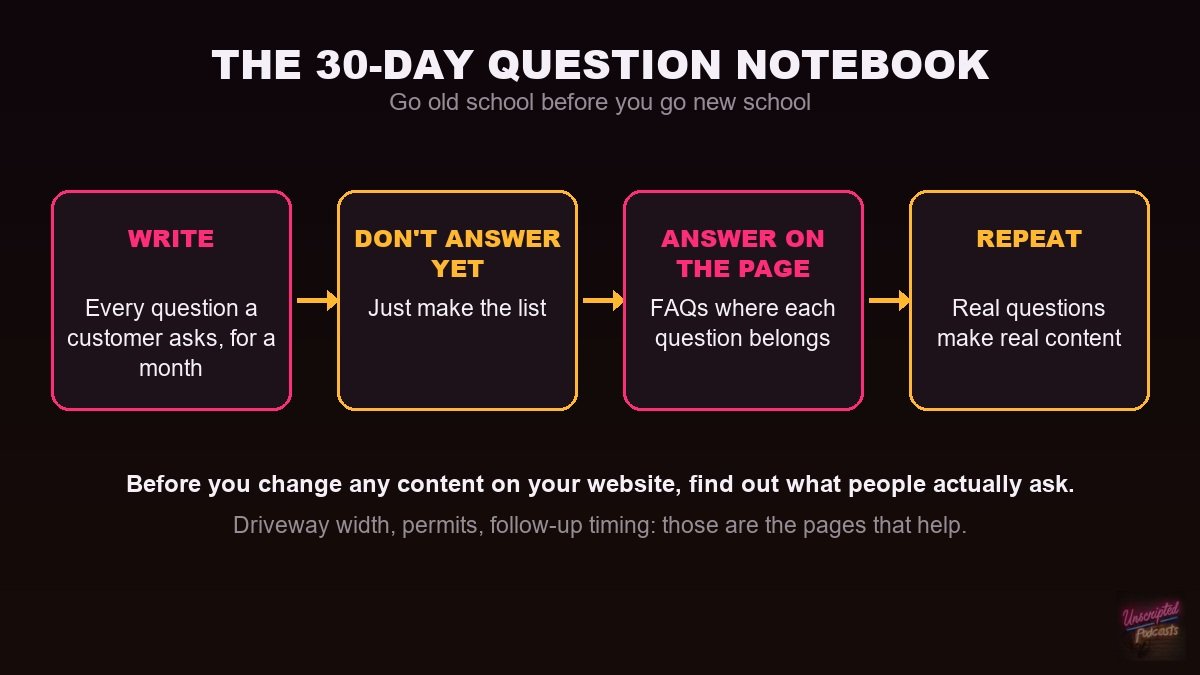
“Before you make any changes to your content on your website, get a notebook. I’m saying old school, a notebook. And for a month, write down every question people ask you.”
You don’t have to answer them in the moment. Just make the list. When it’s time to update your website, answer those questions, because they are real and they make good content. Clients tell him they thought he was the tech guy. His answer is the title of his book:
“Old school service, new school tools. You need to go old school before you go new school.”
We turned David’s notebook, his one-email exercise and his response-time advice into a free, printable checklist: the Customer Question Notebook SOP. If you want another angle on what customers actually say, Bruce Ashford’s episode on listening to the voice of the customer, ranting or raving pairs well with it.
Don’t try to implement everything today. Pick one thing, the easiest one. David’s suggestion for the easiest thing of all: “start by smiling at your customers and being nice.” Then open one automated email, read it as your customer, and change one line.
Connect with David
- Website: I am Your Virtual Professional
- More on this episode: David’s podcast resource page
- Tools: customer experience and AI tools and the Follow-Up Helper for writing follow-ups that don’t feel pushy
- Book: Old School Service, New School Tools on Amazon
- LinkedIn: David Levine
🎧 Listen: Castos | 📺 Watch: YouTube
Keep going → Browse the interviews