CEO-Speak SOP: Report Marketing in the Numbers Your CEO Actually Uses

This is a Small Business SOP: a free, do-this-today standard operating procedure pulled from a real operator on the Unscripted Small Business podcast. This one comes from Rich M. Smith of Rich M. Smith Growth Studio, who has been chief marketing officer of seven companies over 25 years, including AIG Bank during the 2008 financial crisis.

Most marketing reports lead with traffic and engagement. Most owners read them and still can’t tell whether marketing is making money. If you own the business, you are the CEO in this story: ask your marketer or agency to report this way. If you run the marketing, this is how you keep the CEO’s attention. Run it before your next report.
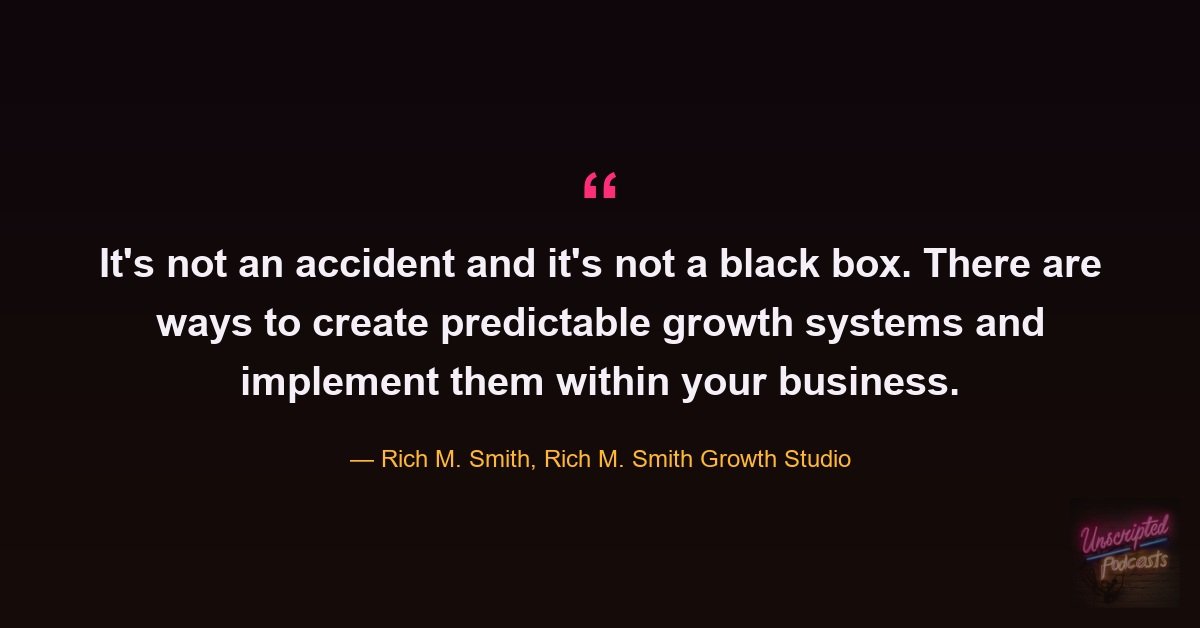
Rich M. Smith quote: growth is not an accident and it's not a black box

The Play: One Line
Translate every marketing metric into the business outcome it stands for, answer the CEO’s next question before it’s asked, and back the whole report with a tested attribution model.

Why marketing reports lose the CEO

Rich credits one skill for his run as a CMO. In his words, “one of the reasons why I’ve been successful as a chief marketing officer is having the ability to translate marketing speak into CEO speak.”

Marketers think in traffic, rankings and engagement. CEOs, CFOs and boards think in revenue, ARR, churn, cost of acquisition and lifetime value. Tell a CEO that web traffic is up 15% and, as Rich puts it, the CEO is thinking “that sounds kind of nice, but I don’t really know if I’m making any money.” His behavioral-science point applies to any report: “Comprehension doesn’t occur unless the audience receives it and absorbs it.”
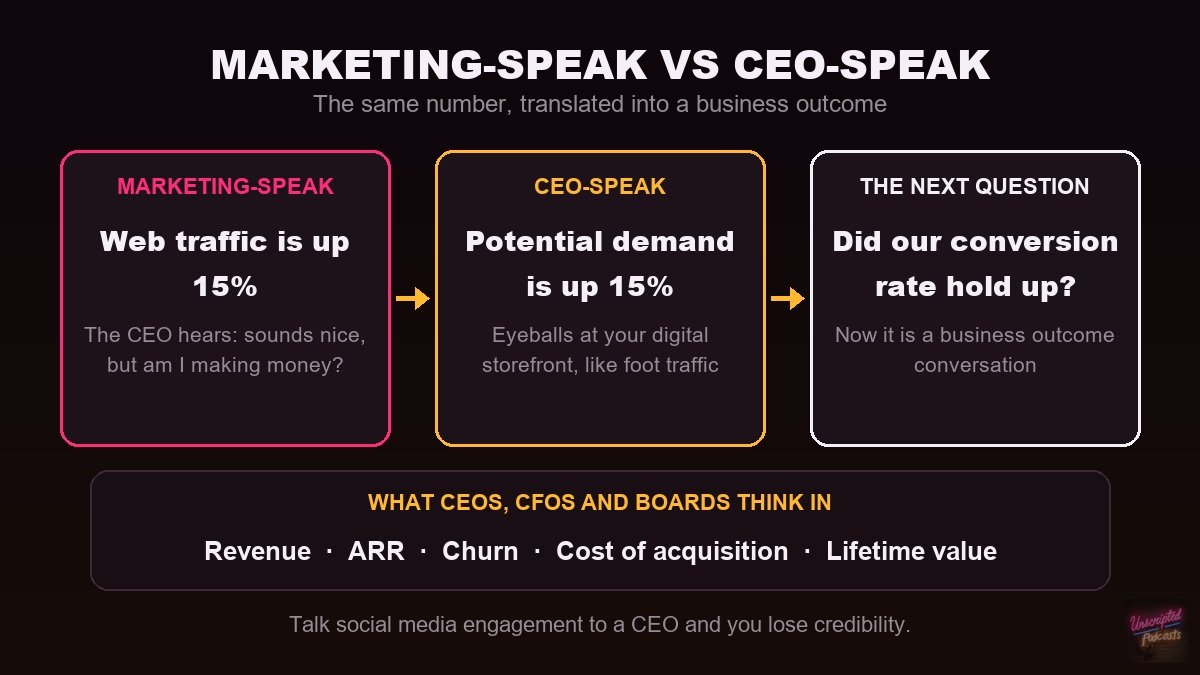
Marketing-speak vs CEO-speak: web traffic up 15% becomes potential demand up 15%, then the conversion-rate question

The 7 steps to a report your CEO will read
1
List what you report today
Write down every number in your last marketing report: web traffic, organic traffic, social media engagement, brand awareness. Rich says these matter. They are just the wrong headline for a CEO.
2
Translate each metric into the outcome it stands for
Web traffic is people arriving at your digital storefront, the online version of foot traffic. That is potential demand. So “web traffic is up 15%” becomes, in Rich’s words, “We’ve increased potential demand by fifteen percent this month over last month.” Do the same for every line on your list.
3
Answer the next question before it’s asked
Rich says a CEO’s very next question is whether the conversion rate on that demand held up, went up or went down. Put the conversion rate right beside the demand number. Now you are having a business-outcome conversation.
4
Lead with the numbers the CEO already uses
Open the report with revenue, ARR, churn, cost of acquisition and lifetime value. Move engagement metrics lower. Rich’s warning: open with social media engagement and the CEO’s eyes roll back, and you lose credibility.
5
Stop judging channels on their own numbers
On a channel-by-channel report, “organic looks amazing because it appears to be free.” It isn’t free. Cut paid marketing and organic traffic goes down. Display ads often look terrible on their own, yet people see the ad, skip the click and type your web address in directly. Write down which channels feed which.
6
Run one controlled test
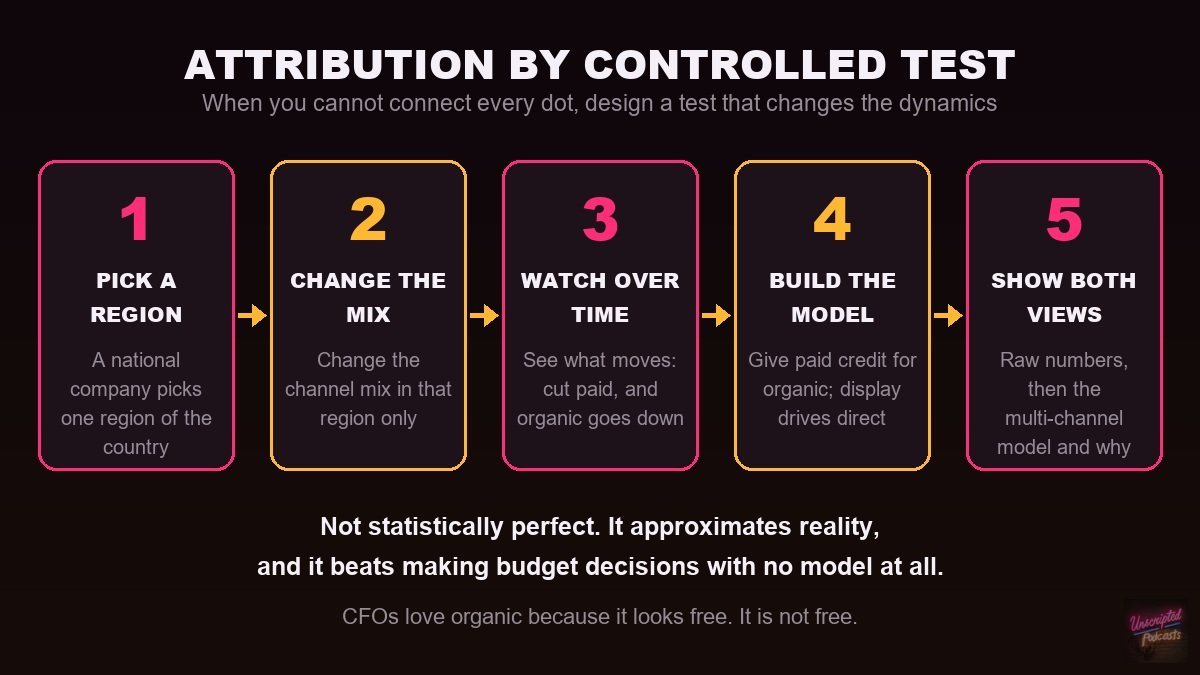
Change your channel mix in one place only, then watch what moves over time. Rich’s example is a national company that changes the mix in one region of the country. The result won’t translate perfectly to everywhere else, and it still shows you how your channels depend on each other. If you serve a single market, the closest version is a time-boxed change in one channel (that adaptation is ours, not Rich’s).
7
Build the model and show both views
Use what the test taught you to share credit across channels, such as giving paid some credit for the organic traffic it generates. Then present three things: the raw numbers, the numbers after your multi-channel attribution model, and why you chose each assumption. Rich’s standard: “they’re not perfect, but they’re better than not having a tool like that to help us make those decisions.”
Attribution by controlled test: pick a region, change the mix, watch over time, build the model, show both views

The numbers behind the play

Rich built this habit across a long run of CMO seats, from Fortune 500 financial services to regional health care. His attribution models, he says, “were never perfect, they were never going to be perfect, but they would approximate reality.” That is the bar: close enough to make budget decisions on, with the assumptions written down.

7
companies Rich has served as CMO
25
years in marketing leadership
5
numbers CEOs think in: revenue, ARR, churn, CAC, lifetime value
3
views in every report: raw, modeled, and why

Take the whole SOP with you

One printable page: the play, the steps, a translation worksheet and a checklist. No email required.

📥 Download the CEO-Speak SOP (PDF)

Listen & watch

This SOP is distilled from Rich M. Smith’s episode on the Unscripted Small Business podcast:

Rich also talked about how AI answers now speak for your business. For that side of the episode, run the Trust Economy SOP.

More operator SOPs, every week.

Real operators, real playbooks: free SOPs you can run this week. Browse the rest at Small Business SOPs and subscribe to Unscripted Small Business so you never miss one.