🎧 Listen: Castos | 📺 Watch: full episode video
This week on the Unscripted Small Business Podcast, host Jeremy Rivera talks with Rich M. Smith of Rich M. Smith Growth Studio. Rich has spent 25 years as a CMO across Fortune 500 financial services, large regional health care, data and technology, and a management consulting company. Today he runs what he calls a growth studio for founder-led businesses, most of them mid-sized, and hosts The Revenue Science Podcast. His core message fits in one line: growth is not an accident, and it is not a black box.
Rich is writing up his own version of this conversation on his blog.
Customers decide on emotion and explain it later
Rich’s degree is in economics, and classical economics assumes everyone is a rational actor. He says that assumption is the problem. Behavioral science shows people take mental shortcuts to cope with the flood of ads, news and email that hits them every day. In his telling, “researchers have documented something like 188 different cognitive biases that we’re all susceptible to.”
“We make emotional decisions and then we rationalize them later and we tell ourselves that those are rational decisions.”
Rich traces the field’s growth to Daniel Kahneman’s Thinking, Fast and Slow. For a small business owner, the takeaway is practical. Your customer is not running a spreadsheet. They are reacting first and reasoning second, so the way you present an offer matters as much as the offer.
Framing is not manipulation
Jeremy pushed back: is marketing just handing people rational excuses for rash decisions? Rich said no. He pointed out that you might fool some people once, but “particularly in today’s world where there’s just so much transparency,” you damage your reputation, and you are probably out of business.
Then he made the point with ground beef. One package is ten percent fat. The other is ninety percent fat free. Same product.
“I didn’t manipulate you, but I was thoughtful about how I framed that to you when I pitched it to you.”
That’s the line between framing and manipulation. You tell the truth, and you choose how to say it so the customer can absorb it.
Translate marketing-speak into CEO-speak
Rich credits one skill for most of his success as a CMO: “having the ability to translate marketing speak into CEO speak.” If you walk into a meeting and say organic web traffic is up 15 percent, the CEO is thinking “that sounds kind of nice, but I don’t really know if I’m making any money.”
“CEOs think in different terms. They think in terms of business outcomes, you know, revenue generation, ARR, churn rates, right, cost of acquisition.”
His fix is to translate the KPI into what it means for the business. Web traffic is people walking into your digital storefront, so say it that way: “We’ve increased potential demand by fifteen percent this month over last month.” The CEO’s next question writes itself. Did the conversion rate on that demand hold up? Now you’re having a business outcome conversation.
To put this into practice step by step, use the CEO-Speak SOP, built from this episode, with a free printable worksheet.
Attribution you can defend: test one region
Jeremy asked whether attribution can still produce the hard numbers a CEO wants, now that AI tools and cross-device journeys have blurred the picture. Rich’s answer was that attribution keeps improving, but there is always an unknown factor. His workaround is controlled tests. If you’re a national company, “you might pick a particular region of the country to change your mix and see what the impact is if you change your mix in that region.”
He used SEO as the example. “CFOs love organic traffic. Let me just tell you. They love it.” Organic looks amazing on a channel report because it appears to be free. But cut paid marketing and SEO traffic goes down, so a good model will “give some credit to paid for the organic that’s being generated.” Display ads work the same way: they look terrible on their own metrics, but people see the ad, skip the click and type in your URL.
“They were never perfect, they were never going to be perfect, but they would approximate reality.”
What AIG Bank taught him about a tarnished brand
Rich was CMO of AIG Bank during the 2008 financial crisis. The bank was not the cause of AIG’s problems, but it was the legal entity that let the federal government do the bailout. When AIG started breaking up, the bank’s distribution disappeared overnight, and Rich had to answer whether to rebrand. He recommended keeping the name.
“We just needed a certain type of customer to do business with us.”
A sophisticated customer would know the deposits were FDIC insured. A new name would have meant buying awareness from zero. The bank stuck with AIG, and Rich says that within 18 months the banking unit was back to profitability. His view of credibility comes from that period: authenticity equals credibility, never make something up for the press, and “Say what you’re gonna do and do what you say.”
AI is outsourced customer service, and outsourced sales
Jeremy opened the AI segment with a line from his friend Matt Brooks of SEOteric: treat AI visibility as outsourced customer service that you don’t directly control but can influence. Rich took it one step further: “I love the phrase outsourced customer service. In many ways, it’s outsourced sales as well.” When he shops now, he asks ChatGPT, Perplexity or Claude, gets three options and a recommendation, and buys the one it recommends.
“What is being said about you, what you put on your website and what you put in your advertising is not necessarily what your customers are actually seeing anymore.”
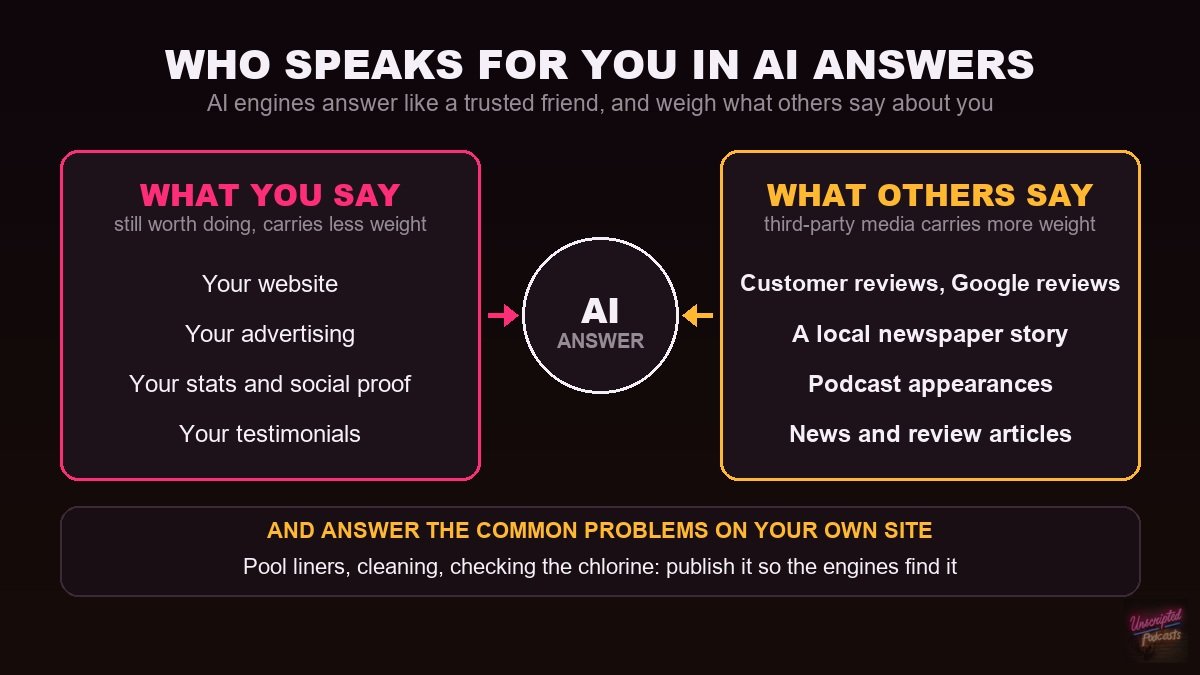
Jeremy made it concrete for a local business. If you’re a Nashville pool builder, what do you need to know about AI, what’s overblown, and what do you need to take seriously? Rich’s answer was third-party media. You can say great things about yourself on your own site, and you should, but “if somebody else says that about me to you, it carries a lot more weight.” For the pool business, that could mean Google reviews, or getting a local newspaper to come out to one of your pool installations.
Jeremy shared new evidence for that: Ben Wills of OppAlerts had just published an AI search visibility study. As Jeremy summarized it from memory, the strongest signal was a backlink profile matched to the industry of the page, followed by linked and unlinked mentions, with homepage relevance fourth. Rich’s read: “it sounds like his results showed that the top three drivers were all third party.” Bruce Ashford’s Trust Economy SOP walks through the reviews, case studies and author pages that feed that third-party trust.
Answer the question before your customer asks it
Rich added a second use of AI engines: people ask them to fix things they already own. He’s a HubSpot user, and when he has a HubSpot question, “I don’t go to HubSpot and ask that question.” He asks an AI engine. For the pool owner, that means thinking “about what are the common problems that people have with their pools.” Jeremy offered liners and cleaning.
“And let me put information on my website that answers those questions. Maybe I’ll do a few videos on, you know, how to check the chlorine concentration in your water or whatever that is.”
Jeremy summed it up: “the best way to come off as an authority is to have already spoken about something before you’re asked about it.” David Levine’s Customer Question Notebook SOP is a simple way to collect those questions for 30 days before you write a word. Rich also pointed out that being invisible as an entrepreneur won’t work, and that podcasts are a great place to build that third-party credibility. Victoria Bennion covered how to get booked in why podcast guesting beats chasing Oprah.
Growth is not an accident, and systems free the founder
Asked for the core message he brings to clients, Rich didn’t hesitate.
“It’s not an accident and it’s not a black box. There are ways to create predictable growth systems and implement them within your business.”
He says founders get stuck after early traction because they’re doing it all themselves, and what got them here isn’t what gets them to the next level. Systems fix that, and they free the founder to do what only the founder can do. His example is the sales-minded founder whose head of sales isn’t as good as they are. That doesn’t make the hire incapable, and time the founder spends on sales is time not spent on the work only they can do. Gil Vaisman takes that idea to its logical end in wanting to be useless in his own business.
Before your next report to an owner or a CEO, rewrite every marketing metric as the business outcome it points to: traffic becomes potential demand, then ask what converted. Then write down the five questions customers ask most about what you sell, and answer each one on your own site. That’s the page an AI engine can find when they ask.
Connect with Rich
- Website: richmsmith.com
- Blog: Make marketing make sense
- The Revenue Science Podcast: @RevenueScienceTV on YouTube
- LinkedIn: Rich M. Smith, the best place to reach him
🎧 Listen: Castos | 📺 Watch: full episode video
Keep going → Browse the interviews