Alfred Poor has watched executives who are great in a boardroom go on a Zoom call and, in his words, look “like they’ve joined witness protection.” Alfred wrote for PC Magazine for over 20 years, spent the last 10 focused on health tech, and works as a professional speaker and a mentor for startups. He founded The 75 Percent Solution to help executives, business owners and startup founders come across better in online meetings and presentations. On this episode of the Unscripted Small Business Podcast, recorded in March 2025, he and host Jeremy Rivera talked about when a meeting should have been a memo, his three rules for a good video call, why he wants you to drop the virtual background, and how to set camera rules without telling your team you don’t trust them.
Why great presenters disappear on a Zoom call
Jeremy opened with how much business has moved online. Twenty or thirty years ago, he said, “there was not even such a thing.” Alfred’s answer starts with people you have probably worked with. They’re “really good in a boardroom. Very persuasive, get everybody on page with them,” or they’re on stage and “they just kill it.” Then they join a video call and the presence is gone.
His explanation is that we’re intentional about the boardroom and the stage. “We think about how we’re going to dress. We think about how we’re going to present ourselves.” For a lot of people, “that just all goes out the window when you’re on a video chat or a video call.”
He blames the pandemic. Skype and Zoom were non-technical products. “You didn’t need any training.” You opened your laptop and started talking, in the kitchen or on the beach. “And so it was so easy, people didn’t think about being intentional about the impression that they were making.”
The pandemic ended, but the meetings stayed online. As of the March 2025 recording, Alfred cited a Gartner estimate that “75% of all business meetings in the US, both internal and external, 75% of them will be held online, because it’s so efficient, because it’s so effective.” That figure is where his company’s name comes from. His worry is what people do with it: “so many people waste that opportunity. They don’t make the best impression they can.”
Jeremy pointed out that this isn’t only about clients. Your relationship with people inside your own company is often distributed too. Alfred told a story from following Skype from the very beginning: its development office in Europe and a team in the US kept a Skype session running between the two offices all day, so you could walk up and say, “can you get Carl over here? Because I got a question for him.” Video, he said, has “become a vital part of even some of the smallest businesses.” Jessica Malnik covered the hard version of this on the show in why hybrid work is the hardest.
Decide whether the meeting needs to happen at all
Jeremy asked how a remote manager or startup CEO uses this technology “without replacing everybody’s activity with being required to be on a meeting all the time.” Alfred went back to an old saying: give a kid a hammer and the whole world looks like a nail. “Just because we have this technology doesn’t mean you have to use it.”
The first question he helps clients answer is when a conversation should be synchronous, with everyone there at the same time, and when asynchronous works just as well. Letters and inter-office mail became email, and email picked up group tools like Slack. “If you don’t need to have it right away, then maybe there are other ways.” Then he quoted the old joke: this meeting could have been a memo.
For Alfred it comes from “a place of respecting the time and energy of the other people.” When he steps on stage as a speaker, everyone in the room has agreed to give him their time, and he has an obligation to make that time worth more than whatever else they could have done. He thinks owners and managers lose sight of that and ask what’s most efficient for themselves. His alternative is to put yourself in the other person’s shoes and ask, “how’s this gonna impact them? And is this the best use of their time?”
Jeremy had the cautionary tale. At one job there was a solid week where, from eight o’clock until lunch, eight people in his office, eight in Boston and eight in California were all on one meeting. They took lunch together on the call, then ran another three hours. “So literally no work that wasn’t in the meeting was getting done by 24 people all at once.”
Alfred’s response was the line the rest of the episode keeps coming back to: “Don’t do things by default, do them on purpose.” Sometimes a big meeting is the right path forward. “But don’t do it just because that’s what we do on Tuesdays.”
Be seen, be heard, minimize distractions
Alfred co-hosted a radio show in New York City for eight years, and he warned audio listeners that his next move wouldn’t play well for them. He leaned into his camera to show the usual video-call view: his head too big, not looking at you. Then he sat back in his office so you could see much more of him, making direct eye contact. Jeremy called the first one “the Zoom head,” complete with nose hairs and people who “don’t even seem to be talking directly to you because their camera’s off to the side.”
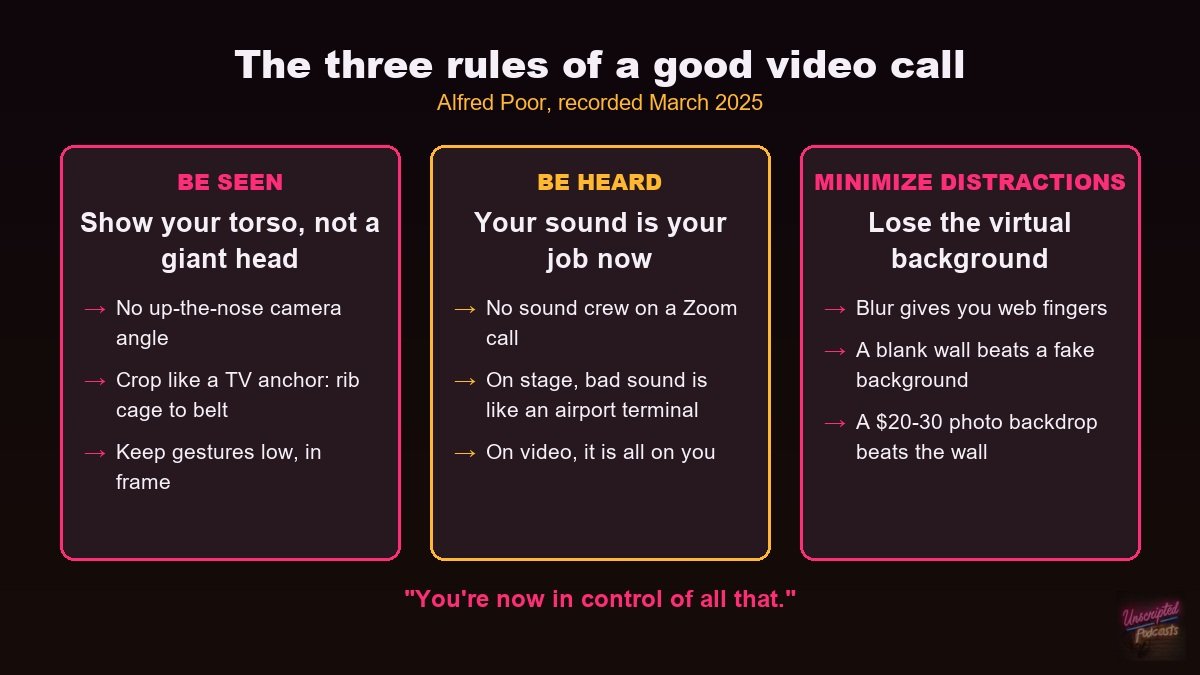
Alfred’s pet peeve is the phrase Zoom fatigue. “I don’t believe there is such a thing.” A bad video call, he argued, is the same problem as a bad conference room meeting or a bad stage talk, and doing it well makes you “more persuasive, more influential, more successful.” It comes down to three points:
“You need to be seen, you need to be heard, and you need to minimize distractions.”
You’ve been to the conference session that fails all three. The speaker stands in the shadows at a podium off to the side. The sound system “sounds like it was borrowed from some airport terminal.” People in the back hold loud conversations. “Not seen, not heard, lots of distractions.”
The difference on Zoom, Teams or Google Meet is who fixes it. “You’re now in control of all that.” Nobody sets your lighting, runs your sound or prepares your room. “It’s all on you.”
Frame yourself like the people on the TV news
Being seen starts with framing. Alfred wants viewers to see the top half of your body, not an up-the-nose close-up. He cited studies by a researcher who works on video meetings and online presentations, and said one finding was that “the more of your torso that’s visible to your audience, the more approachable, the more trustworthy, the more convincing you’re going to appear to them.”
Jeremy added that we read form and gesture as well as voice. Alfred agreed that this is why we use video instead of phone calls in the first place: posture, gestures and facial expression. Speech coaches tell you to keep your hand gestures low, around the center of your body. On a head-only shot your hands pop in and out of frame, and holding a product up by your face “is really awkward.”
Then he told clients to ignore all the experts, himself included. “Just go watch television.” Watch your favorite news channel and you won’t see a giant head filling the screen. “In almost every case, they’re going to be cropped somewhere between the bottom of the rib cage and the top of the belt.” Why do they do it? He doesn’t care. “If that’s what the professionals want to do, they must have a reason. So that’s what I’m going to do.”
Friends don’t let friends use virtual backgrounds
On distractions, Alfred has a mantra: “Friends don’t let friends use Zoom virtual backgrounds.” That includes blur. On most computers, if your hands are visible “they get web fingers,” long hair swirls in and out like Waterworld, and your chair or part of your arm appears and disappears. People notice it and stop paying full attention to you.
His fixes come in three levels:
- A blank wall. “A blank wall behind you is going to be better than your typical virtual background.”
- A green screen. Chroma key helps the computer, but you still need a fast computer, lots of memory and a good graphics card to make it look right.
- A photographer’s backdrop. “There’s a $20 or $30 solution to this. No technology required.” Search Amazon for photographer backdrops (brick walls, weathered boards, bookshelves), hang one on a rolling clothes rack from Target or Walmart, and you have a sharp, in-focus background you can move from the bedroom to the kitchen. Prices are as of March 2025.
The bonus move is printing your logo or company name on vinyl and sticking it on the backdrop. Now you’re presenting yourself in a way that’s “congruent with your message, your personal brand, your professional brand, your corporate messaging.” The same goes for clothes. A t-shirt and cutoffs are fine if they’re part of your brand. “But do it on purpose.”
Jeremy summed up the first half of the episode: be selective about when you use meetings as a tool, “narrowing down that band, not expanding it,” then take the ones you keep seriously and stage yourself before you start.
Camera-on rules should follow the information, not distrust
Another of Alfred’s pet peeves is the manager who makes everyone turn their camera on to prove they’re paying attention. “What does that tell the other people about your level of trust in them?” If you want to keep your best employees, starting from “this is third grade and I don’t trust you” is probably not where you want to begin. And as a speaker, he pointed out, he doesn’t call the audience up on stage so everyone can stare at them.
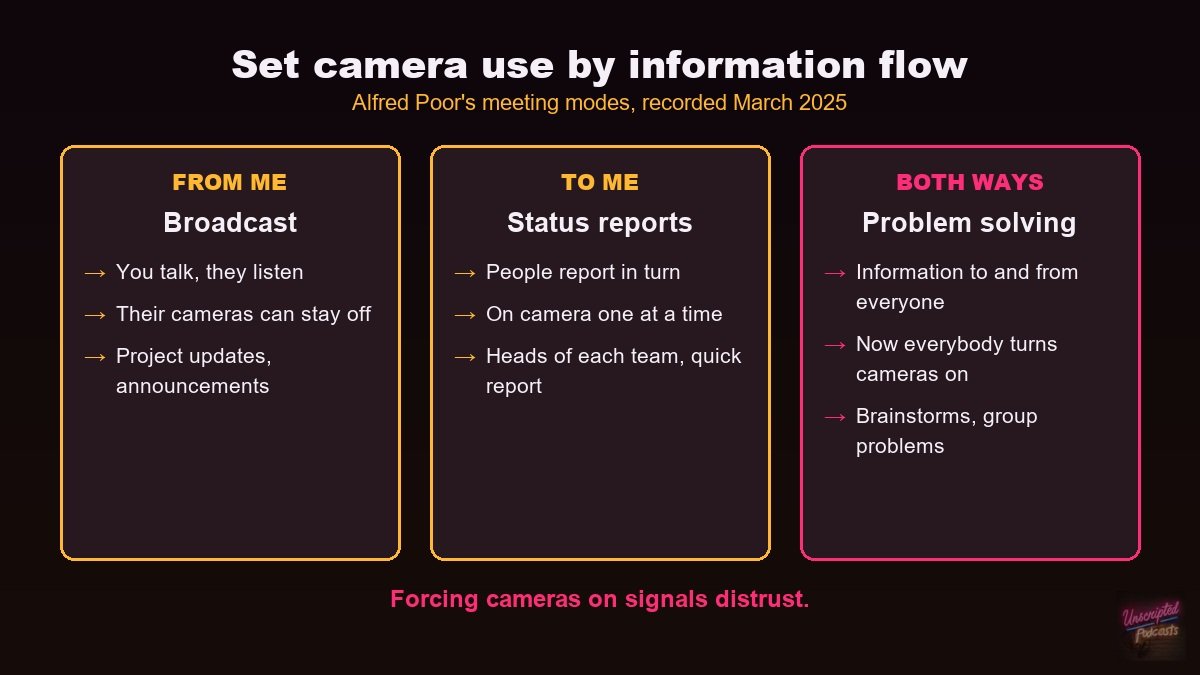
Instead he asks “what’s the goal of the meeting?” and looks at how information flows:
- From you. You’re telling everyone something so they’re on the same page. You talk, they listen, and their cameras can stay off.
- To you. Status reports. Put people on camera one at a time while they report.
- Both ways. Brainstorming or problem solving with the whole group. “Then put everybody on camera.”
Jeremy offered his own three categories: a broadcast like a CEO’s quarterly update, a dialogue where two people share information back and forth, and an open brainstorm where anybody can raise a hand. He asked if there were more. Alfred reframed it around “how the information is flowing” and said those three cover most scenarios, though one meeting can hold all of them. His example agenda: start with “here’s where things stand on this project,” then hear a quick report from each team head, then “now everybody please turn your cameras on, because this is a problem we need to solve.”
The point is “meetings that people want to attend,” where people feel their time is respected. “You’re not always going to succeed. But if you make the effort, you stand a much better chance of more success.”
Alfred’s meeting modes as 8 steps you can run on your next team call, with a fill-in meeting planner and a free printable PDF. No email required.
You’re not born knowing how to run meetings
Jeremy asked what advice has carried over from the boardroom of the 1960s. Alfred’s answer was “being intentional and not just walking in and winging it.” He described the best boss he ever had, who was already at his desk when Alfred came in early and still there when he left late. Probably not the best lesson in work-life balance, he admitted, “but the point was that I never felt that he was asking me to do more than he was willing to do.”
Jeremy named the opposite. In corporate settings, he said, things become “a game of you just do this because this is how we do it,” with more and more disrespect for the worker, “almost a digital aristocracy.” Alfred compared it to fraternity hazing: I went through this, so you have to. He said there are probably fewer than five people in the world who could tell him “I need you on a meeting” and get him there without question.
“You’re not born knowing how to run meetings.” Going to meetings your whole career doesn’t teach you to run one, and “nobody’s born knowing how to lead” either. You learn it by doing and by reading, and Alfred’s advice is the same as before: “don’t accept the defaults.” Barry Moline made a related point about leading a team on the show in hire for get-along ability.
The three I’s of improvement
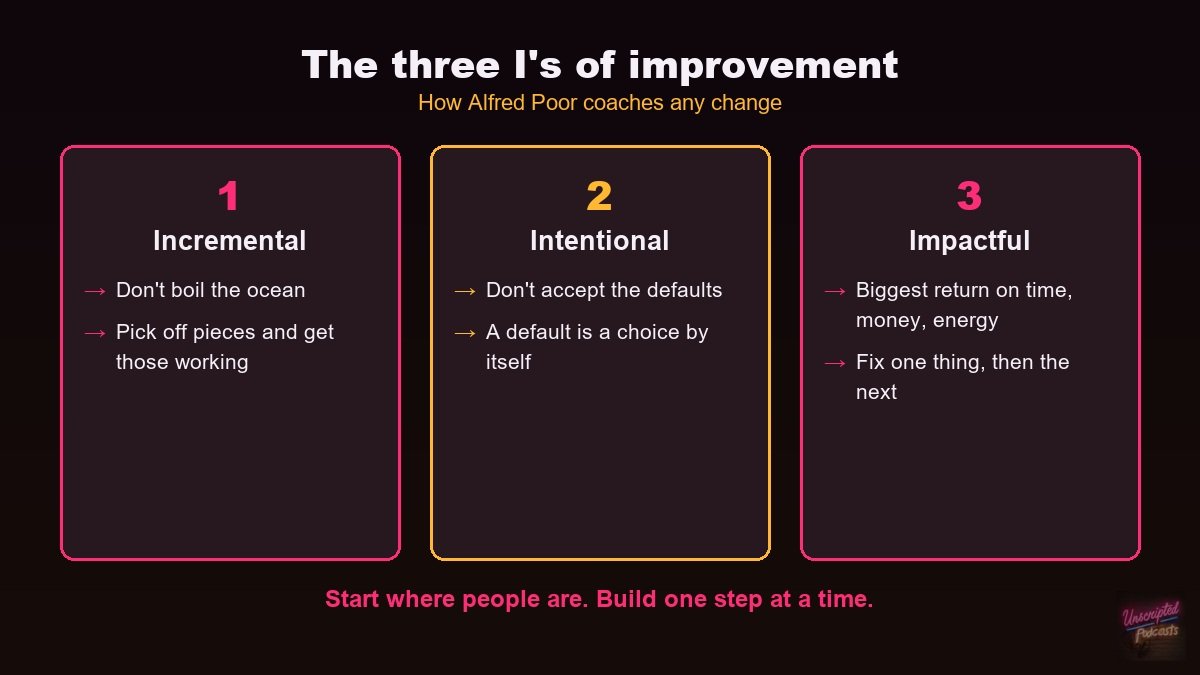
To wrap up, Jeremy asked for the one takeaway Alfred always gives clients. It’s what he calls his three I’s of improvement, and he said they apply to any change you want to make, not only how you look on camera. Improvements should be “incremental, that are intentional, and that are impactful.”
- Incremental. Don’t try to change everything at once. “Don’t boil the ocean.” Pick off pieces and get them working.
- Intentional. Don’t accept the defaults.
- Impactful. Choose the steps with the biggest return on your time, money and energy. “Pick one thing, fix the one thing that’s going to have the biggest impact,” then the next.
“A default is a choice by itself. You’re choosing not to change it.”
Opening your laptop without thinking about eye contact, camera angle or framing is a default, and that’s a choice too. He doesn’t use a script with his clients. He starts with what each person already has, their equipment, budget, talent and experience, and builds one step at a time.
Questions to ask yourself, based on what Alfred covered: Could my next meeting be an email or a Slack message? If someone joined my last video call cold, would they see my torso or my nostrils? Is anything behind me moving, blurring or melting? Am I asking for cameras on because the meeting needs faces, or because I want to check on people? Which one change to my setup would have the biggest impact this week?
Also on Unscripted Small Business
If you present for a living, read Oreet Kaufman on word dieting and presentation design, and for the in-person side of trust, Nick Garofalo on why a warm handshake beats a thousand LinkedIn posts.
Two more takes on this conversation: what marketers can take from Alfred Poor on the video call as a brand touchpoint on SEO Arcade, and Jeremy’s own reflection on meetings that could have been a memo.
Where to find Alfred Poor and The 75 Percent Solution
- The 75 Percent Solution: the75percent.com
- Personal site: alfredpoor.com
- LinkedIn: Alfred Poor. He asked listeners who connect to mention the Unscripted Podcast so he knows where you heard him.
- Health Tech Insider, which he edits: healthtechinsider.com
This episode is supported by our sponsor OppAlerts, a link building database that finds link and mention opportunities filtered by relevance to your business.
Sponsor disclosure: OppAlerts is a paid sponsor of the Unscripted podcast network. Links to it are marked as sponsored. Alfred Poor has no connection to it.
Keep going → Browse the interviews