This is a Small Business SOP: a free, do-this-today standard operating procedure pulled from a real operator on the Unscripted Small Business podcast. This one comes from Chuck Mobley of Polar Bear Air Conditioning, who started the company in the Cayman Islands 38 years ago after he was fired from his technician job. He grew it from one employee, himself, to about 44, with a sister company, Appliance Doctors, and he has since handed the business to his son.
You know the complaint. The company says it’ll be there between nine and one, you take the morning off, and the truck shows up at three. Polar Bear fixed that by dropping time windows altogether. The team guarantees only the first call of the day, tells the customer to carry on with their day, and has the technician call 20 to 30 minutes before arriving. Here it is as seven steps you can add to your booking script this week.
Why a time window sets you up to fail
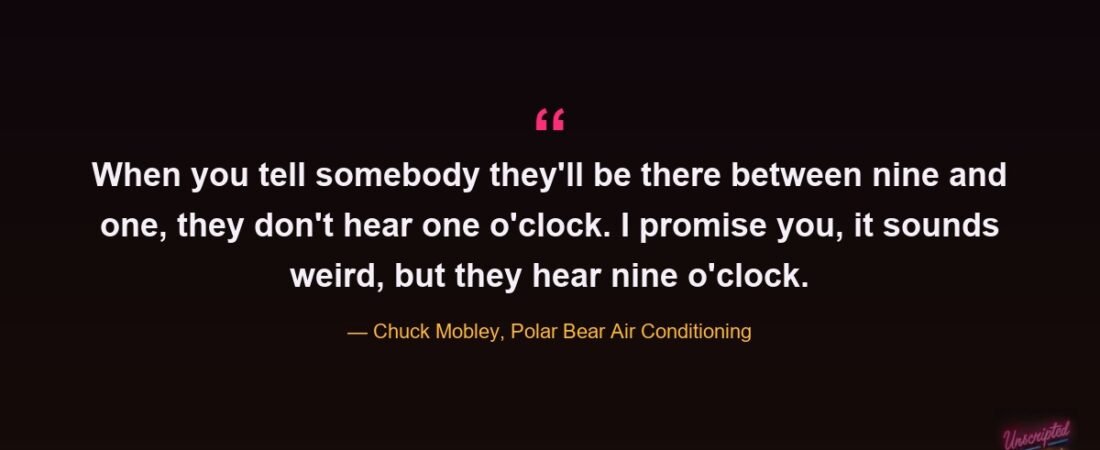
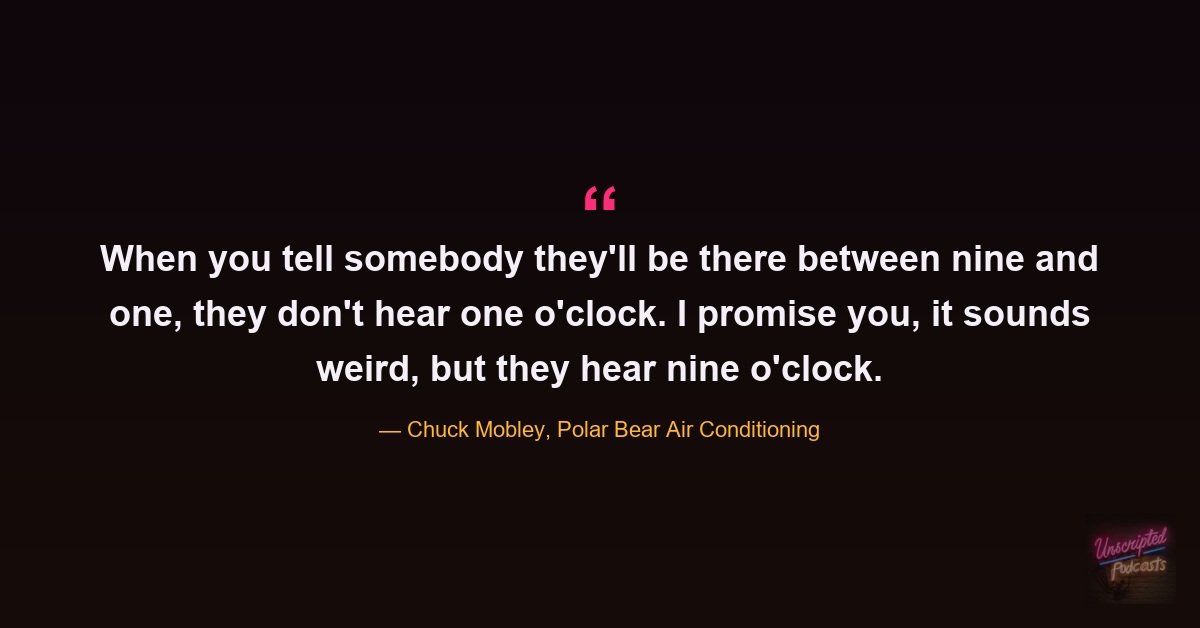
A time window looks like a fair deal for both sides. You get room for jobs that run long, and the customer gets a range to plan around. Chuck says it doesn’t work that way, because the customer hears only the first number. Tell them nine to one and they plan for nine. When the truck isn’t there at nine, you’ve broken a promise you never meant to make.
Your schedule can’t keep that promise anyway. In Chuck’s words, a technician “might go on a call and he might spend thirty minutes, but he might be there the rest of the day.” Every job after the first one inherits that uncertainty. So he stopped guessing: “I just hate to disappoint people.”
This isn’t only an HVAC problem. Plumbers, appliance repair, pest control, cable installers and anyone else who sends a truck to a house runs into it. (Those examples are ours.) Chuck’s summary for all of them: “If you run a service business, don’t promise you can give windows, morning or afternoon.”
The numbers behind the play
All four come from Chuck on the episode. They describe his company, so treat them as one operator’s experience, not benchmarks. Polar Bear’s customer reviews are public if you want to see how customers talk about the service.
The 7-step no-time-window schedule
Steps 1 to 6 are built from what Chuck described on the episode. Step 7 is Jeremy’s point from the same conversation, so the policy reaches customers before they ever call.
Your booking script, filled in from Polar Bear’s
Copy this table or print the PDF. The middle column is Polar Bear’s version from the episode. Write yours in the right-hand column and keep it next to whoever books your jobs.
| Step | Polar Bear’s version | Your version |
|---|---|---|
| What you guarantee | The first call of the day. No windows. | |
| Why there’s no window | “We don’t want to waste your time.” | |
| What the customer does | “Continue about your day as if we don’t exist.” | |
| The reassurance | “We’re not going to forget about your problem.” | |
| The heads-up | The technician calls 20 to 30 minutes before he arrives. | |
| The check question | “Will that be enough time that you can leave work or leave what you’re doing?” |
Two other options came up on the episode, both from Jeremy. You can tell customers their place in line (“there are three customers in front of you”), the way his railroad-engineer dad’s crew took turns going out. And if your trucks have GPS, you can send a live link so the customer can watch the truck on its way.
Two printable pages: the play, the 7 steps, a fill-in booking script and a checklist. No email required.
📥 Download the No Time Windows SOP (PDF)Listen & watch
This SOP is distilled from Chuck Mobley’s episode on the Unscripted Small Business podcast:
- 🔊 Read the full episode recap: Chuck Mobley of Polar Bear on why he stopped giving time windows
- 🎧 Listen on Castos
- 🎥 Watch on YouTube
- 🌐 Polar Bear Air Conditioning (and its sister company Appliance Doctors) in the Cayman Islands
The episode also covers why Chuck competes with Amazon, Disney World and the Ritz instead of the HVAC company down the street, where AI belongs in a service business, and the core value he has kept for almost 40 years. That’s all in the recap. SEO Arcade wrote up the marketing side: how to explain how your service works on your website so customers and AI assistants get it right. Chuck also wrote a book about his life and the business, Leap Before You Look: But God…, and you can find him at chuckmobley.com.
Related SOPs: if callers wait too long to hear back at all, start with the AI Lead Callback SOP. For a phone script your whole team can follow, see the First Call SOP and the Simple Systems SOP.
No time window scheduling: try it on next week’s bookings
You don’t need new software for this. Pick a start date, take “between” out of your booking script, and replace it with the first-call promise, the “continue about your day” line, the 20 to 30 minute heads-up and the reason you do it. Then put the same words on your website. After a couple of weeks, count how many customers called to ask where the technician was. If that number drops, the script is working.
Real operators, real playbooks: free SOPs you can run this week. Browse the rest at Small Business SOPs and subscribe to Unscripted Small Business so you never miss one.