🎧 Listen: the episode on Castos | 📺 Watch: full episode on YouTube
Ask Chuck Mobley why you should trust him as an expert and he’ll tell you not to. “Jeremy, don’t ever trust me as an expert in anything. I’m an air conditioning technician that started an air conditioning business after I got fired from my job.” Then he gives the numbers. In 38 years, Polar Bear Air Conditioning grew from one employee, Chuck himself, to about forty-four employees and five thousand customers. He says Polar Bear and its sister company Appliance Doctors are heading toward four thousand five-star reviews between them. On this episode of the Unscripted Small Business Podcast, he and host Jeremy Rivera talked about why Polar Bear no longer gives customers a time window, how he wants AI to handle the boring work so his people can talk to customers, and how HVAC service has changed.
Common sense over business acumen
Chuck didn’t plan to own a company. He was fired, “not for misbehavior, but for refusing to continue to use my car as an asset for a service company.” It came to a head when his car went into the shop and he had to rent one to keep running service calls. He had some technical knowledge and not much else. “It was a year in before I realized, wow, I can make money doing this.”
What he did have was his parents’ example. His mom sold real estate, and “she would just go out in the middle of the night and go wrap people’s pipes up” when a client with a listed house was out of town. She’d send his dad to mow their grass. “And so when I started this business, the only thing that I knew was to give great service to my customers.”
Chuck has since passed the business to his son, who he says is running it better than he did, because his son has a business degree. Chuck’s advice for owners without one is gentler than you’d expect from a guy who never went: “I’m not saying that a business degree doesn’t help you, but sometimes we learn our way out of common sense.”
For Jeremy, the common-sense part of a service business is calling people back quickly. He pointed to Ignitvio’s lead response study, which mystery-shopped 1,824 local businesses and found 68% never responded within 24 hours. Knowing to answer the phone is easy. Doing it for thirty-some years is the hard part.
Why Polar Bear stopped giving customers a time window
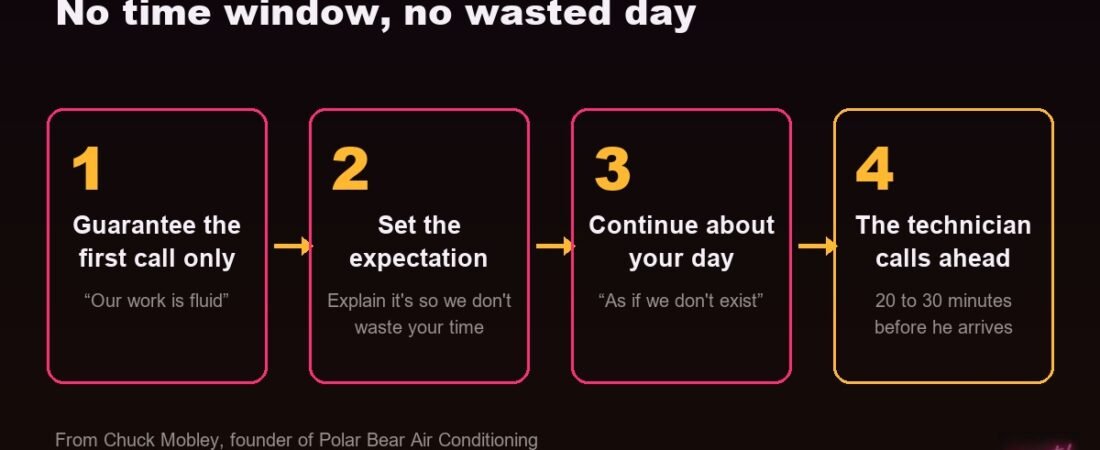
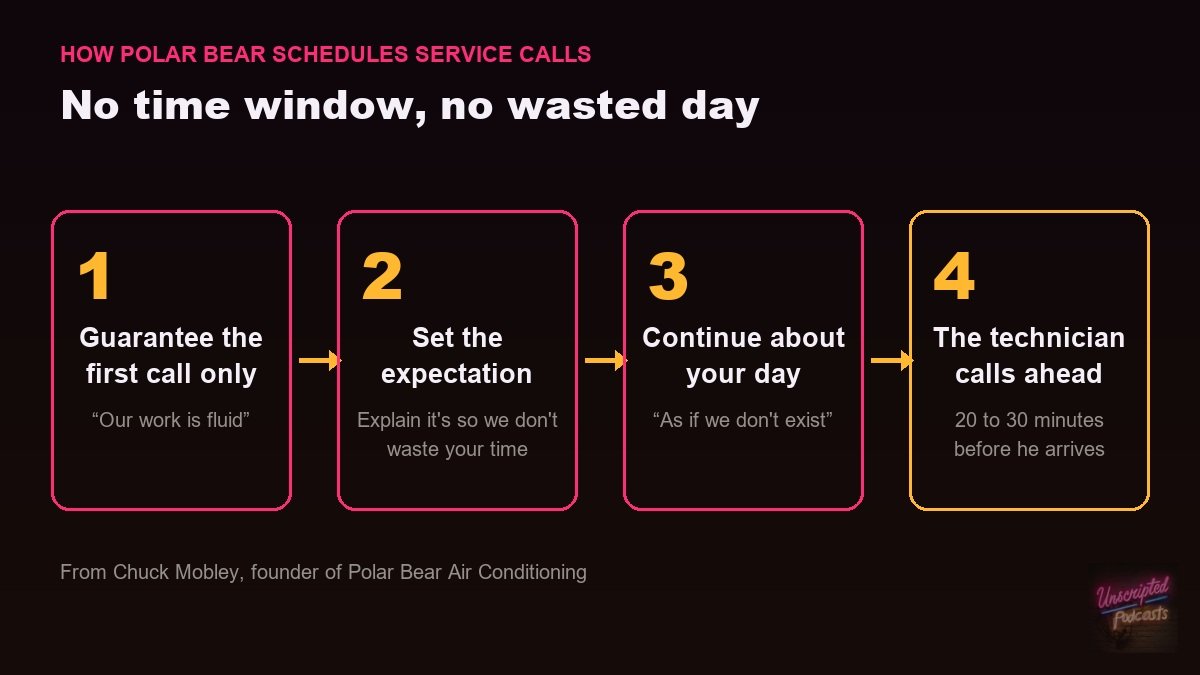
Jeremy brought up the classic service-industry complaint: you said you’d be there sometime between nine and five, and nobody called. Chuck’s answer was the most practical advice in the episode. “We no longer give a time window. We can only guarantee the first call, because our work is fluid.” A technician might spend thirty minutes on a call, or he might be there the rest of the day.
The problem with a window, he says, is what customers do with it.
“They will actually say, ‘You guys promised you would be here at nine o’clock.’” He compares it to a job offer. Tell a candidate the salary is between fifty and sixty thousand, and “all they hear is the sixty thousand.”
So Polar Bear doesn’t promise a morning or an afternoon. Here is what the customer hears instead: “We don’t want to waste your time, and so continue about your day as if we don’t exist. We’re not going to forget about your problem, and our technician will call you twenty to thirty minutes before he arrives. Will that be enough time that you can leave work or leave what you’re doing?”
Set the expectation and explain the benefit
Dropping the window only works if the customer understands why. Everybody’s biggest fear with a nine-to-five window, Chuck says, is calling in to work, missing the day, and watching the truck pull up at five. “You have to explain the benefit to the customer. Otherwise they think we just don’t want to give a time, that we want to show up when we want to.” The message is “we’re doing this for you, so we don’t waste your time.”
Jeremy called that a core marketing principle and pushed it one step further: put it on your website, not just in the phone call. As Matt Brooks of SEOteric put it to him, “you have new customer support representatives who don’t work for you,” meaning ChatGPT, Claude, Perplexity, Google and Microsoft. A site that says “call us for details about our booking” tells none of them how your scheduling works. Jeremy’s dad was a railroad engineer, and the crew board worked the same way: there are nine engineers ahead of you, and you’ll be the tenth one out. Customers can live with that if you tell them.
Chuck guarantees only the first call, tells customers to continue about their day, has the technician call 20 to 30 minutes out and explains why. We wrote that up as the No Time Windows SOP: seven steps any service business can add to its booking script, with a fill-in script and a free printable PDF.
Competing with Amazon, Disney World and the Ritz
Chuck moved from the United States to the Cayman Islands in 1984 and never moved back. He remembers when “if you didn’t give good service, you didn’t have a job,” and he’s honest that he gets frustrated with bad service now. In the devotional he’s writing, he describes standing at a grocery counter while the cashier scans his things without looking up. His old move was a sarcastic “Good morning. I’m fine, thank you. Thank you for asking.” He’s changed that. “I need to genuinely ask them, ‘Hey, how you doing this morning? Is everything all right?’” The answer he often gets: “I’m so sorry. I’m just worried about how I’m gonna pay my rent.”
That empathy is the bar he sets for Polar Bear, and the comparison isn’t to other HVAC companies.
He added the Ritz hotel in Coral Gables, Florida, to the list. “Once they’ve experienced great service, then I want them to expect that. In fact, I wanna be the standard.” His hope is that other Cayman businesses say, “wow, we need to teach our employees to give service like Polar Bear.” Jeremy mentioned a study he’d seen on the cause of negative reviews: most of them came down to a lack of communication, not the product. Chuck’s reply was short: “We get that as well.”
Use AI for the mundane so people can be people
When people tell Chuck they won’t use AI because it will replace people, he tells them how Polar Bear is starting to use it. “The most important interaction we have is between our employee who knows everything about our company and the customer. So I’m not gonna chance that to AI.” In a small business, a customer service rep might also be the bookkeeper and the data-entry clerk. “So get AI to do the data input, but keep your frontline people talking to that customer.” They might not be as smart as AI, he says, “but they have emotion and they have feeling.” He calls that gift don de gente, Spanish for being a people person.
He gave an example from the week before we recorded. A customer called to cancel an appointment because their husband was sick. His team is trained not to just say “call us when it’s a better time.” Instead: “I’m so sorry to hear that your husband is ill. And we can definitely reschedule it, but more importantly, is there anything that we can do? Can we go pick up some medicine?”
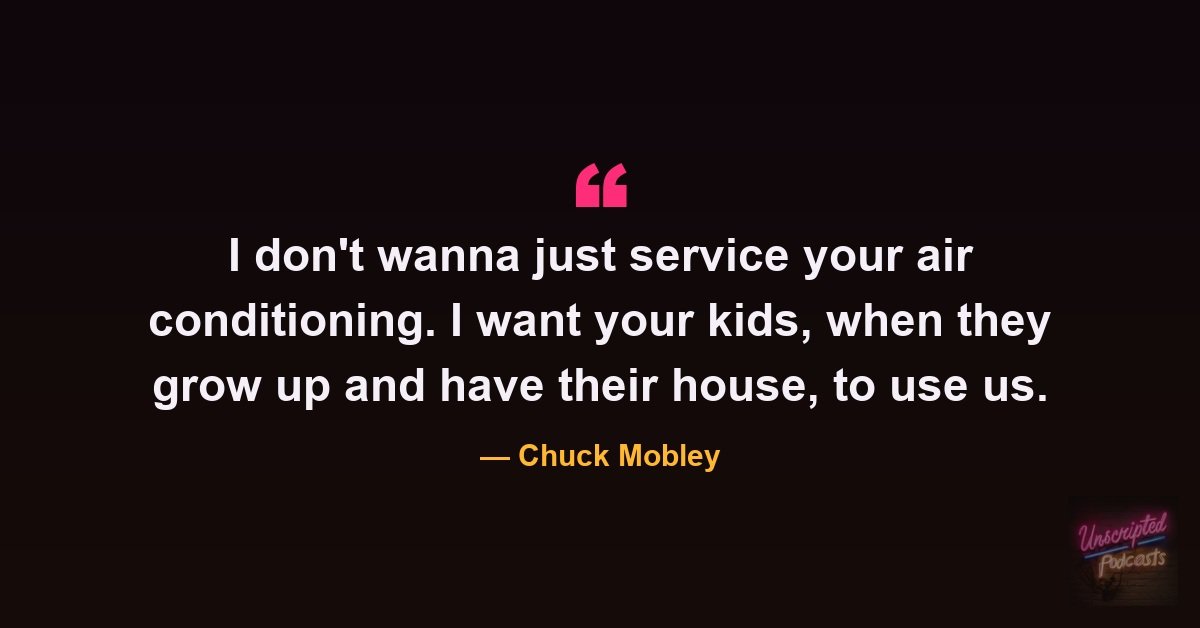
“And so we’re getting into that now: the third generation of people who wouldn’t consider using anybody else but Polar Bear.” Jeremy added a point from his friend Michael McDougald, who wrote about AI being used to churn out slop: when AI saves you half an hour, put most of that time back into quality instead of spending all of it somewhere else.
How HVAC service has changed
Asked whether AI is the biggest change he’s seen, Chuck said his industry doesn’t change monthly, “but we go through yearly changes.” Thermostats are on the Wi-Fi now, so “we’re actually having to go and program thermostats” and make sure the connection is steady. Efficiency rules change, and older equipment that still works becomes obsolete “because you can’t get parts for it,” or one failed part means replacing both the indoor and outdoor units. Then there’s indoor air quality. “Mold was on bread, right?” Now, he says, any mark on a wall becomes the air conditioning guy’s problem. The EPA keeps a plain-language indoor air quality guide if you want the background.
By comparison, “AI for us is small peanuts.” Plenty of HVAC contractors are technicians with an “if it ain’t broke, I ain’t gonna fix it” outlook, so they’re slow to adopt it. Chuck’s view is that the industry changing “forces us to adapt.”
The golden rule after almost 40 years in business
Jeremy asked for one thing listeners could take away. Chuck warned them to sit down first, “because this is profound.” Then: “The golden rule still works, in our personal relationships and in our business relationships. So treat people the way you want to be treated.” It takes care of employees, suppliers and customers. “In almost forty years of business, that has been the main core value in our business that stood the test of time.” You can read how Polar Bear writes it down on its core values page.
Jeremy’s take was that the value of a human-to-human conversation goes up as technology adds layers between people. Chuck agreed and said it matters even more for technicians, “because they’re actually out there with the customers.”
Leap Before You Look: But God…
Chuck has written a book, Leap Before You Look: But God…, and he describes it as “an irreverent faith book, but there’s lessons to be learned in each and every chapter, and it’s entertaining.” It’s the story of a man who does things on a whim: he started a business “basically out of desperation,” goes to Africa without studying up first, and once took a four-hour course before a static-line jump whose parachute only half opened. A few chapters cover the early days of the business, and some are about his mother. “It’s an easy read, because I don’t know any big words.” His site, chuckmobley.com, links to the book and to the charities he supports.
If you run a service business, you can turn Chuck’s call-ahead promise into a process. Our AI Lead Callback SOP covers the same split he described: let the system handle the speed, and let a person handle the conversation.
Running a service business? Here’s what Chuck described Polar Bear doing: guarantee only the first call of the day, skip the morning or afternoon window, have the technician phone 20 to 30 minutes before arriving, and tell the customer up front that it’s so you don’t waste their time. Hand data input to AI and keep your people on the phone with customers. If you’re in the Cayman Islands and need air conditioning service, start with Polar Bear’s AC repair page. For appliance repairs, see Appliance Doctors.
Also on Unscripted Small Business
For more on keeping the promises your marketing makes, read Matt Tyner on why marketing makes the promise and operations keeps it, and for another owner who lets AI bring the lead while a person closes it, Rich Thomas of CHAOS Moto on speed to lead.
Two more takes on this conversation: on SEO Arcade, how to tell customers and AI how your service works, and Jeremy’s own story of why you can learn your way out of common sense, from a railroad dad to a hosting support desk.
Where to find Chuck Mobley, Polar Bear Air Conditioning and Appliance Doctors
- Chuck’s website: chuckmobley.com
- Book: Leap Before You Look: But God… on Amazon
- Polar Bear Air Conditioning: polarbear.ky, including the Polar Bear team and customer reviews
- Appliance Doctors: appliancedoctors.ky
🎧 Listen: the episode on Castos | 📺 Watch: full episode on YouTube
Keep going → Browse the interviews