This is a Small Business SOP, a free, do-this-today standard operating procedure pulled from a real operator on the Unscripted podcast network. This one comes from Melyssa Jaskiewicz, Executive Director of Leveling the Fields, a Charleston, South Carolina organization that runs girls’ sports programming inside elementary schools.
Her staffing problem is your staffing problem wearing different clothes. She has to put qualified, cleared adults in front of eight- to eleven-year-olds, on somebody else’s campus, on a calendar she does not control. The obvious move is to recruit outside volunteers and train them up. She does not do that. She hires the school’s own teachers and puts them on payroll — and it solved three problems with one decision. Run this one this week.
Why hiring from inside your client’s building works
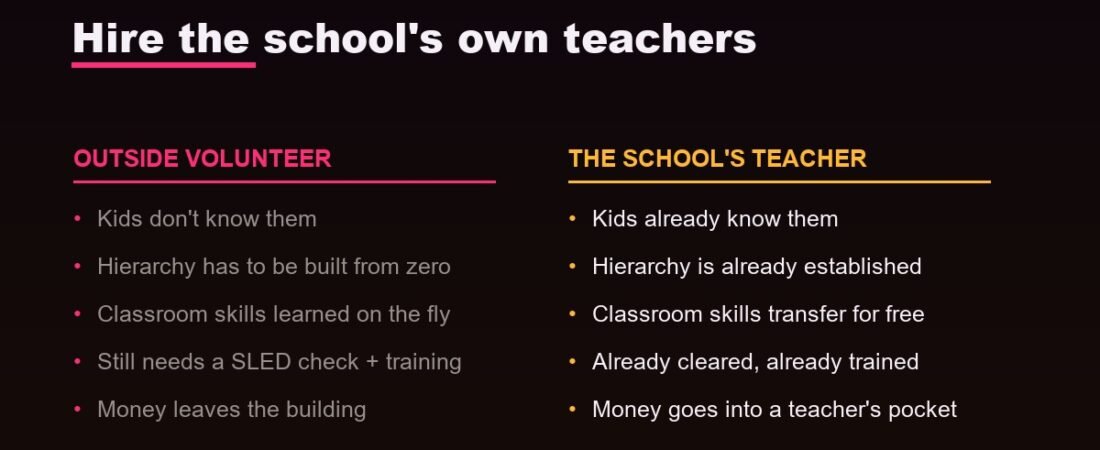
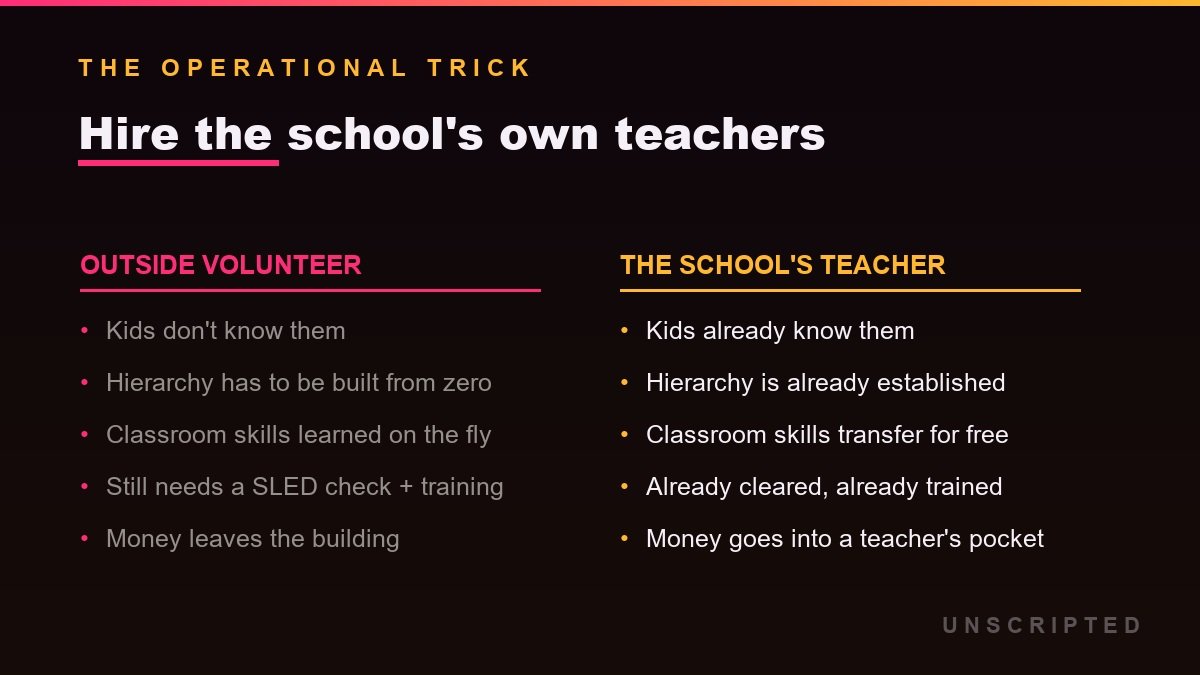
Look at what one hire buys her. Money goes back into a teacher’s pocket, which is a real outcome for the community she is already claiming to serve. Authority arrives pre-installed, because as she puts it, “they’re already seen as teachers that are respected… the kids automatically know the hierarchy. They know who’s in charge.” And the hardest skill in the job — managing a room full of nine-year-olds who have just been let outside — transfers for free.
That last one is the part you should steal. You are not paying to build a competency; you are renting one that is already fully formed and already calibrated to this exact room. In her words: “In hiring teachers, they automatically know how to handle that, because that’s what they’re doing all day, every day. And so that’s really been a saving grace.”
An outside volunteer costs you less on paper and more everywhere else. You pay in onboarding, in the weeks it takes them to earn authority with people who have never met them, in the no-shows you cannot schedule around, and in the churn when the novelty wears off. The insider walks in on day one already knowing the names, the room, the rules and the exits.
Where the insider hire transfers outside a nonprofit
Any time your work happens on ground somebody else owns, there is an insider hire sitting in front of you:
- Property services. Hire from the building’s existing maintenance crew for your after-hours or turnover work. They already have the keys, the layout and the tenants’ trust.
- Agencies. Hire a client’s former employee as the account lead. They know the internal politics you would otherwise spend two quarters discovering.
- Catering and events. Staff from the venue’s own banquet team rather than importing a crew that has never found that kitchen’s ice machine.
- Managed IT. Hire the person who has quietly been the office’s unofficial tech support for six years. They already know which machine is cursed.
- Home services. Hire the subcontractor a builder already uses on the sites you are entering, instead of teaching a new crew that builder’s standards from scratch.
The test is simple. If a stranger would need three weeks to learn the environment, and somebody already in it would need three days, the person already in it is the higher-leverage hire even at a higher rate.
The 6 steps
The second play: answer your non-revenue inbox in hours, not weeks
Speed-to-lead is a sales idea, and you have probably already applied it to your quote requests. Melyssa applies it to the inflow that never shows up on an invoice. She interviewed a candidate who had reached out to a local shelter to volunteer and did not hear back for almost a year. That person never went back.
Her fix was structural, not motivational: she staffed a volunteer manager whose job is to guarantee the clock. Her organization now replies “within a couple of hours.”
Do the same audit on your own non-revenue inboxes, because they are almost certainly unowned. Job applicants. Partnership enquiries. Referral sources. Vendors pitching something you might actually need. Community groups. Every one of those is somebody deciding, in the silence, whether you are a serious operation. Give each inbox a named owner and a published response window, then measure it — the same way you would measure a lead.
The numbers behind the episode
Two printable pages: the play, the six steps, a fill-in worksheet and a run-the-play checklist. No email required, no gate, no form.
Listen to the full episode
This SOP is distilled from Melyssa Jaskiewicz’s conversation with Jeremy Rivera on the Unscripted podcast network:
- 🔊 Read the full episode recap — “Only 24% of C-Suite Executives Are Women. 94% of Them Played Sports.”
- 🎧 Listen to the episode on Castos
- 🌐 Leveling the Fields
Real operators, real playbooks — free SOPs you can run this week. Browse the rest at Small Business SOPs.