🎧 Listen: Castos | 📺 Watch: YouTube
What do you do when the product you want to sell doesn’t exist in your country yet, and the one you can import isn’t good enough?
Michael Gerard answered that in 1999 by becoming a manufacturer. He’s the founder of Wildwood Ovens and Barbecues, an LA-based maker of high-end wood-fired ovens, Argentine grills, Brazilian barbecues and Japanese yakitori grills. He sat down with Jeremy Rivera on the Unscripted Small Business Podcast to talk about the 24 years since: marketing a category nobody had a word for, selling to chefs instead of kitchens, and what he’d tell you before you start anything yourself.
“Be prepared to roll up your sleeves. Be prepared to work 12 to 16 hours a day.”
The import that turned him into a manufacturer
Wildwood started around wood-fired pizza ovens because, in Michael’s words, “they didn’t really exist here.” So he imported one.
“So we imported an oven and we found out that the packaging was terrible. The product was not so good. And that’s when we decided to go vertically integrated and produce molds and cast our own ovens.”
He had no casting background. A friend pointed him at fiberglass, he found a fiberglass mold expert to build the first positive, and over time the process moved to foam blocks CNC-shaped from computer-aided designs. You don’t need the expertise on day one. You need to know who has it. Melissa Denning learned the same thing inventing her first product from zero: a patent attorney she trusted and a design firm whose owner had built something similar before.
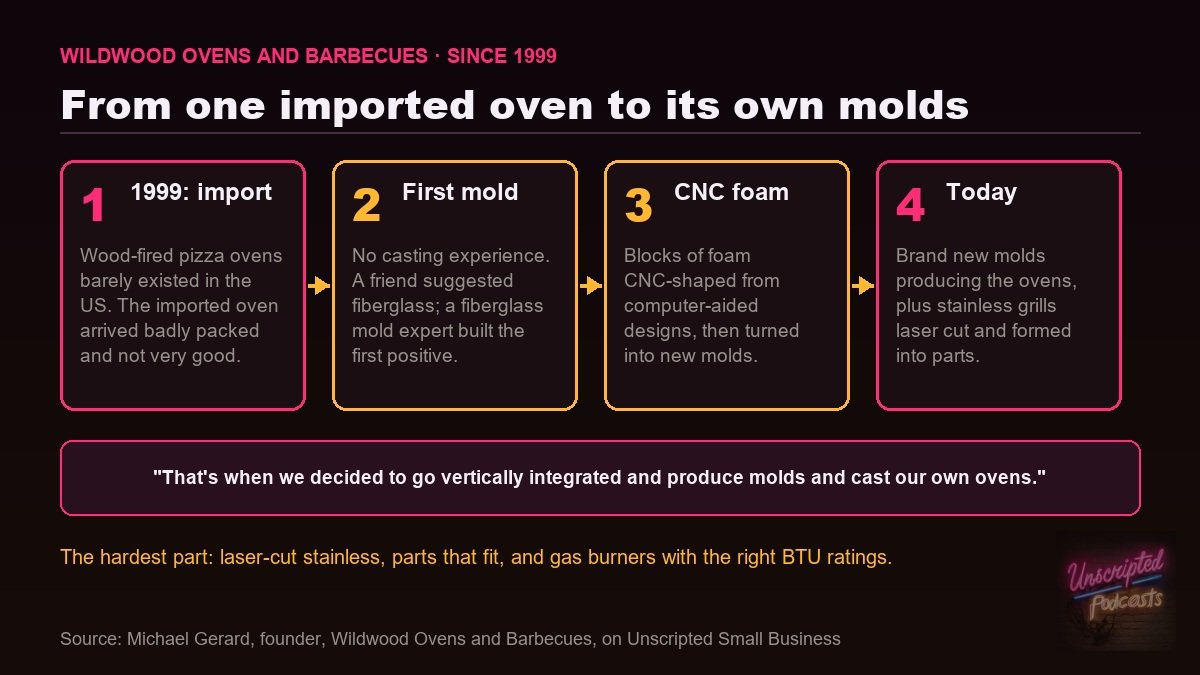
That decision is also why the hardest part of the business has been the grills, not the ovens. Laser-cut stainless, parts that have to fit, and a gas burner with the right BTU rating. “I didn’t come from that background,” he said. He’s over the hump now.
How do you market something nobody is searching for?
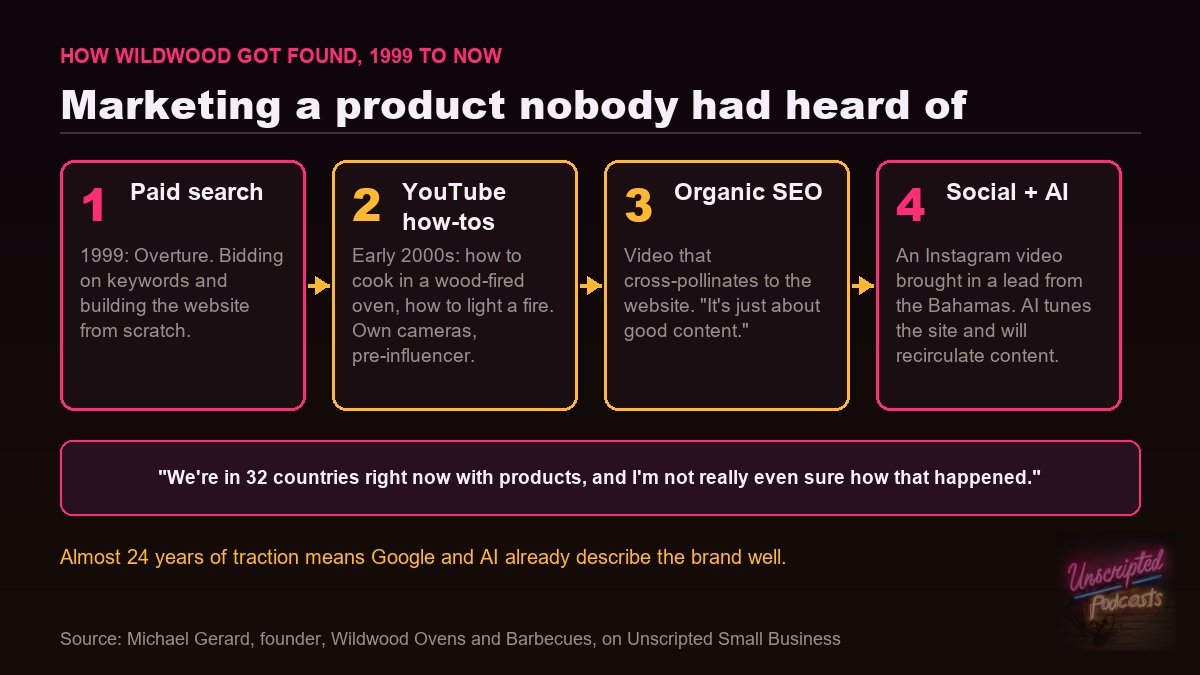
In 1999 there was no Google as you know it. Wildwood bid on keywords on Overture, built the website from scratch, and eventually moved from paid ads to organic search. The part that actually built demand was video.
“We started off, you know, in early 2000s by producing YouTube videos on how to cook in a wood-fired oven, how to light a fire.”
Michael bought his own camera gear to do it (and admits he regrets that part, because the tech changed so fast). There were no influencers to hire. He just bet that “there was a lot of people like me that would be fascinated in having a wood-fired pizza oven in their home.”
Twenty-plus years later the playbook hasn’t changed much. Asked how he approaches SEO now:
“That’s really always a game changer is the more content you have on YouTube that cross pollinates to the website.”
If you’re launching a product people don’t know to look for, here’s the takeaway: teach before you sell. A how-to video answers a question your buyer will have before they ever know your brand name. Anthony Prichard makes the same case from the SEO side in his video SEO interview.
AI is a tool before it’s a channel
Jeremy asked whether AI search was on his mind as a founder. Michael’s answer was practical. His web developer uses it on coding problems, and the team is starting to use it to tune the site “anywhere that it lacks as far as Google search friendliness.”
Does Wildwood show up when you ask an AI about it? He’s not worried.
“Google’s got us indexed very well if you get into AI and do the AI search for it. It’s got a really good description of who we are and what we do.”
That’s what 24 years of consistent content buys you. Next on his list: handing the day-to-day social posting to AI, because “we’ve got so much content I can put it into AI and just keep recirculating it on a calendar and a schedule.”
Sell to the chef, not the kitchen
Wildwood serves two markets, home cooks and commercial kitchens, and Michael has always gone after the commercial side through one person.
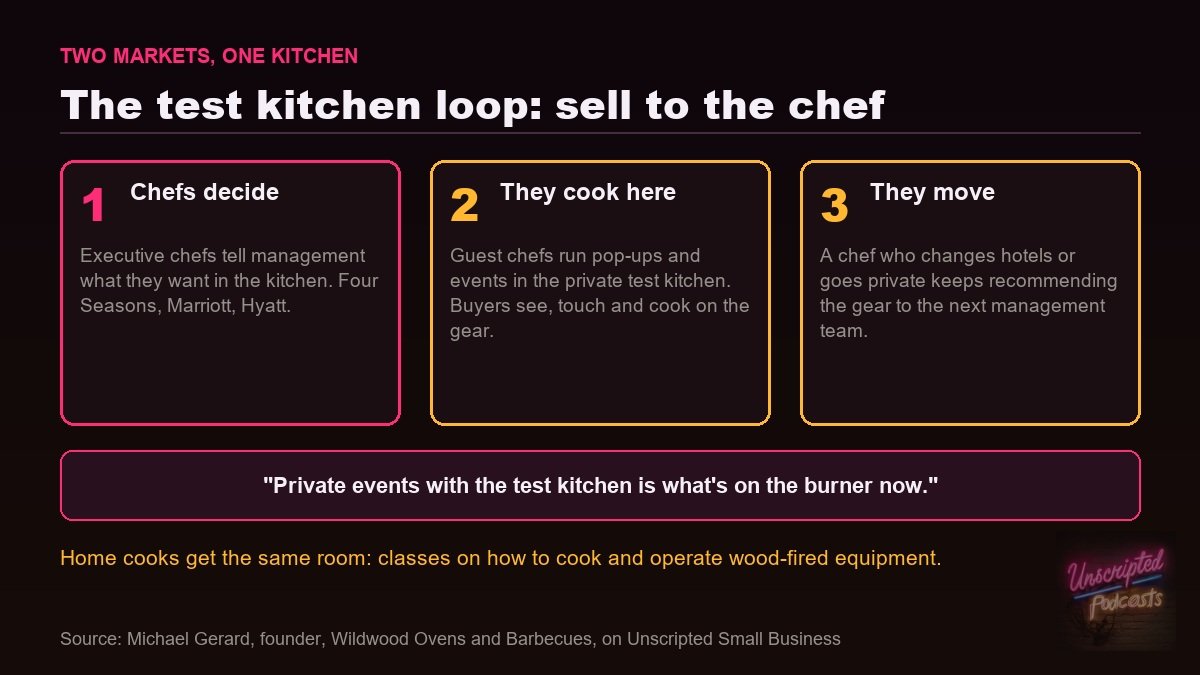
“The executive chefs are the ones that tell management what they want in their kitchen and management tends to listen to their chefs.”
Over the years that brought in Four Seasons, Marriott and the Hyatt Group. And because chefs move, the relationship moves with them. “They may move to a different hotel, they may move into the private sector,” but they keep recommending the gear.
Jeremy had seen the same pattern with a client in the fry oil business, whose content was talking to fry cooks with no budget instead of the chefs and owners making the capital investment. He tells that story in more detail in his conversation with Grady Teske. Ask yourself who actually signs off on your product. Then check whether your content is written for them.
The test kitchen does two jobs
What’s next for Wildwood is its private test kitchen. For home cooks, it’s a place to learn how to cook on wood-fired equipment. For the business, it’s a showroom that sells itself when guest chefs run pop-ups and events.
“Clients get to see the products, touch them, feel them, cook on them, watch a chef cook on them and then realize, hey, you know, they could take this home today or they can, you know, put it into their restaurant.”
He sees a revenue line in it too: a private dining experience two to three days a week, with limited seating and menus he calls “pretty crazy and off the hook.” The best days he remembers were teaching. Teach for America and KIPP schools came through for team building, and a Boeing vice president brought his family for an in-depth oven class. “I enjoyed teaching and passing on the knowledge.”
32 countries, and nobody planned it
“You know we’re in 32 countries right now with products, and I’m not really even sure how that happened.”
The Palace of Oman. Jordan. North and West Africa. A prospect in the Bahamas who found them through an Instagram video. Michael’s guess is web search, and the fact that the website has always said Wildwood will ship internationally. Put the answer to “can I buy this from here?” on the site and some of the world will answer it for you.
Tariffs are the other side of that global reach. Most of the stainless steel comes from China, which has hit the grill line. “Yeah, we’re fighting that.”
Bootstrapped, and ready to hand off marketing
Wildwood has been a bootstrap business the whole way. Michael’s next move is upper management, starting with marketing.
“I’m good at what I do, but I can’t do everything you know so I’m looking at bringing in management that’s adept at marketing could do a better job than me at marketing.”
That’s the founder moment a lot of you will hit: the business outgrows the person who built it, and the smartest thing left to do is hire someone better at a piece of it than you are.
His advice if you’re thinking of starting
Jeremy closed on the question he asks every founder. What’s the cornerstone advice for someone who thinks they see an opportunity?
“Be prepared to roll up your sleeves. Be prepared to work 12 to 16 hours a day.”
And the part that makes it doable:
“We’re living a golden time right now where there’s so much content and information out there that we can train ourselves to learn whatever we need to learn.”
He didn’t know how to cast an oven or calculate a BTU rating either. He learned.
Connect with Michael and Wildwood
- Website: wildwoodovens.com
- Instagram: @WildwoodOvensLA
- YouTube: Wildwood Ovens and Barbecues
🎧 Listen: Castos | 📺 Watch: YouTube
Keep going → Browse the interviews