🎧 Listen: Castos
This week on the Unscripted Small Business Podcast, host Jeremy Rivera sits down with Natalie Yuse, who started Deckhand Detailing in Seattle in 1990, about a year out of high school. She had never touched a boat. She is afraid of water. Today the company runs 25 employees and she runs the company.
“So as a 19-year-old, mean, yeah, I’m going to start a boat detailing business. It sounded great to me at the time. So that’s exactly what I did.”
If you have ever told yourself you need to know the trade, raise the money and polish the plan before you start, this one is for you. Here’s what 35 years of cleaning other people’s boats taught her about starting, hiring, customers and cash.
You don’t need the perfect plan. You need a bucket.
Natalie picked her business on three filters: low startup cost, something she could do physically and mentally, and work she’d take pride in. Car detailing crossed her mind first. Then she noticed there were “a million car detailers” and a city full of boats.
“And so I actually walked down to Marina and I asked someone who was out on their boat and I was like, I have a question, who cleans your boat? And they were like, well, we don’t know of anyone, do you? And I was like, I’ll be right back.”
She ran to the store for a bucket and soap. That’s the whole market research phase. Her first real job came from a crusty old sea captain who asked, in all seriousness, whether a girl could do this kind of work. She waited for the punchline. There wasn’t one. So she cleaned his dirty sailboat well enough that he kept sending her work, and that dock carried her through the learning curve. She tells the full story on the Deckhand Detailing story page, and it’s worth your five minutes.
Jeremy’s point here is one you’ve probably felt: not everything takes seed capital. A lot of people stay stuck in a job because the business they picture needs money they don’t have, when the business in front of them needs a bucket.
Fake it till you make it. Don’t fake it till you break it.
That line is the title of her second book, and it’s the most honest summary of starting out you’ll hear. The first half is the 19-year-old who knew nothing and went anyway. The second half is the lesson that cost her.
“And some of the things that I’ve learned along the way was, you know, saying yes to a job I should have said no to because it was more advanced than what I was ready to take on. And that hurt me a little bit and it set me back.”
She also makes a case for not knowing what’s coming. If someone had handed her a list on Monday of everything that would go wrong that week, including a day deep in a greasy engine room, she says she’d have quit for an office job. Nobody did, so she kept going, and every one of those weeks became part of the learning curve.
Her advice for you, if you’re waiting to launch:
“Don’t wait until everything seems perfect and, I’m ready to launch. Just go for it and get started.”
Train the customer to be a good customer
Letting go of the work was the hard part. When she cleaned every boat herself, she knew every boat was perfect. Growing meant hiring, training people well up front, and building a system for when things go wrong. Then she did something most owners never think to do.
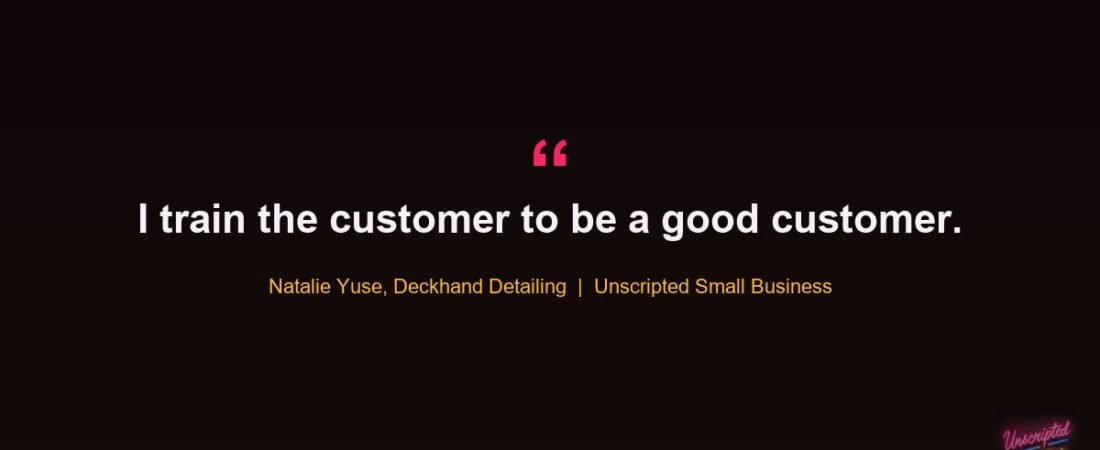
“I train the customer to be a good customer. I train them how to be a good customer. And I realize a lot of people say, the customer is always right. No, they aren’t. Sometimes they just don’t know.”
Here’s how it works in practice. A new customer spots a missed spot and gets upset. Natalie’s answer, more or less: the boat didn’t sink, did it? We’ll be happy to get it, and from now on, just let us know. She treats it as no big deal, so the customer learns it’s no big deal.
“And now we’ve got customers who we’ve had for 10, 20 years, who are like, hey, can you just send someone out whenever you get a chance? No big deal.”
Four other founders pushed back on the same old saying in Is the Customer Always Right? 4 Founders Push Back, if you want more angles on it.
Grow at a pace you can handle
Jeremy raised the trap every solo operator hits: the one big client who could double your business or sink it. Take them on and scale up fast, or let the white whale go? Natalie’s answer is slow growth, done on purpose. She’d rather be part of her company than an absentee owner, and she’s wary of the rush to make something big right away.
Seasonality is part of pacing too. Seattle boating is seasonal, but her business mostly isn’t:
- March through November is exterior detailing season.
- Winter is when her crews do interior boat detailing, the work she saves for the colder months.
- Boat shows help fill the slower stretches with more of that work.
If your trade has an off-season, the question is what version of your service still makes sense when the weather turns.
Cash flow, debt and the $50 bonus
Two lessons sit near the back of her book. The first is about money:
“You’re going to have some debt and that’s okay because that debt is gonna help you grow faster and further than if you were just waiting to pay for everything with cash.”
Cash flow, she says, is how you keep yourself from going into a hole you never climb out of. Five more founders weigh in on that in How Should a Small Business Manage Cash Flow?
The second is about people. She has handed new hires a $50 bonus just for doing good work, and watched them get floored because no employer had ever done that before.
“My employees to me are everything. They are allowing me to be where I want to be at any given time. And I know how hard they work.”
Boat detailing is hard work with high turnover everywhere else. Many of her employees have been with her for over five years, some over ten. She puts that down to flexible schedules and how she treats them, and to being able to tell them honestly: I’ve been in the trenches, so my job now is to support you. If you want to go deeper on that, read how to get employees to care about the business like their own.
Marketing a boat detailer in the AI search era
Natalie started with the Yellow Pages and an answering machine. Now she builds her own website, writes code for fun and keeps up with AI. Her estimate request form asks how people found her, and she says 99% of the time the answer is Google search. So she:
- Rewrites blog posts and site content around the actual questions people type into AI tools, not just keywords
- Works those long-tail phrases into social posts too
- Makes sure the business is listed everywhere it needs to be
- Tracks her rankings with tools that tell her when she slips
“And I think these days, you really do have to stay on that all the time. None of my competitors do that.”
Jeremy added a line from his friend Michael McDougald of Right Thing SEO: ChatGPT is your most popular but least trained employee, so give it the training material through your website. Then he made the case he and Matt Brooks of SEOteric keep coming back to: E-E-A-T is really a writing style, so write in first person. If your site says “the company has been on the water since 1990,” you’ve separated yourself from your own expertise. If it says what you learned, on which boats, and why, you’re the one an AI answer can cite. That’s the same argument Jeremy makes in The Interview Is the Information Gain: the stuff only you know is the part nobody else can copy.
Her books and courses
Jeremy promised on the episode to put these links in the show notes. Here they are.
- The Insider’s Guide to Boat Cleaning and Detailing, her first book, written during the 2008 recession. It also comes signed from the Deckhand Detailing book page. Readers who wanted to start their own detailing companies asked for training, so she built a three-day in-person course and trained people from across the country, Canada and even Wales.
- Fake It Till You Make It… But Don’t Fake It Till You Break It!, her second book: 30 lessons learned in over 30 years in business.
- Boat Detail Training, the online courses she built when COVID stopped people flying in, including a boat detailing business startup course.
Her next venture is Smarter Small Biz, where she’s building three online courses for small business owners: using AI for business, Online Marketing Demystified, and hiring and managing employees. It’s still in the early stages.
Connect with Natalie
- Deckhand Detailing: deckhanddetailing.com
- Instagram: @deckhanddetail
- Courses: boatdetailtraining.com
She got her start by walking down a dock and asking a stranger one question. So what’s the one question you haven’t asked yet?
🎧 Listen: Castos
Keep going → Browse the interviews