Unscripted Small Business Podcast
Your Business Isn’t Stuck. It’s In A Stage.
Matthew Pohl of The ReWild Group on why complexity is counted in people, and why the rulebook that got you here is often the thing keeping you here.
🎧 Listen: this episode on Castos · the whole show · More interviews: the full archive
Matthew Pohl is the founder of the ReWild Group in Denver, Colorado. He works with owners on a stages-of-growth roadmap, and what makes it genuinely useful is how low the entry price is. You do not need a valuation, a consultant, or a five-year plan to use it. You need your employee count. Host Jeremy Rivera talked with him for about 38 minutes on Unscripted Small Business, and it is one of the most practical conversations the show has had.
Why Matthew Cares About This
Pohl and his wife, who is also his business partner, ran a company together for twelve years before they had it valued. The number disappointed them. The business had been flat for roughly a decade and they could not explain it. Looking for an answer, he found a researcher who had mapped how businesses change as they grow, and he started running his company by that map.
Three years later revenue had tripled, the team had gone from about eight employees to 40, and they sold for ten times what the business had been valued at in year twelve.
Start By Counting People
The stages have nothing to do with how old your business is or how much it sells. They are about complexity, and complexity comes from people.
“But it’s rather the number of people in the business that really are the highest correlation to this level of complexity.” — Matthew Pohl
The Stages, In Plain Numbers
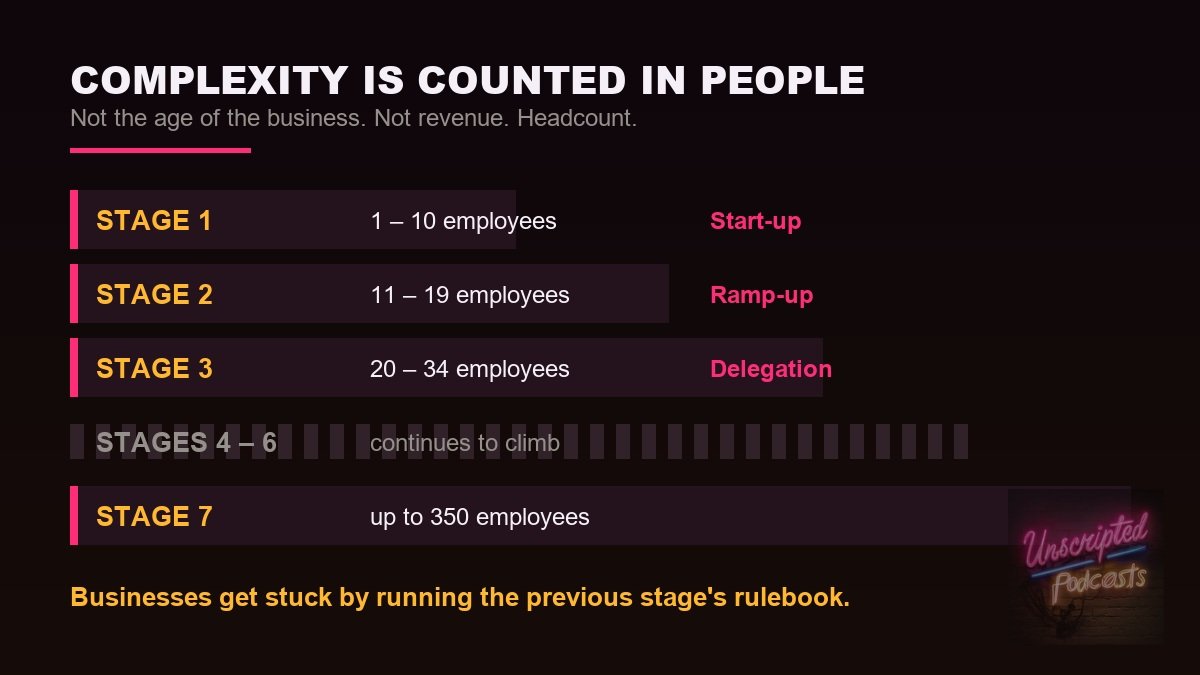
“So if you have one to 10 employees, you’re in stage one. If you have 11 to 19, you’re in stage two. Stage three is from 20 to 34 employees. And it continues to go up until you hit stage seven.” — Matthew Pohl
Stage seven runs up to 350 employees. Stage three has a name that tells you exactly what it demands of an owner: the delegation stage.
Why the number matters at all: “it’s really this level of complexity that drives how that business needs to be operated.”
And here is the part that explains the wall so many owners run into. Businesses get stuck “primarily because they are dealing with stage specific challenges and they’re trying to use an old rule book”.
The playbook that got you here is often the exact thing keeping you here.
Stage Two Is Called The Ramp-Up
Asked to make it concrete, Pohl picked a backyard pool installation company sitting in stage two.
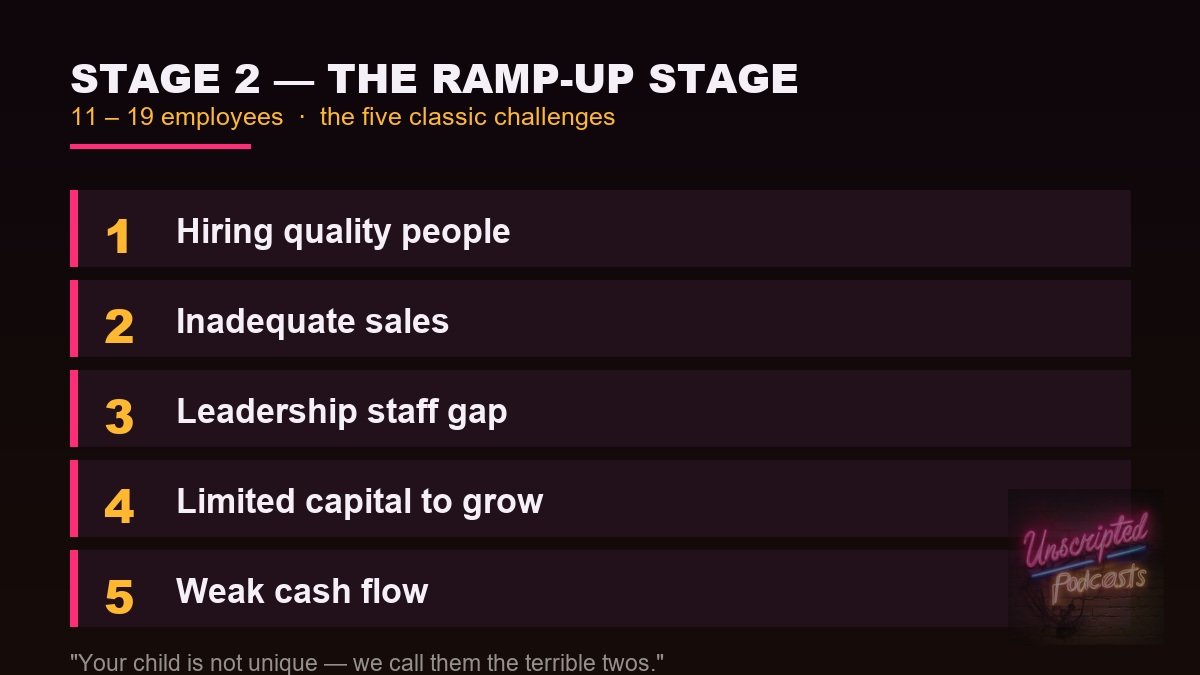
“Stage two is what we call the ramp-up stage. It’s 11 to 19 employees.” — Matthew Pohl
Five challenges show up in stage two so reliably that his team calls them the classic challenges:
- Hiring quality people
- Inadequate sales
- Leadership staff gap
- Limited capital to grow
- Weak cash flow
Hiring is hard here for a reason that has nothing to do with you being bad at it. “you’re doubling the size of your organization from stage one. You haven’t hired that many people, so you’re not necessarily very good at hiring and finding candidates and onboarding and all that kind of thing.” Often the roles have not even been defined yet, so “So you don’t even know who you’re trying to hire, what positions they’re supposed to be filling.”
The leadership staff gap is the quieter one. At five people you are in everything. At fifteen you cannot be.
“You don’t communicate as directly with the entire team as frequently. And so there’s this distance that starts to be created between the team members and you as their leader.” — Matthew Pohl
He also pointed out that “the research is industry agnostic”, so a landscaping company, a pool installer and a professional services firm hit the same fundamentals.
You Do Not Have A Personal Failing, You Have A Teenager
This was the best stretch of the conversation. Pohl compares stage challenges to raising kids, and the comparison does real work.
“your child is not unique, we call them the terrible twos” — Matthew Pohl
“So knowing the challenges helps you understand that it’s not you as a business owner you’re failing, that it’s your problem. No, you just have a teenager and you have to deal with it.” — Matthew Pohl
“No matter how good of a parent you are, you’re going to get some of that teenage vibe when your child is a teenager.”
If you are stuck right now, the odds are very good that you are stuck in a normal place, at a normal size, for normal reasons. That is not permission to ignore it. It is permission to stop taking it personally and start working the actual problem.
What If You Do Not Want To Grow?
Plenty of owners want a good business rather than a big one. Pohl hears the question constantly.
The roadmap still helps, because it is “a best practices for how to be healthy in a given stage.” A healthy business is more resilient when the market turns and more profitable while it is calm, which makes it more enjoyable to own at any size.
But he added a caution worth sitting with. A lot of owners who say they do not want to grow actually tried and got pushed back. “around ten to twelve employees all of a sudden things got really wonky.” Staying small on purpose is a choice. Staying small because growing felt too heavy is something else.
Adding A Second Location
If you are expanding into another city or another state, the stage rules still apply and you get a new problem stacked on top of them.
Peter S. Bergeron heard this episode and pushed back on headcount as the measure of complexity. In his view, a second location is really a second company, with its own suppliers, costs and controls.
“Yeah, I would say multi location has its own challenge, right? Whether that’s just opposite ends of a metropolitan area, two different states across the country, obviously each of those distances creates unique challenges.” — Matthew Pohl
His answer is written, shared values. Core values are your promise to your team. Brand values are your promise to your market. When people cannot see each other every day, those written promises are what hold the culture together.
Does AI Change Any Of This?
Short answer, no, and he explained why cleanly. His model was never counting dollars.
“revenue is not a function of complexity” — Matthew Pohl
“We’re not focused on revenue. We’re focused on the people. Because people are where the complexity is created because you have individuals who have to communicate and interact and work together.” — Matthew Pohl
Double your revenue with AI while keeping ten employees and “you’re still in stage one, even though your revenue doubled.” He does expect revenue per employee to shift a lot over the next few years. The stage math stays where it is.
The Story Behind The Framework
Asked what previous interviewers never think to ask him, Pohl talked about his parents. They ran an interior design business for twenty five years.
“one day they went to the store, locked the door, and handed the keys to their landlord. Their business failed. They walked away with nothing.” — Matthew Pohl
“My parents ended up on welfare food stamps.” His father took work as a busboy and a dishwasher. “he never really recovered from that. He was never the same.”
“He was an amazing interior designer. But he didn’t understand what he needed to do to run a business.” — Matthew Pohl
That gap between being excellent at the craft and knowing how to run the business is the whole reason ReWild exists.
“our mission is to multiply the number of exceptional businesses globally, because exceptional businesses not only benefit the owner, they benefit the people that are part of that organization.” — Matthew Pohl
If You Ever Want To Sell
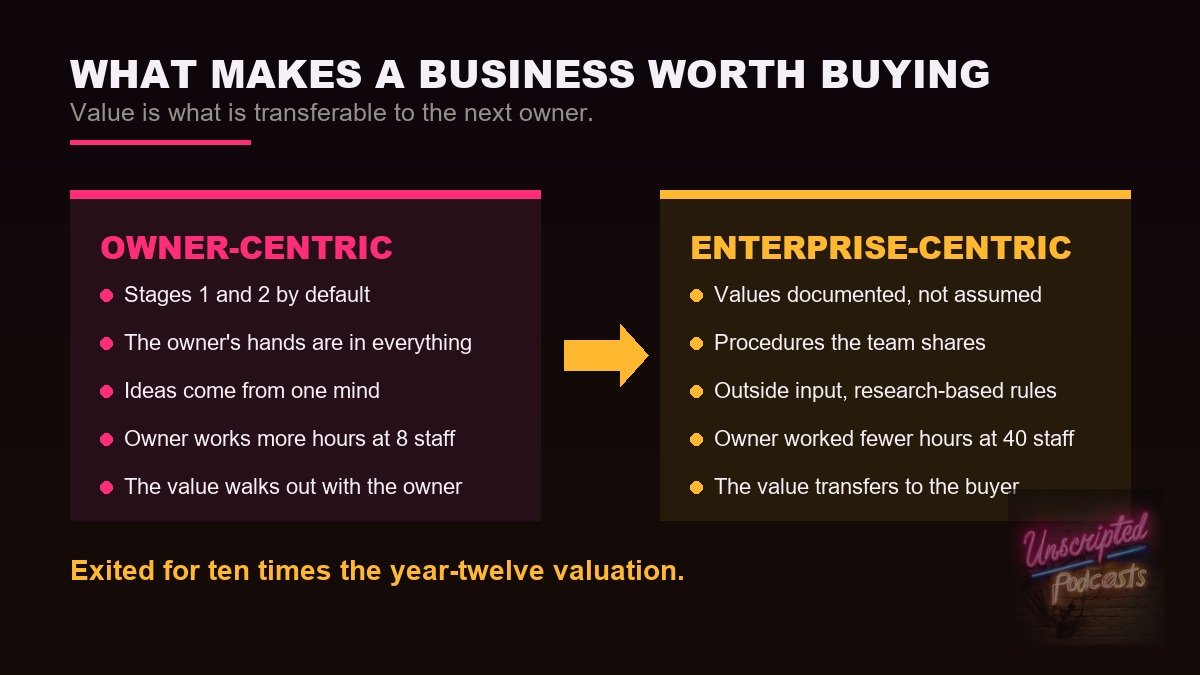
The conversation got into exits partly because of an earlier episode with Brandon Moon, who does end of life consulting for businesses. Jeremy called him the death consultant for businesses on that show, which is Jeremy’s label and not his. You can listen to that one here.
Pohl’s rule for exit value is short and it is not about multiples.
“You have to understand that the value of a business is what’s transferable, what the next owner gets out of that. And if a lot of the business is you, when you walk away from that business, that value leaves with you.” — Matthew Pohl
The proof that his own business had crossed over into something a buyer would pay for:
“I was working more hours when I had eight employees than when I had 40 employees.” — Matthew Pohl
How To Find Your Stage
His advice is one sentence long: “The first step is to calculate your stage”. ReWild has a stage calculator, a page of free resources, and stage two resources if that is where you land. Matthew has two book series, eighteen titles in total on Amazon, and ReWild runs a network of certified coaches and advisors for owners who want hands-on help.
If you want more reading first, start with his own seven stages roadmap and his piece on reducing owner dependency in the delegation stage.
Connect With Matthew Pohl
Matthew Pohl is the founder of The ReWild Group in Denver, Colorado. You can read more about Matthew, run the stage calculator, or work through the free resources.
For the other half of the transferable-value argument, Gil Vaisman on wanting to be useless in his own business is the operator’s version of what Pohl describes at the stage level. And two of stage two’s five challenges are money problems, which Meaghan Wall on why cash flow outranks revenue takes apart in detail.
🎧 Listen: this episode on Castos · the whole show · More interviews: the full archive