🎧 Listen: Castos | 📺 Watch: YouTube
This week on the Unscripted Small Business Podcast, host Jeremy Rivera sits down with Peter S. Bergeron, author of The Trapped Operator and the founder of Wrestling Against Time. Peter grew up inside his father’s business, got fired from it at fourteen, came back at twenty-nine, and was the one who had to close it in 2020.
He went looking for what went wrong. What he found was that his family’s ending was the rule, not the exception.
“Found out our ending was more the norm than the exception, led me into other questions, which led me into finding out that small business continuation as a whole is even worse than small family business.”
Peter has also published his own version of this conversation: why doing everything right can still feel like survival mode, on 12fatalissues.com.
The job that shows up after you launch
Peter’s framework looks at small business from an angle most owners never get taught.
“More looking at the business of running a small business and what it takes behind it and those pieces to the job when someone launches a company that they don’t know is coming and what comes around it and eventually, as I call it, ends up trapping them inside their organization.”
The people who get trapped, he says, are usually the good leaders. They treat staff as a team, not a cost line, and they step in to absorb the risk every time something goes sideways.
“Think of it as that great team lead you’ve had in a corporate job who says, make sure you take your weekend and I’ll step in and take care of it this weekend. That type of leader, that’s that small business leader who ends up in that trapped mode.”
And most of them were never trained for the business side at all.
“The majority of small business owners came from a different field. So again, you step in and you think of how it’s done elsewhere, but you’re kind of loosely putting it together, like we kind of do in our own life. We all run a household, but we all do it a little different.”
Education, experience, and what you can hire
Jeremy skipped college, then later hired a classmate who finished his degree. He asked Peter where education actually earns its keep. Peter, who is working on a doctorate, did not defend his undergrad.
“My undergrad degree did not prepare me for anything, ’cause I wasn’t actively learning in it. So there was zero value. There was more value in what I knew about business from all my years of being at the kitchen table.”
“The skill side, most of that we can hire actually, if we’re really good at it. We can assemble good teams.”
The catch is that in a small business, the person with the product idea and the person who owns the business are the same person.
“It’s almost as if they’re two separate pieces, but in small business we’re that same person. And that’s that complexity that starts adding to it right away. You are the product driver, but you own the business too.”
The accidental business owner
Jeremy talks to a lot of roofers and contractors whose first love is swinging a hammer. Peter knows the type. His brother-in-law’s family started a foundation company exactly that way.
“It starts off good, it’s just a truck or two and everything’s great, and then you expand a little bit and you have four trucks. And all of a sudden you’re no longer out doing the hammer swinging, you’re no longer on site doing the stuff you love. You’re back dealing with the bank on a ratio. You’re back at the home office dealing with the insurance renewal.”
His answer is not to hand the keys over. It is to build bumpers, so the owner keeps visibility and control while someone else handles the bank.
“Now you have a business that can transfer to somebody else later. Now you have a business that is moving and supporting itself, as opposed to you stepping in as the backstop to everything, which happens so often.”
Plain words, not finance jargon
Jeremy asked for the vocabulary that bushwhacks owners. Peter went the other way: strip the jargon out. He taught business finance at a community college in Southwest Florida and threw out the international finance chapter for what a lender will actually ask.
“They wanna know your debt service ratio. How much is your debt payments, your total debt payments, versus your income? That’s what your bank’s gonna care about.”
“Your line of credit is gonna be your receivables and it’s gonna be your inventory. It’s gonna be fifty percent of your inventory, seventy, eighty percent of your receivables.”
Same with customers. Skip the ratios and look at one number first: customer concentration, and keep any single customer under thirty or forty percent.
How a trapped operator gets out
Step one is naming it. Peter’s team built a six-question snapshot that shows owners where they think they are. The surprise is how often the feeling and the numbers disagree.
“You’re acting like you’re talking about that you’re operating in survival mode, meaning like you have all the issues going, finance doesn’t feel secure. But when we look at the metrics, the statistics of it, you’re actually doing quite well.”
If an owner is not sure where they stand, Peter starts even simpler: a tally sheet by the desk.
“If you say your role is chief marketing officer and you’re answering questions about production orders, you’re answering questions about accounting ratios or payroll HR issues, that’s not fitting your structure.”
Fire prevention before you start
For solo founders stacking every hat on one head, Peter’s advice is to plan the offload while you still have time to think.
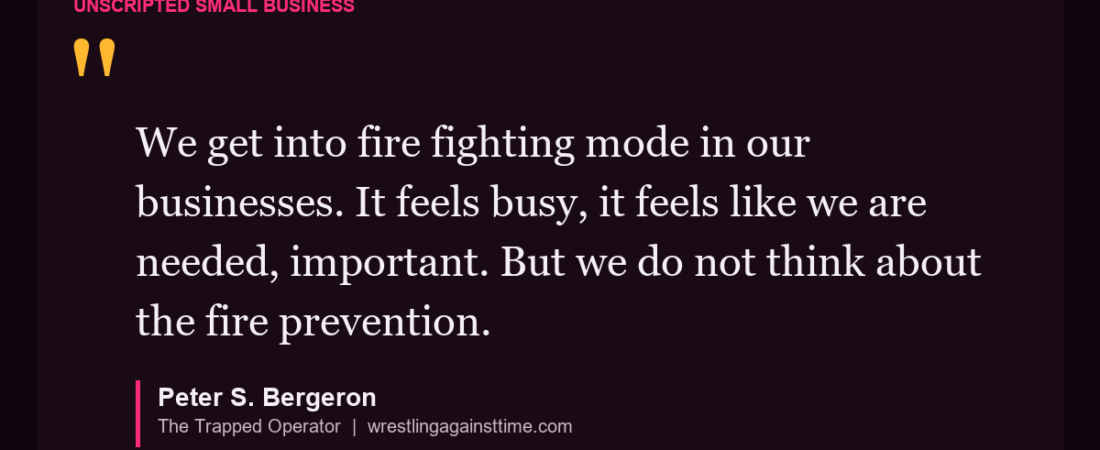
“We get into fire fighting mode in our businesses, it feels busy, it feels like we’re needed, important, those same type of traps, but we don’t think about the fire prevention. The best time to build the fire prevention is before you even start anything.”
That includes the exit. Partners who write the dissolution terms into their operating agreement on day one are doing it right. Peter borrowed his father’s line about drivers who pull out of the driveway without a destination.
“I’m starting my business. Okay, how do you want to get out? Well, what do you mean how do I want to get out? I’m just starting. Okay, but you’re heading somewhere, and the where has to be getting out.”
Jeremy brought up Brandon Moon’s end-of-business consulting, and Peter told the story of a friend who did everything right, bought his practice for pennies on the dollar, earned a great living, and still wonders if he left something on the table.
A second location is a second company
Jeremy has consulted for a manufacturer of precast concrete walls in Florida that wants nationwide reach, which means a second hub in Houston. Peter pushed back on a guest from an earlier episode on growth stages who used headcount as the measure of complexity. Location, he says, matters more.
“Wait, Houston, that’s a different area for getting raw materials. Yeah, it seems like it’s the exact same, but the costs are really going to be different. And are we thinking about that? So now our financial controls and how we evaluate it changes.”
Then add customer type on top: cash, credit, government, or an international buyer paying by letter of credit when the goods land on the dock. Each one is another layer of the second job.
AI as a force multiplier, not a hammer
Jeremy quoted Matt Brooks of SEOteric, who calls AI your least trained customer support rep, and asked whether AI for small business is real firepower or a production line for AI slop. Peter sees firepower, with a condition.
“The downside with AI is that you can so rapidly create something that may have nothing behind it. So even that term, framework, loses some of its luster, because you can just type it in and go, create my framework.”
Jeremy’s rule is to aim AI at one specific problem. The Ignitvio lead response study mystery-shopped 1,824 local businesses and found 68 percent never replied within 24 hours. That is a job for a tool that never sleeps. Peter agreed.
“That’s what you want the AI to be doing, is that repetitive work, the administrative task and things like that, so that you have the opportunity to have that deeper thinking about a strategic problem or a customer retention problem.”
“But finding the best practice, that’s still inside us, I believe.”
You’re not alone
Asked for the one thing to remember, Peter did not pick a metric.
“They’re not alone. And that’s one of the things that I actually hear more often than I expected, is a loneliness of business ownership.”
“You say, I’ll take the sacrifice and I’ll work the extra hours, or I won’t deposit my check this week. You’re not the only one who’s done that. Others have done that. We don’t need to be doing that. Let’s step back and figure out why we’re doing that and reset.”
Peter’s simplest diagnostic costs nothing: keep a tally by your desk for a day. Write the hat you say you wear at the top, then mark every question you answer that belongs to someone else’s hat. Those marks are the roles you will hire for first.
Connect with Peter
- The book: The Trapped Operator, where the bonus materials live
- Diagnostics, articles, playbooks and courses: 12fatalissues.com
- His IP library: wrestlingagainsttime.com
- LinkedIn: Peter Bergeron
🎧 Listen: Castos | 📺 Watch: YouTube
Keep going → Browse the interviews