🎧 Listen: Castos | 📺 Watch: full episode on YouTube
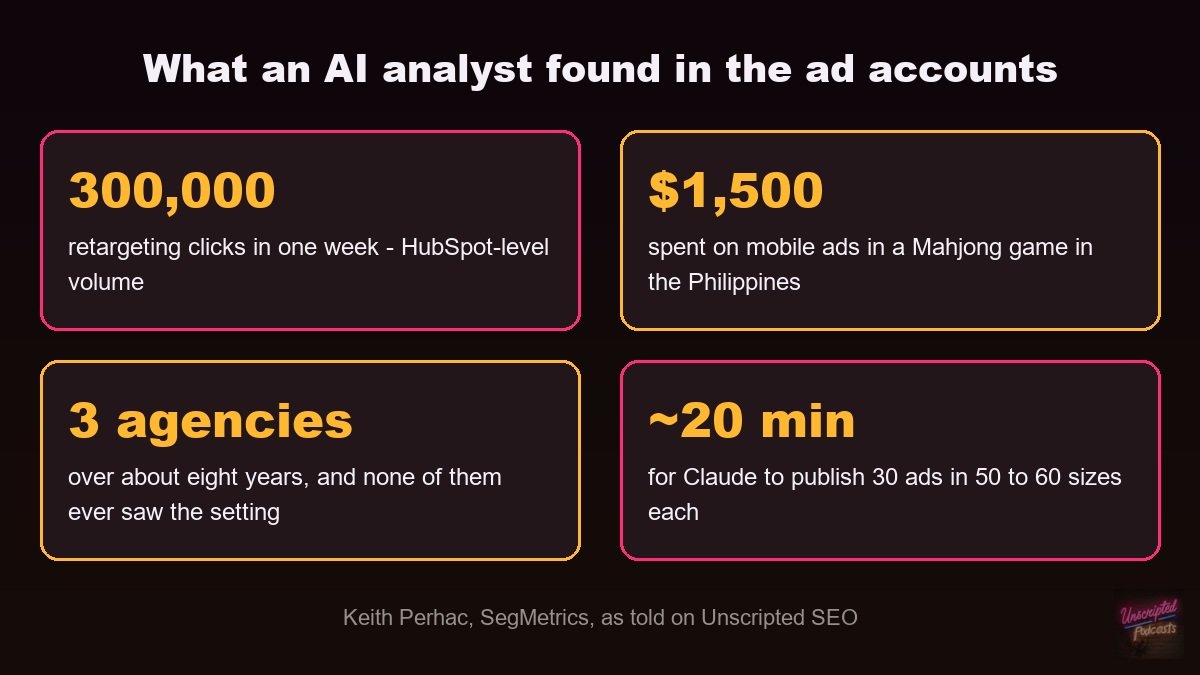
If you pay an agency to run your ads, you get a weekly report that says things are fine. Keith Perhac got those reports too, from three different agencies over about eight years. Then he pointed Claude at his ad accounts and found $1,500 spent on mobile ads inside a Mahjong game in the Philippines. Keith is the founder of SegMetrics, attribution software that puts a dollar value on every piece of a marketing funnel, and before that he ran a conversion rate optimization agency. On this episode he and host Jeremy Rivera talked about how you audit your ad spend with AI, what attribution actually means for an owner, and why your website is now the end of the funnel instead of the front door.
Three agencies missed a $1,500 leak in eight years of ad reports
The clue was a number that was too good. One week’s report showed roughly 300,000 retargeting clicks. Keith knew his business doesn’t have that many people to retarget. That’s HubSpot-sized traffic, in a week. So instead of asking the agency, he asked Claude, which was already connected to SegMetrics and through it to every ad platform he runs.
Claude found that the top-level settings looked right, “but there were a couple of settings deeper down that were overriding it.” An expanded-audiences option had been switched on somewhere below the main ad, and it bled into the others. That’s where the Mahjong money went. Keith’s reaction is the one you’d have:
“And I was like, we did who with the what now?”
It wasn’t the only leak, and nobody had caught any of them. “We had had three agencies work with us over like eight years. None of them ever saw this.” Keith doesn’t blame them. “It’s no one’s fault, but it’s just marketing is so complicated right now that it is impossible to see.” One ad platform alone has enough nested settings to hide a problem for years, and you’re probably running two or three.
How to audit your ad spend with AI, the way Keith runs it now
Keith didn’t stop at one fix. He moved the whole routine into Claude. Here’s the loop he described, and you can copy the shape of it even if your tools are different:
- Connect the data first. Claude works through SegMetrics, which is hooked up to the ad platforms, so it can see spend and results in one place instead of five dashboards.
- Ask about the number that looks wrong. Keith’s whole find started with “just go figure out why.”
- Let it report on a schedule. “I go in three times a week. Claude pings me and says, Hey, here’s how it’s going. Here’s what I recommend.”
- Argue with it. “I push back, I say, really? Do you think so?” The recommendation that survives the argument is the one that ships.
- Have it check its own math. Every answer SegMetrics gives Claude also shows the report it came from, so Keith can see the numbers behind the advice.
The result: “now we’re getting actual freaking leads for really affordable prices in the industries that we want.” If you want the full checklist version, the SOP for auditing ad accounts for hidden spend leaks on SEO Arcade turns Keith’s story into steps you can run this week.
Trust, but verify, and watch for confirm fatigue
Handing your ad account to an AI has a cost, and Keith named two. The first is trust. “I’m a big proponent of trust, but verify,” he said, which is why the report sits next to every answer. The second is you. He calls it confirm fatigue: “Where you keep pressing enter because you’re like, Yes, Claude, do that.” After enough of those, “We stop thinking critically about some of them.” If you’ve ever approved a change without reading it, you know the feeling. Keith’s scariest moment is a Claude message that starts, “I was blocked by the sandbox.”
Attribution for owners comes down to two questions
Attribution sounds like an agency word, but you already ask the questions it answers. Keith’s first rule:
“I think the first thing people need to understand about attribution is that it’s not a panopticon.”
Years ago a customer saw an ad, browsed, joined your list and bought. Now Keith has “five devices sitting on my desk right now,” and your customers move between Google, social media, AI chat, Facebook ads, YouTube and Reddit before they ever call you. Trying to map every step is a losing game. So he splits it into two questions:
- First touch: “where did people first find out about me?” That’s how you acquire customers.
- Last touch: “what is the last thing they did before they opted in or purchased?” That’s what makes them convert.
Everything in between is the messy middle. Jeremy’s example is a buyer who finds you through AI, takes it to Google, emails it to their spouse, who runs her own search and sends it back, and the visit lands in your analytics as direct traffic. Keith says the middle still matters, but only when you have a choice to make, like whether to spend more time on one social channel or one blog post. His filter for any report: “what is the decision you’re gonna make from it?” Rich Thomas on letting AI bring the lead and a human close it picks up the same messy middle from the sales side, and Rich M. Smith on attribution you can defend shows how to test one region when the numbers won’t settle the argument.
Your website is the end of the funnel now
For years the website was the center of everything. Your ads, your social posts and your SEO all pointed back to it. Keith, borrowing from Rand Fishkin and Amanda Natividad’s work on zero-click marketing, says that’s flipped. “The value of the site has gone down,” he said, and then he put it this way:
“It’s the end of the funnel. It’s that conversion play is your website. And the awareness is social media. It’s ads, it’s LLMs, it’s all this stuff around it.”
That doesn’t mean you stop caring about search. “The SEO has not, it has not gone away. It’s just changed where it’s being like leveraged.” What changed is where people form their opinion of you before they visit. When someone asks an AI tool whether SegMetrics is any good, Keith says, “It’s looking not only at my website, but also at like Trustpilot, and it’s looking at social media and Reddit.” So your reviews, your Reddit mentions and your social presence are now part of your marketing whether you manage them or not.
And because AI leans toward the average, a single complaint carries more weight than you’d think. “You can have a billion glowing reviews and one bad review,” and the bad one still shows up in the answer. Jeremy’s version for owners: fix the product problem people keep complaining about, because an unhappy customer who posts on Reddit is now a search problem. For the trust side of this, Bruce Ashford on winning the humans and the AI models that recommend you is the next thing to read.
AI hides where your visitors came from
One more reason your reports feel off. When someone clicks a link inside an AI tool, the visit used to carry a referrer that told your analytics where it came from. “AI is now hiding that from the website,” Keith said. “Now they’re hiding it, so it looks like direct.” If your direct traffic is climbing and you can’t explain it, some of it is probably people who found you in an AI answer. Keith compares it to the year Google stopped showing you which search terms sent visitors. The industry screamed, then got used to it.
Chat is the new interface for the software you pay for
Keith barely logs into his own product anymore. “I think that chat is the new user interface for a lot of” software, he said, especially tools built on data, like project management and analytics. SegMetrics runs an MCP server, the connector that lets Claude talk to it, and Keith asks Claude how his webinar is doing instead of opening a dashboard. Claude also asks the follow-up questions a person would skip, like which industries the new signups came from, and “it chirps when we’re ready.”
For you as a business owner, there are two takeaways. First, you may already be paying for software you could query instead of click through, so check which of your tools connect to Claude or ChatGPT. Second, if customers or their bots ever need to do business with you, “this is why it’s important for businesses to have APIs.” Keith’s point is that even non-technical people now tell an AI to go update their contacts in Kit, and it reads the documentation and does it. If a bot can’t use your service, you’re missing “what’s going to be, I think, the largest use case of people using your software.”
Let AI build the ad sizes, and keep the weird ideas for yourself
Keith doesn’t use AI to write his copy or make his images. “It’s always you can always tell us AI.” What he hands off is the part he hated. He decides what the ad says and how it looks, and Claude builds the rest from his headshots and past designs: 30 ads across two platforms, 50 to 60 sizes each, motion and static, published in about 20 minutes, with a contact sheet so he can scroll through and approve. “It’s honestly freeing,” he said. If you want to try a smaller version of this, the AI Animated Product Ad SOP walks you through one polished product ad without an agency.
He drew the line at ideas. “AI is an average machine,” and marketing doesn’t move on average:
“You can’t do the same thing as everyone else and succeed in marketing. You have to do something different.”
Right now the different idea comes from the founder. Keith worked in Japan for most of his adult life and sees two approaches to AI at work. In Japan, it’s “we’re not firing anyone,” and everyone uses AI to get more done. In America, the dream is to push a button like George Jetson and send everyone home. As a small business owner he feels both pulls, since not having to hire twenty people to get the same marketing out is “a huge boon for me.” Dr. Gleb Tsipursky on why employees resist AI picks up that Japan comparison from the team side.
Start your ad spend audit with the number that looks too good
You don’t need SegMetrics to start. Pull last month’s report from whoever runs your ads, find the one number that seems too good or doesn’t match what you see in sales, and ask an AI tool with access to that account to explain it. Read the settings it flags, not just the summary. Then make it a habit, because Keith’s leak sat there through three agencies. Next for SegMetrics is SegMetrics.ai, which Keith calls “the doing layer,” built to launch ads and edit contacts instead of only answering questions, plus lessons on building that kind of engine “so that your marketing becomes proactive, not reactive.”
Try Keith’s moves this month. Write down your two attribution questions: where do customers first find you, and what do they do right before they buy? Pick one ad account and ask an AI to explain any number that looks off, then check the setting yourself. Search your business name on an AI tool and see which reviews and Reddit threads it quotes back to you, because that’s the front of your funnel now.
Also on Unscripted Small Business
Keith’s point about tracking pairs with Kate Hendrickson on building a tracking system you’ll actually use, and why a 5% close-rate lift beats 20% more leads does the math on spending smarter instead of spending more.
This conversation first aired on Unscripted SEO. For the marketer’s version, read Keith Perhac on attribution and chat as the new SaaS interface, the first-touch and last-touch attribution breakdown on SEO Arcade, and Jeremy’s own take on why chat is the new SaaS interface.
Connect with Keith Perhac
- SegMetrics: segmetrics.io
- SegMetrics.ai, the doing layer: segmetrics.ai
- LinkedIn: Keith Perhac
🎧 Listen: Castos | 📺 Watch: full episode on YouTube
This episode is supported by our sponsors: uSERP, a GEO agency for brands that want to show up in AI answers; Oleno, which builds shared marketing context for AI tools so a whole team gets consistent results from Claude and ChatGPT; and ClearLead Digital, which does property management digital marketing for property managers who want more owner leads.
Sponsor disclosure: uSERP, Oleno and ClearLead Digital are paid sponsors of the Unscripted podcast network. Links to them are marked as sponsored.
Keep going → Browse the interviews