🎧 Listen: Castos | 📺 Watch: full episode on YouTube
Anil Gupta has a rule you already follow for your right shoulder – you’d never hand it over just because someone asked – and he wants you to apply it to your happiness. Anil is a relationship coach who goes by The Love Doctor, and on this episode of the Unscripted Small Business Podcast he told host Jeremy Rivera why he treats forgiveness as the fastest way to get your power back, why he says “languaging is everything,” the one question he’d have every spouse ask, and the three-foot rule he runs on everyone he meets. If you run a business, most of it works just as well on a rude customer or a stressed employee as it does at home.
Jeremy opened with the biggest question he could think of: what is love? Anil said most people don’t really know, and that changing your definition changes everything. He was careful to say his isn’t the only right one, but he thinks it removes a lot of pain and suffering:
“Love is acceptance.”
His example is a newborn. Parents accept the baby as is, and to them it’s the most beautiful thing in the world. Do the same with the people in your life, he says, and stop focusing on the things you don’t like. “Just accept the other person as they are. And that also means accept yourself.”
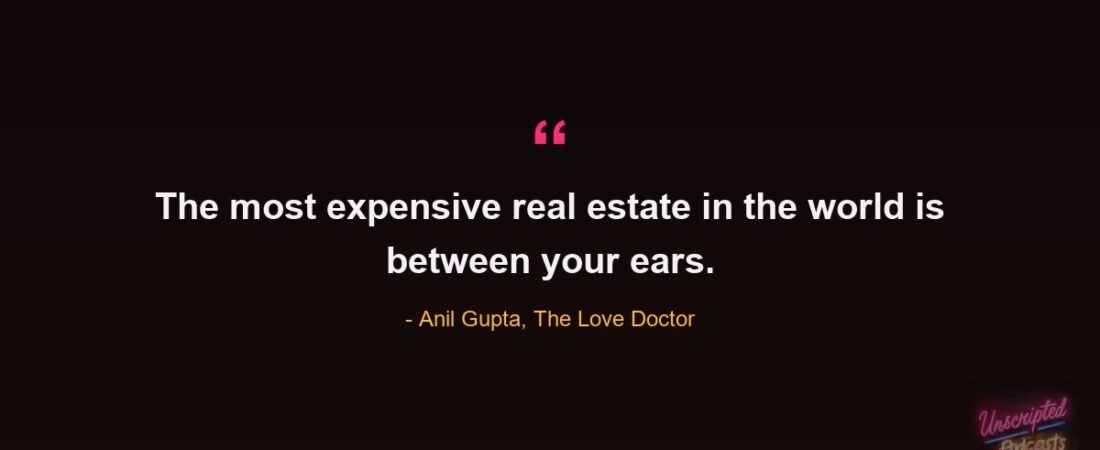
Forgiveness is the express pathway to freedom
When Jeremy asked whether people who hurt others mostly lack love for themselves, Anil said it’s a function of many things, including experiences, betrayal, or “a cry for help.” Then he went to what he’s noticed in people who live a richer, fuller, happier life: they can forgive.
“The quality of your life is dependent upon the depth and authenticity of the forgiveness you extend to yourself and to others.”
His view is that most of us never got the tools. “We were never taught how to forgive. We were never taught the art of giving, the art of gratitude, the art of growing.” He says it’s something we must teach our children.
The most expensive real estate in the world is between your ears
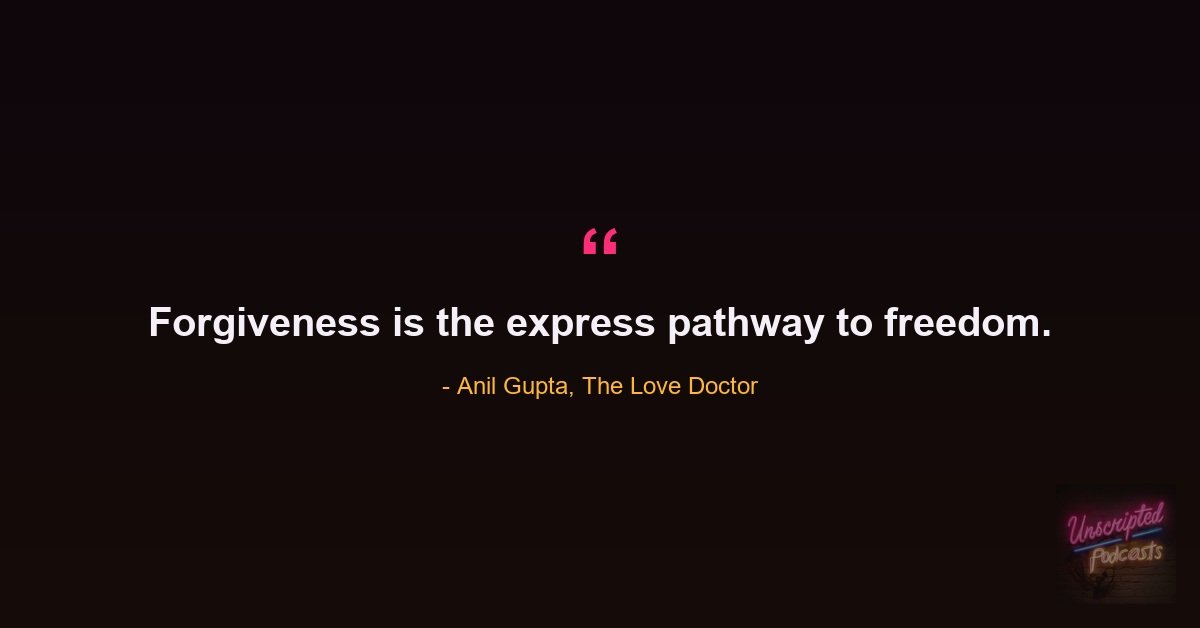
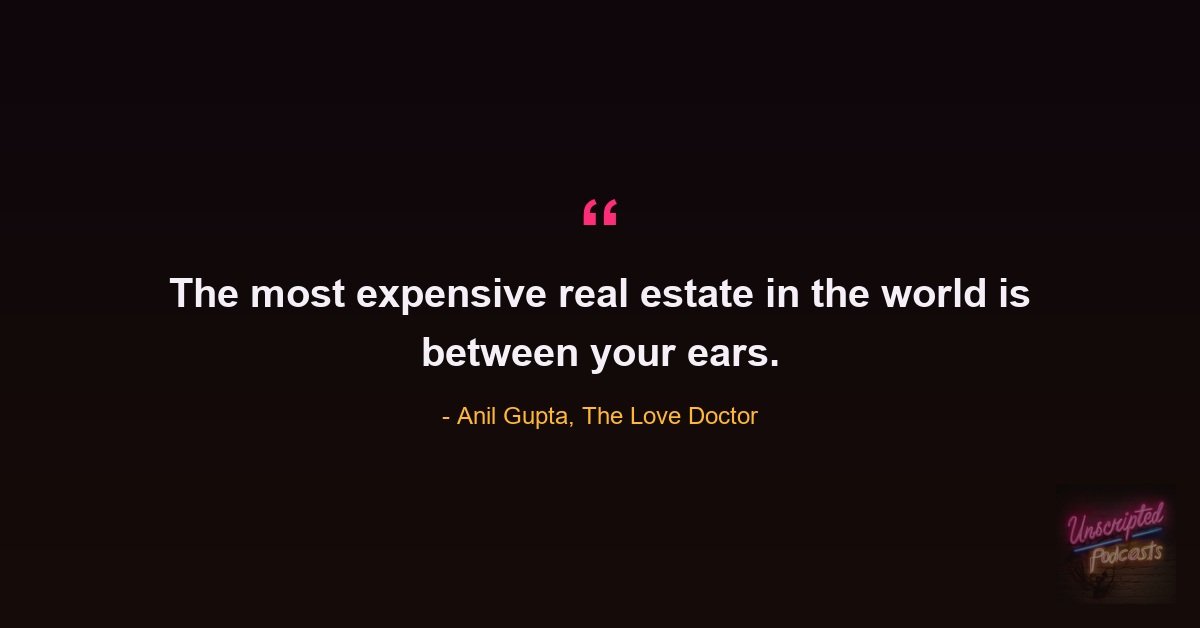
Jeremy pushed on the hard part. Why should you give anything to someone who took something from you? Anil answered with a house. Imagine you own your dream house, you invite someone in, and they start abusing you and the house. Would you let them stay? Of course not. “You see, the most expensive real estate in the world is between your ears.”
Holding on to what someone did, he says, means you get to suffer and feel the pain, and in his view it drains your energy and vitality. He was clear that forgiving isn’t the same as excusing. “So by you forgiving, it doesn’t mean you forget.” And:
“It doesn’t mean that you’re letting them get away with it, it’s just that you’re not giving them your power. There’s a big difference. Don’t give your power away.”
The part he called beautiful: “you never need to have that conversation with the other person.” You make a decision on your own. “Today’s freedom day. Today’s forgiveness day.”
The right shoulder rule
This is the line most people will remember from the episode. Anil asked Jeremy whether he’d rip off his right shoulder and hand it over if Anil asked. Jeremy said no. Anil’s reply:
“It’s a rule that you have, it’s a good rule, keep it. What if you had the same rule for your happiness? Under no circumstances will I give my happiness away.”
But we do give it away, he says, all day. “Someone cuts you up, you miss the bus, you missed the train, you didn’t get that promotion, someone said something to you, we give it up because we’re so good at it, because we practice it.” His alternative: “Something happens, I’m not gonna react. I’m gonna be this nonstick frying pan spray. Nothing’s gonna stick.”
If you own a business, try it on the next customer who’s short with you, or the vendor who misses a deadline. The call still needs handling. You just don’t have to hand over the rest of your day with it. Later in the conversation he named it directly when talking about couples: “The right shoulder rule. You decide not to.”
It’s all about intent, and growth is one of three G’s
Asked about nature versus nurture, Anil told a story instead. You see him, the love doctor, walking down the road holding hands with his wife, and suddenly he throws her to the ground. You’d think he’s a fraud. Then you ask a better question, and he tells you: “There was a poisonous snake just about to bite my wife. So I threw her to safety and got in the way.”
His point is that people will judge the action and miss the reason. “You can’t please all of the people all of the time. But it’s all about intent.” He remembers trying to paint a door as a kid: “my intent was to paint a door once and I messed it up. My dad was furious, but my intent was pure.” With age and maturity, he says, you learn where to apply your intent and ask yourself what you need to do to grow.
That growth is part of what he calls the happiness formula: “the happiness formula, which is G times G times G,” for give, grow and gratitude. On the grow side, he says “you have to grow emotionally, physically, spiritually, mentally, financially, and relationshipally.” His questions for doing it are plain ones: “Have I told my partner what she means to me? Have I told my kids how amazing they are?” For him, “It’s constant and never ending improvement.”
From optometrist to “a calling”
Jeremy asked about his background and “this particular business.” Anil pushed back on the word. “I don’t even consider it as a business, it’s really a calling.”
He says he was born in Kenya, his family moved to London in 1966, and he practiced as an optometrist for 20 years before he and his wife moved to America. Then 2008. In his words, “I was suicidal in two thousand and eight. I’d lost everything on the stock market real estate.” And then: “And I started helping people.”
If you’re struggling, call or text 988 (US) to reach the Suicide & Crisis Lifeline.
He says the events he ran grew from five people to ten thousand, and that he’s since written five bestselling books, including Immediate Happiness. He lists TEDx, Fox News, Sky TV, ABC, NBC and iHeartRadio among his appearances, says he’s spoken at Harvard, and says he’s coached Mike Tyson along with millionaires and billionaires. His site describes nearly three decades in love coaching. He framed all of it with one line: “It’s not what happens in life, it’s who you become.”
“And my identity was money. Now my identity is love.”
He left listeners with a question worth asking about your own work: “what is it you love to do, and why am I not doing it.”
Languaging is everything
Jeremy asked how people should handle trauma. Anil’s answer is about words. “So Jeremy, languaging is everything.” If he were coaching you, he says, he’d tell you to “never ever use the word trauma,” because in his view the label deepens a neural pathway. “I have trauma, that’s a label. So change it to I had an experience.” He applies the same idea to “cancer survivor,” which he’d reframe as “You are a cancer thriver, you beat cancer.”
That’s Anil’s coaching approach to language, not a clinical position. Trauma and PTSD are real, and if you’re living with either, a licensed clinician is the right person to talk to. Therapist Kinsey Morgan covered that side on this show in workplace trauma and EMDR.
The broader idea is one you can use with your team and your customers. “Keep away from labels.” And:
“Look at things as they are, not what they mean. As human beings, we’re meaning making machines.”
His example is his own. “My wife doesn’t call me back. I make it mean she doesn’t love me.” What actually happened? “All that happened was she ran out of battery on a phone.” We’re very good at catastrophizing, he says. His fix: “Change the languaging, ask better quality questions, and you’ll start to notice you’ll feel better.”
Labels start early. Jeremy brought up his eight-year-old son, who sometimes says “I’m stupid” after a mistake. Jeremy’s answer had been that his son isn’t stupid, he just made a mistake. Anil asked if he could coach him, and offered a sharper version:
“I know you are not stupid. You just did a stupid thing. And I do stupid things all the time, but that doesn’t make me stupid.”
Then remind the child of times they were smart, he says, because it changes focus. “And you gotta be certain.” His bigger image: if you walk into a dark room, you turn on the light, but “most human beings try and remove the darkness from their lives. All they have to do is be the light.”
One question to ask your partner, and a script for repair
Jeremy asked how couples adjust as both people change over the years. Anil said it’s very easy to get comfortable, and gave him a question to ask his wife:
“Honey, what can I do to make you feel even more loved?”
Keep asking “What else can I do?” until the list runs out, he says, then ask what makes her feel respected, and let her ask you both questions too. In his experience, “For men it’s easy. Good job, well done, I’m proud of you. Women want to feel safe, they want to be heard, they want to feel understood, they want you to be present.” And “remember the stuff you used to do, Jeremy, that you haven’t done for a while. That would rekindle so much.”
For the hurt that comes with real life together, he gave a script: “So honey, I know I hurt you. It wasn’t my intent to do so. Please forgive me. I love you.” Followed by: “Would you be open to letting this go and letting us create a brand new future?” He added that “hurt is a choice,” which ties back to the right shoulder rule.
One more piece he thinks strains a lot of relationships: when the kids arrive, they become the number one priority. “But if you continue to make your partner your number one priority, they will always feel loved and respected.” In his view, “The kids will see it and your capacity to give to them increases. Everybody wins.”
Everything we do, we do for a feeling
Anil’s read on why people act the way they do: “So see, everything that we do, we do for a feeling.” The nice car, the house, the money in the bank, all for the feeling they give us. When someone’s behavior is getting to you, he says, “focus on the person, not their behavior,” and acknowledge them before they ask for it. He told a story of coaching someone who said his dad had done nothing for him. When Anil asked what his father had done, the man started crying and listed it: an education, money when he needed it, help when he needed it. He’d been focusing on the behavior.
That habit, acknowledging people before they ask, works with a front-desk team or a long-time customer as well as with family. So does Anil’s observation about how we invest in ourselves: “A lot of people want to earn more money, so they get a business coach.” We hire trainers to get fit. “But how often do you get a relationship coach or a relationship expert helping you in your relationships? We don’t, because we think we can handle it.”
“But we can handle it, but we’re not optimizing it.”
Be so amazing that you cannot be ignored
Jeremy asked for one sentence he’d give everyone in the world. Anil said he had the perfect answer:
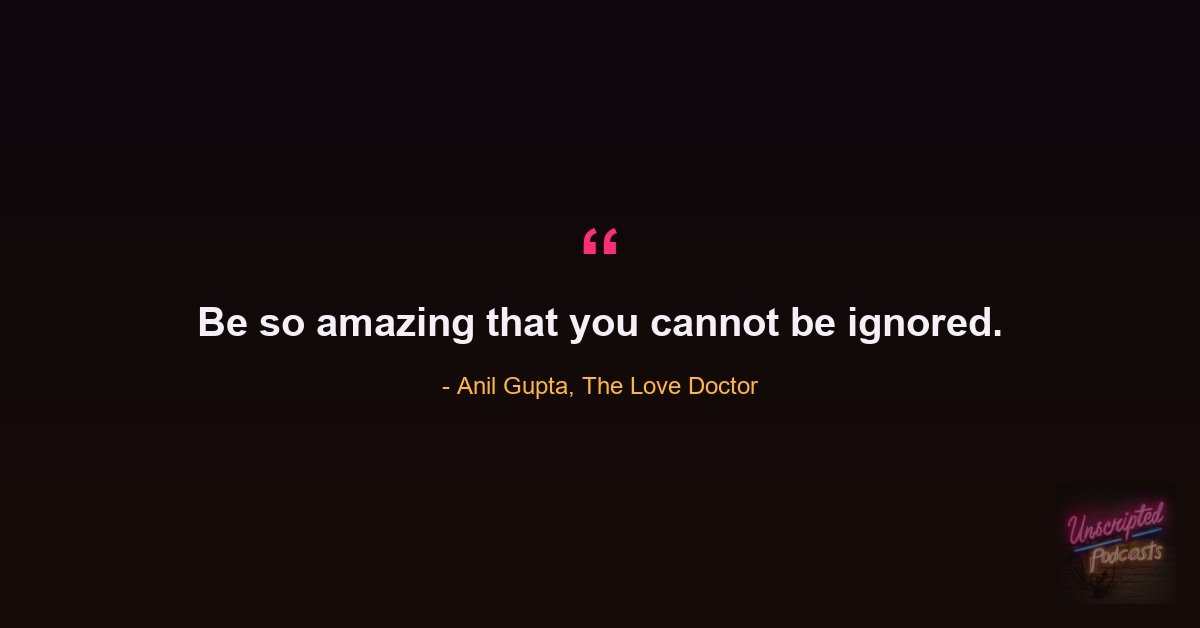
“Be so amazing that you cannot be ignored. And if you are ignored, it doesn’t matter because how you show up will be the best version of you.”
He practices it with what he calls a three-foot rule: “Anyone who comes within three feet of me, I’m gonna say something to them, compliment them, make a joke.” The reason: “We never know what other people are going through.” He says five or ten seconds of kindness could change someone’s day, even someone in a very dark place. He coaches some of the smartest, richest people on the planet, he says, and when they tell him their stories, “they’re going through hell and we just don’t know.”
His advice for those moments is short: “Just be kinder. You know, instead of reacting, respond.” And “a candle can light a million candles.”
For a small business, the three-foot rule is a service habit you can teach. Everyone who walks in, calls or stands at the counter gets acknowledged by name or with a kind word before anything else happens. It costs nothing, and it changes how your place feels.
Pick one of Anil’s habits and run it for a week. Use the right shoulder rule the next time a customer or vendor tries to ruin your afternoon: handle the problem, keep your happiness. Ask your partner “what can I do to make you feel even more loved?” and keep asking “what else?” Try the three-foot rule at your counter or on your calls. And take his closing challenge: “So today, just perform five acts of random kindness. Notice how you feel.” If you want more from Anil, his book is Immediate Happiness, his free video library is on his site, and you can request a call with him.
Also on Unscripted Small Business
Anil’s pivot from money to a calling pairs with Dr. John A. King on purpose over motivation, and Julika Novkova on the human side of small business picks up his point about how owners think and feel.
Want the step-by-step version? Use the free Right Shoulder Rule SOP built from this episode – eight steps and a printable one-page reset.
Two more takes on this conversation: what marketers can learn from customers as meaning-making machines on SEO Arcade, and Jeremy’s own reflection on what Anil taught him about languaging.
Connect with Anil
- Website: meetanil.com
- About Anil: Anil Gupta, The Love Doctor
- Book: Immediate Happiness
- Book Anil to speak or for your podcast: book Anil
- LinkedIn: Anil Gupta
- Instagram: @anilgupta_lovedoctor
- YouTube: @AnilLoveDoc
- TikTok: @thelovedoctor05
- Facebook: AnilLoveDoc
🎧 Listen: Castos | 📺 Watch: full episode on YouTube
This article shares Anil Gupta’s views and coaching approach from the episode. It is not medical or mental health advice. If you’re dealing with trauma, PTSD or a health condition, talk to a licensed professional.
This episode is supported by our sponsors: uSERP, a GEO agency that helps brands get found in AI search, Oleno, which gives a whole team the same shared context so everyone uses AI the same way, and ClearLead Digital, which does property management digital marketing.
Sponsor disclosure: uSERP, Oleno and ClearLead Digital are paid sponsors of the Unscripted podcast network. Links to them are marked as sponsored.
Keep going → Browse the interviews