🎧 Listen: the episode on Castos | 📺 Watch: full episode on YouTube
Barry Moline says you can’t change anyone’s mind. People have to discover new facts and change their own. Barry is president of BJM Solutions, spent 29 years as a CEO in the electric utility industry, and wrote Connect! How to Quickly Collaborate for Success in Business and Life. He’s back on the Unscripted Small Business Podcast after his first conversation with host Jeremy Rivera on hiring for get-along ability. If you missed that one, go back and watch it. This time they talked about persuasion, authority, how to read a meeting while you’re in it, a “cool billion” in COVID relief, and the holiday party committee that set Barry on the path to CEO.
Barry now helps people understand leadership, teamwork, culture, influence and persuasion. He also plays guitar every day, usually a couple of times a day. “I would say it’s my therapy.”
Persuasion means meeting people where they are
Jeremy opened with a pushback on how most people picture persuasion: you talk, and you replace the other person’s understanding with yours. Barry agreed that’s wrong. His approach is to “meet people where they are.”
“Persuasion is actually not about presenting the best argument and changing people’s minds. It’s really not possible to change people’s minds. People have to discover new thoughts, new facts, new information.”
If you try to force a change on someone, “it rarely works. That’s more in the realm of brainwashing.” Instead you find out where people are and “fill in the gaps.” Barry’s version: “there may be some new information that you haven’t heard. Let me share that with you.” Then, “with that new information, now we can reevaluate the problem.”
Jeremy added the tribal side. People listen to their own leaders and tribesmates, and they don’t inherently trust someone from another tribe. If you come in hot as the outsider, “you’re going to hit a hard biological firewall,” and “anything that you say is immediately discountable, regardless of the quality of your facts or logical arguments.”
Unity is why the tailgater’s restaurant tip works
Barry frames persuasion with a Martian who lands and says, “take me to your leader.” If the Martian asked how to get the leader to listen, Barry’s first piece of advice would be to build a relationship. The trait behind it is unity, being in the same tribe.
Picture a tailgate before the big game. You don’t care what the people in the next van do for a living or how they vote. “We all know that we just love the blue and orange.” When one of them recommends a new restaurant, you go, because you trust them. The reason runs deeper than team colors:
“We’re gonna see these people tomorrow, or again next week at the next home game … And if that restaurant that they recommended was terrible, well, that’s not going to be good for our relationship.”
Compare that to the generic used-car salesman. The deal closes and you never see them again, so “they could lie.” Barry calls unity “the strongest element of persuasion: having something in common with somebody,” plus knowing you’ll be around tomorrow to stand behind what you said. That’s why a good recommendation sounds like his: “the fried chicken was really good, but somebody at my table also got a hamburger and it was so-so.” If you run a local business, you’re the person your customers will see tomorrow. That’s an advantage a stranger can’t buy.
Authority works best when someone else names you
Jeremy pushed past unity. In a round table of peers, he said, it can be hard to decide anything because nobody stands out. He brought up his conversation with Bradley Benner of Semantic Links. In SEO, link building works on the same principle Barry was about to describe: other sites vouch for your authority, your expertise and your trust. Jeremy asked whether leaders need that kind of outside vouching once a group accepts them.
Barry’s answer: authority, and when nobody is pointing to your authority directly, social proof. Both do one job. “What authority does and what social proof does, is they reduce people’s uncertainty.” And he set a realistic bar:
“Uncertainty rarely gets down to zero. If we’re lucky, we can make it a 60-40 kind of a thing, where we feel confident 60% of the time and we’re reducing our risk. Sometimes it’s a 51-49, and we’re going with our gut.”
Then the line every small business owner should remember: “There’s no question that when it comes to authority, it’s always better to have someone else identify us as an authority.” Barry’s example is introducing Jeremy to a friend named Sam who has a website problem. Barry tells Sam that Jeremy is an SEO expert. Now Jeremy only has to say, “tell me about your problem, Sam.” In Barry’s words, “I’ve lent you my authority as an introduction to Sam.”
When there’s no introduction, people turn to the crowd: star ratings, testimonials and comments. “When we’re buying an Airbnb, we always look at the comments. What did people like? Was it clean? Was it safe? Was it a good neighborhood?” If a stranger is checking your website for that proof right now, the free Trust Audit SOP walks through what to fix first.
Operate on two planes in every meeting
Jeremy called meetings a proving ground, “a diplomatic event” as much as a place to share information. Barry’s advice for a group of ten to twenty people is to “be both in the meeting, participating, and then simultaneously be evaluating the meeting.” Who’s talking? How much are you talking? Is someone dominating?
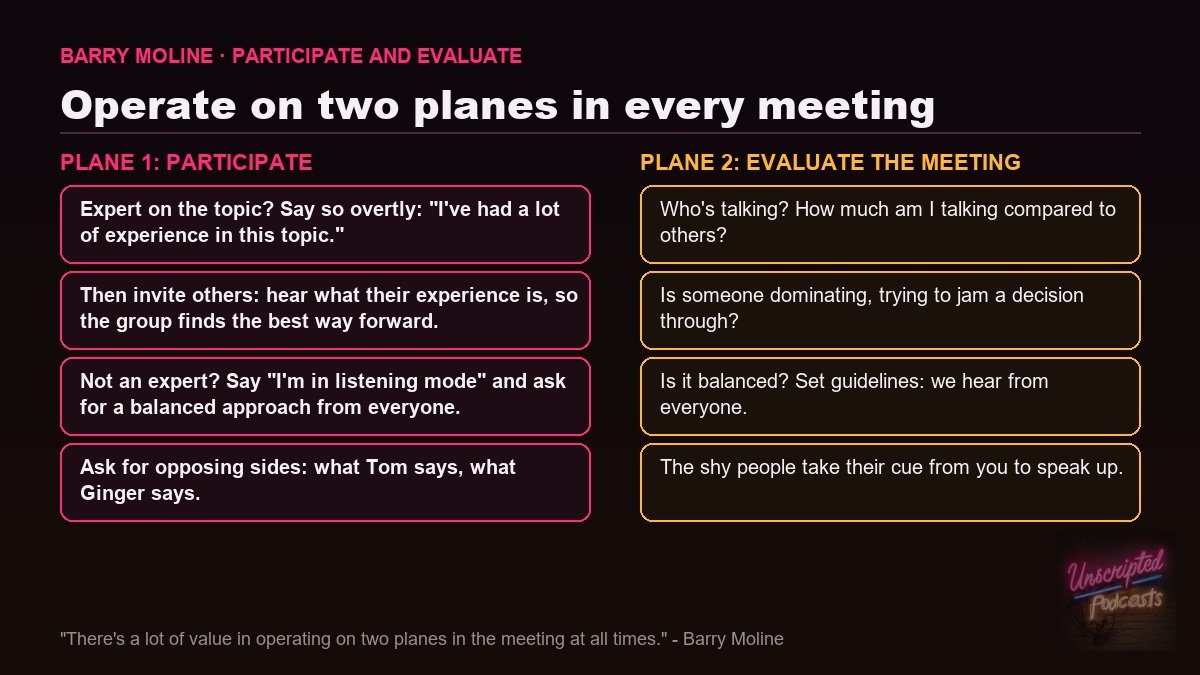
How you participate depends on what you know:
- If you’re the expert on the topic, say it out loud: “I’ve had a lot of experience in this topic.” Then add that you’d like to hear from others “so that we can evaluate what the best way forward is.” People hear an expert who is also open-minded.
- If you’re not, say “I’m in listening mode.” Ask to hear what Tom has to say and what Ginger has to say, and ask for opposing sides.
Either way, you’re watching for the person who tries to “jam through a decision that is bad for the group,” and you’re giving the quiet people permission to talk. “There’s a lot of value in operating on two planes in the meeting at all times.” And “the people that are shy, they’re getting a cue from you.” If your meetings happen on video, Alfred Poor’s advice on being seen and being heard pairs well with this.
You don’t ask, you don’t get: the cool billion
Jeremy asked for a recent challenge, and Barry told a big one from COVID. People lost jobs and stopped paying their electric bills. Normally that’s in the low single digits. Barry says that during COVID, “25% of customers were not paying their bills.” The industry guideline is to shut customers off early, but nobody could shut off a quarter of society’s power and water.
Barry recalls seeing a news item that California had ten point eight billion dollars in COVID money to help people in need. He walked down the hall to his chief lobbyist. The unpaid bills, the arrearages, added up to about a billion dollars. “Let’s go get a billion dollars from the state.” Electric utilities had never asked the state for money. He named the folder on his computer “cool billion.” (He’s quick to add: “we never said that to the legislature.”)
When his group’s utility CEOs heard the plan, “our CEOs looked at me like I was crazy.” They said the legislature would slam the door. Barry’s reply:
“Hey, you don’t ask, you don’t get. Is it okay with you if we ask? … Does it bother you if we ask? And they said, no, it doesn’t bother us. Go ask.”
The legislature didn’t say yes right away. It said “prove it.” Barry compared it to the Wizard of Oz: “bring us the broom of the Wicked Witch of the West.” Bring us this information, now this, now have somebody come and talk to us. “But they never said no.” His team answered with spreadsheets and customer information every time. By Barry’s account, it took months and conversations with 120 legislators, and the legislature agreed to the billion. When COVID dragged on and the arrearages reached $2 billion, the structure was already in place, and the legislature gave them a second billion. “So we got two billion dollars.”
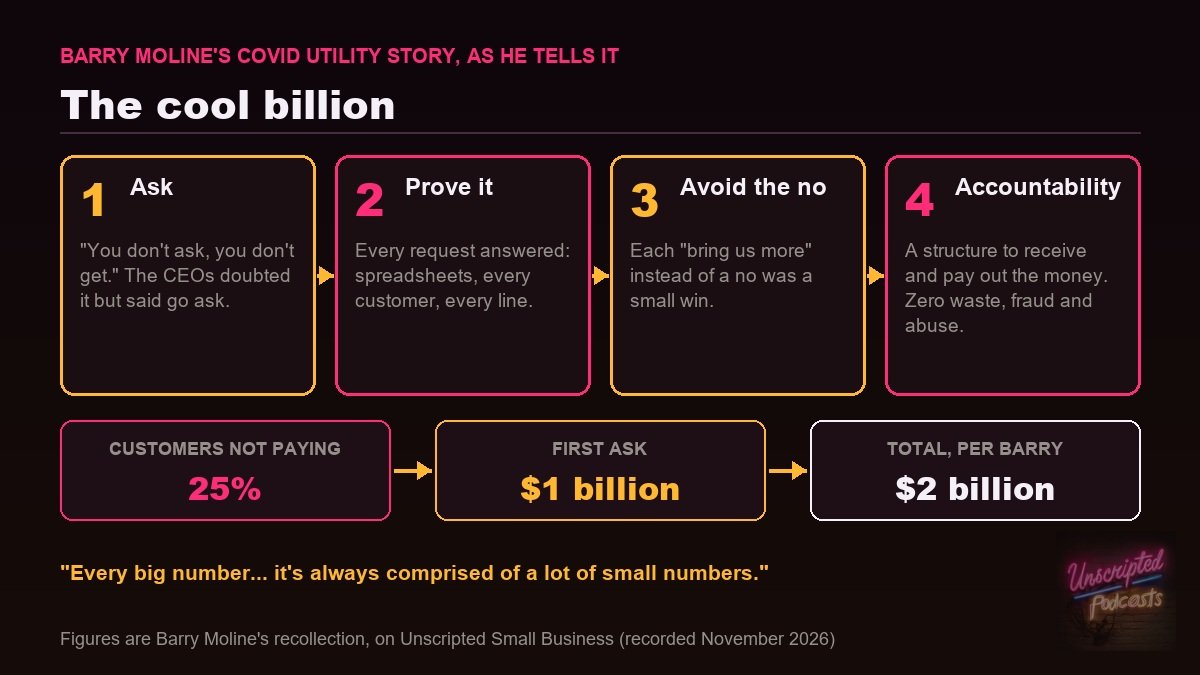
Barry took three lessons from it:
- Accountability. “We had to show every single customer on a spreadsheet, what they owed.”
- Big numbers are small numbers. “Every big number, when you hear a big number somewhere, it’s always comprised of a lot of small numbers.” A billion dollars was “a few hundred thousand people that had bills that they couldn’t pay.”
- Small wins count. His members didn’t believe at first. Every win along the way was “the avoidance of a no.” Each “give us this information” meant they were a step closer.
Barry asked for the big number, then answered every “prove it” with the small numbers behind it until the answer was yes. We wrote that up as the Big Ask SOP: seven steps for making your own big ask and backing every line of it.
Responsibility is the thread in 53,792 leadership books
Jeremy spent seven years in a corporate job, and he’s seen plenty of people pass on more responsibility. “It does take a certain amount of fortitude to put yourself forward,” he said. Barry tied it to his own research. When he was pulling his leadership material together, he went to Amazon and counted the leadership books: 53,792, by his count. Across all of them, “the number one thread in all of them is responsibility.”
“The number one characteristic across all leadership studies is the desire to take the lead. Now it doesn’t mean you have to be Superman and be aggressive and out in front of everything.”
It means a problem comes up, nobody knows much about it, and you say you’re happy to try. You can do it as part of a team. “That right there is an action of leadership.” Jeremy compared it to George Washington in the French and Indian War, stepping in after the general was shot and turning a rout into a retreat. It was still a loss, but stepping up meant it went better than it would have on its own.
How a holiday party committee made Barry a CEO
Barry’s first job in the utility industry was at a 75-person company in Washington, DC. A few months in, at a September all-hands meeting, his friend Arsinia from HR asked for volunteers for the holiday party planning committee. “The room went quiet. It was about 10 seconds of quiet.” At about five seconds, Barry felt bad for his friend and raised his hand.
The CEO came to every committee meeting, because he loved the holiday party as a way to get people interacting who normally didn’t. In January he showed up at Barry’s office, and Barry assumed he was in trouble. Instead, the CEO said Barry had good ideas and “weren’t afraid to share.” He asked Barry to ask the first question at the Q&A sessions of the company’s June conference, where 2,000 people came to hear speakers like General Colin Powell and Dan Rather. Barry did it for five years.
In the fifth year, a group of utilities from Florida pulled him aside. They needed a CEO, “somebody to stand up for us,” and they’d watched him ask questions of big-time speakers for years. He applied, competed and got the job.
“I would not have gotten that job had I not raised my hand to be on that holiday party planning committee, because one thing led to another.”
Barry says it never felt natural. He had to build up “the gumption to stand up and say what needed to be said,” and he got more comfortable over time. His advice: “it’s not something that we all are comfortable doing. But when you see those opportunities, it’s good to stand up and do them.”
Try Barry’s moves in your business this week. In your next meeting, say whether you’re the expert on a topic or in listening mode, and ask the quiet person what they think. Ask a happy customer to introduce you to someone they know, because authority lands better when someone else names you. Make a list of the things you haven’t asked for because you assumed the answer was no. And the next time the room goes quiet, raise your hand.
Also on Unscripted Small Business
Barry’s case for letting others name you the expert pairs with Evan Boyer on PR for small business reputation, and Irwin Hau on fluff vs facts covers the social proof your website needs when nobody is vouching for you.
Two more takes on this conversation: why it’s always better when someone else names you the expert on SEO Arcade, and Jeremy’s own reflection on raising your hand.
Connect with Barry Moline
Barry speaks at conferences and trains on leadership, teamwork, culture, influence and persuasion. “I love talking to folks about these topics,” he said, and a phone call or email comes with no obligation.
- Website: barrymoline.com
- Email: barry@barrymoline.com
- Free downloads on teams and influence: barrymoline.com/resources
- Book: Connect! How to Quickly Collaborate for Success in Business and Life
- LinkedIn: Barry Moline
- Episode 1: Hire for get-along ability
Sponsor disclosure: Semantic Links is a paid sponsor of the Unscripted podcasts. Links to it are marked as sponsored.
🎧 Listen: the episode on Castos | 📺 Watch: full episode on YouTube
Keep going → Browse the interviews